That building behind the trees in this wintry landscape is the Perimeter Institute, where I’ll be spending a few days.

Wintry??? Sounds like an April fool’s joke but it isn’t. This really is a long winter.

That building behind the trees in this wintry landscape is the Perimeter Institute, where I’ll be spending a few days.
Wintry??? Sounds like an April fool’s joke but it isn’t. This really is a long winter.
This article appeared today in Hungarian in HVG (World Economics Weekly), a Hungarian news magazine. I felt compelled to translate it into English and publish it here in my blog.
March 29, 2013
Author: Nóra Köves
An essay about the quarter century old Fidesz [Alliance of Young Democrats] party by one of the student protest participants. The author was overcome by a strange sensation while standing in the courtyard of the party’s headquarters, with a copy of the party’s 1989 program pamphlet retrieved from the trash.
Fidesz and I are roughly of the same age. I barely learned to speak when Viktor Orban gave his memorable speech during the reburial ceremony of Imre Nagy [Hungary’s prime minister during the failed 1956 revolution, executed in 1958 and rehabilitated in 1989], in which he stated that “in the sixth coffin lies not just a murdered youth but our own next twenty or who knows how many years.” Back then nobody thought that nearly 25 years later the last nail in this very coffin will be hammered in by the same enthusiastically orating young man. On June 16, 1989, as my parents were listening to this young man in their small highrise flat in the town of Zalaegerszeg, they most certainly did not believe that nearly 25 years later their daughter would be fighting for that free and democratic Hungary which they thought was a done deal as they leaned back in their armchairs. They did not think that the very same young democrats who fought for the freedom of a country with many others back then will attempt to take it away a quarter century later.
A few years ago I would not have thought either that my knowledge of international human rights law, which I spent long nights studying, will be used not in Africa or the Middle East, but I will have to stand up for human rights in Hungary. It did not enter my mind that one day I’d reach the point where, within the rules of active civil disobedience, I’ll be using my own body to defend democracy and a lawful constitutional state, because no other means remain at my disposal. And I certainly would not have thought that one day I’d be protesting in the courtyard of the party headquarters of Fidesz, or that I’d be sitting in pouring snow on the stairs of Parliament, demanding a constitution, democracy, and rule of law, accepting the consequences of civil disobedience with both acts, because I see no other way to save the country in which I would like to live and raise children.
Because I dream of a Hungary in which the rule of law and human dignity are fundamental values, in which all people are created equal, in which families are tied by love and not by the government’s conceptual framework. Where our homeless neighbors receive compassion and real help, not police harassment and misdemeanor fines. Where disadvantaged children can look to the future with hope, knowing that they have a chance to become what they would like to be. That this is now only a dream is a result of the fact that those one-time young democrats who 25 years ago fought for similar values forgot it all by now, and wasted away our recently acquired freedom with their tyrannical lust for power.
As I was protesting as a young democrat in the courtyard of the one-time young democrats, carrying the party’s discarded 1989 pamphlet, it occurred to me that in their one-time party office Orban and others must have felt the same gratifying excitement that we did. They must have felt that they were doing something for the rule of law, for the country in which they wanted to live. I stood there and failed to understand how this feeling, which thoroughly permeates a person and leaves a lasting memory, could have disappeared so without a trace and what may have replaced it. I did not have to wait long for the answer: it suddenly appeared in the form of several large, muscular, especially intimidating “security guards”, who were exactly like the ones who hired them: demands for “constitution, democracy, and the rule of law” meant nothing for them because they only believed in force and brutality, and considered money more important than freedom.
But I know that I have nothing to fear. I need not fear from muscular security, from the stick-wielding participants of the “peace march” who frightened others with acid, from the threatening letters, or even from the groundless accusations of the government’s smear propaganda. I do not have to fear because my trust is infinite in my own generation, in those youth who already tasted freedom, and I know that even if sometimes they awake late, in the end they won’t allow freedom to be wasted away. In this country, we will not permit the strong to oppress the weak, or to dismiss as criminals those who are poor or are different from the majority. We will not permit our universities and cultural spaces to be subject to the state’s tyranny. We will not permit them to trample on our Constitutional Court, we will not permit them to steal our future! And let there be no misunderstanding. Given enough time, no generation permits this. Members of Fidesz think that freedom is not important to the people. I think they are wrong. Voters may not appreciate the significance of specific steps, but when they feel on their own skin the harmful effects of this government, the shackles of the fourth amendment of the constitution, their attention will no longer be diverted even by reduced utility bills.
Fidesz and I are approximately of the same age. We are of the same age as this fragile democracy, which they right now are doing their best to tear apart, just so that they can stay in their comfortable velvet chairs longer, forcing onto us their misguided fantasies. I repeat, our generation as democrats will not permit this. We will respond to the government’s infinitely violent and aggressive, exclusionary and legally depriving policies again and again with determined – ever more determined, but nonviolent – action and we will show that freedom, equality, solidarity, tolerance and love are the only way to lay down the foundation of a functioning, democratic, lawful state. In 1989, Fidesz also knew this. This is why I promise that we will continue showing them a mirror until the Hungarian people choose to replace them, or until they acknowledge their former selves and ideals, and the fact that they betrayed every single one of them.
Here is one of our four cats, Kifli. (Literally, his name means croissant in Hungarian. How did he get this name, you ask? Well, when we got him back in 2001, he was only a few weeks old and he and his brother Szürke actually fit on the palm of my hand, both of them together. Szürke is a gray tabby and perhaps somewhat unimaginatively, that’s exactly what his name means in Hungarian; gray, that is. Kifli has the color of a freshly baked bun, but when he was little, Kifli was very thin and did not look like a bun at all. In Hungarian bakeries, the two most common small bakery products are buns and croissants; not the puffy French type made from leavened dough, but croissants baked from the same dough that is used to make white bread and, well, buns. These croissants are long and thin, just like Kifli. Hence, his name.)
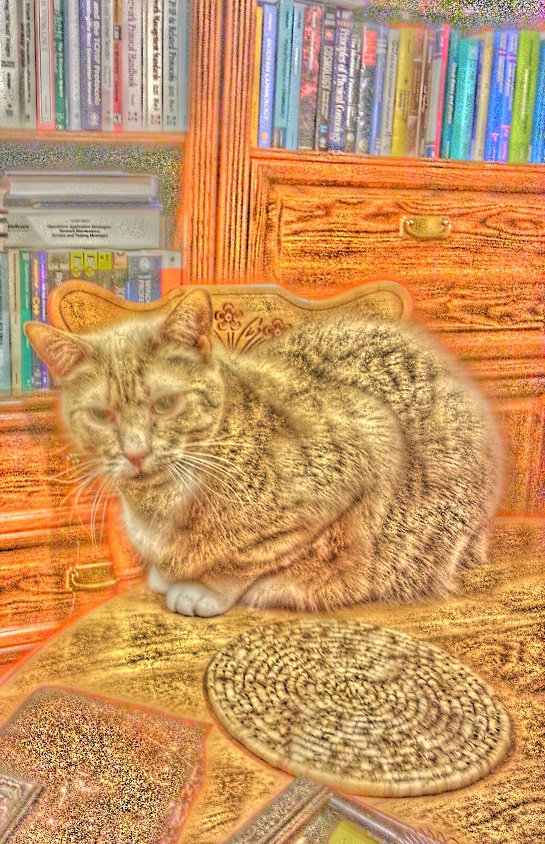
Anyhow, I was testing out an Android photo editing app (PicsArt, in case you’re wondering; seems like an excellent app, by the way) tonight when I snapped this picture of Kifli and applied one of the app’s effects. I think it’s real nice. And while it’s not so nice that Kifli jumped onto a table that he’s not supposed to be on, I certainly approve of his reading choices.
This used to be a subject of many jokes, like this one: “When two popes meet, how do they greet each other?”
Not anymore. Two popes met today, prayed, and had lunch together.

I’d still like to know how they greeted each other, though. And what did they have for lunch?
I thought my server would break some record in the coming months, perhaps running up to two years without a restart.
Alas, that will not happen: we received notice from Ottawa Hydro that they will be doing maintenance tomorrow morning and our power will be shut off for a while. The duration (3.5 hours) is way more than what my server’s UPS can handle.
Oh well. It was nice while it lasted:
$ uptime
21:30:33 up 582 days, 2:02, 4 users, load average: 0.85, 0.51, 0.55
 No, I am not trying to cast rhetorical doubt on the assertion that Assad’s government has used chemical weapons in the on-going civil war in Syria. As a matter of fact, I find the assertion believable and credible.
But, lest we forget what happened exactly ten years ago… Having just finished wading through the Mother Jones timeline about the lies and deceptions leading up to the Iraq war, I have to ask myself: can these assertions be really believed, or should we demand corroborating evidence?
CNN is certainly ready to go to war. Their talking heads are already discussing what is needed beyond air strikes.

One of the most outrageous assertions concerning the run-up to the Iraq war is that the US intelligence community made a series of honest mistakes and that in fact, most foreign intelligence agencies agreed that Iraq probably possessed weapons of mass destruction.
This is a pack of lies (incidentally, still perpetrated by talking heads on Sunday television.)
Left-wing magazine Mother Jones published an updated timeline of the events leading up to the war. The recurring theme: ALL the WMD evidence used to create support for the war was cherry-picked, uncorroborated, or outright fabricated, and this fact was KNOWN to the Bush White House. Indeed, it was known to many outside the White House, including laypeople like myself, who chose not to be blinded by the White House’s pro-war propaganda blitz.
Here is an excerpt from the Mother Jones timeline, focusing solely on the intelligence estimates and ignoring other data points (e.g., justifying torture, underestimating the cost of war, failing to plan for the occupation.)
So that’s it. I don’t think there is much doubt here. The case for the war on Iraq was based on trumped up evidence, purposeful misuse of intelligence data, the silencing of detractors, lies, intentional fabrications, dubious confessions obtained using torture, and purposefully ignoring expert contrary opinions both within the US intelligence community and from abroad.
Later rationalizations shifted the picture slightly, trying to pretend that the war was based on the fact that the possibility that Iraq had WMDs could not be excluded with absolute certainty, and that Hussein himself was interested in creating ambiguity. This may be technically true but it misses the point: Iraq was not attacked on the premise that they may have a few leftover chemical shells filled with mustard gas or that they may, at some unspecified future date, restart WMD programs. Iraq was attacked on the premise that Hussein’s active, reconstituted nuclear, chemical, and biological weapons programs represent a clear and imminent threat to the security of the United States.
It was bullshit then, and it is bullshit today.
Looking out my window this morning, here is the winter landscape that I saw:
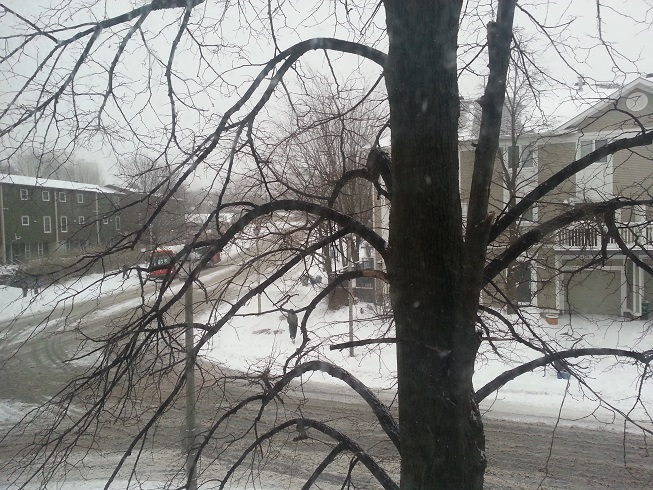
This is not what those blasted groundhogs promised. They are bold-faced liars, the little creeps. The next time you run into Punxsutawney Phil or Wiarton Willie, keep an eye on your wallet; you just don’t know what the little sons of bitches are capable of.
 I was already blogging 10 years ago, perhaps blogging more than these days as before the advent of social media, almost no-one ever yelled back. Anyhow, we are now rapidly approaching the anniversary of the day I dubbed “black Thursday” in my blog (I actually changed the background color to black, causing me no small amount of grief when years later, I converted my static HTML blog by writing a simple homebrew blog engine and I had to write workaround code to process the custom formatting.)
Back then, I used to express my disappointment and disgust with the campaign of lies that led up to this war by presenting some relevant statistics in my blog. Perhaps this is a good opportunity to do it again:
| War budget requested by President Bush, assuming hostilities end in 30 days | $75,000,000,000.00 |
| Actual cost of the Iraqi war to the US and allies according to the LA Times | $1,700,000,000,000.00 |
| Weapons of Mass Destruction found in Iraqi possession | 0 |
| Number of people killed in the 9/11 terrorist attacks | 2,996 |
| Number of US troops killed in Iraq | 4,409 |
| Number of US troops wounded in Iraq | 31,926 |
| Number of Iraqi civilians killed, conservative estimate by Iraq Body Count | ~120,000 |
| Debt-to-GDP ratio of the United States (public debt) at Bush’s inauguration | 56% |
| Debt-to-GDP ratio of the United States at the end of Bush’s term | 84% |
And the end result of this valiant effort? Iraq is now strongly under the influence of Iran, which became a major regional power that is no longer contained by Saddam Hussein’s regime. The credibility of the United States remains low. The United States economy is hindered by a recession that is combined with debt-to-GDP levels unprecedented since the end of WW2.
And it took another president, Barack Hussein Obama, to find and kill the mastermind behind the September 11 attacks, Osama bin Laden… who, incidentally, was not in any way connected with Saddam Hussein’s regime.
In a post a few days ago, I expressed my skeptical views concerning the interpretation of some of the recent Higgs results from CERN. I used a simple analogy, an example in which measuring the average height of the inhabitants in a set of buildings is used to determine which of them may house the Harlem Globetrotters.
However, I came to realize (thanks in part to some helpful criticism that my post received) that I left out one possibility. What if the buildings are too small? Or the ‘Trotters are just too, hmm, tired after a long party and end up in the wrong building? In that case, a measurement may look like this:
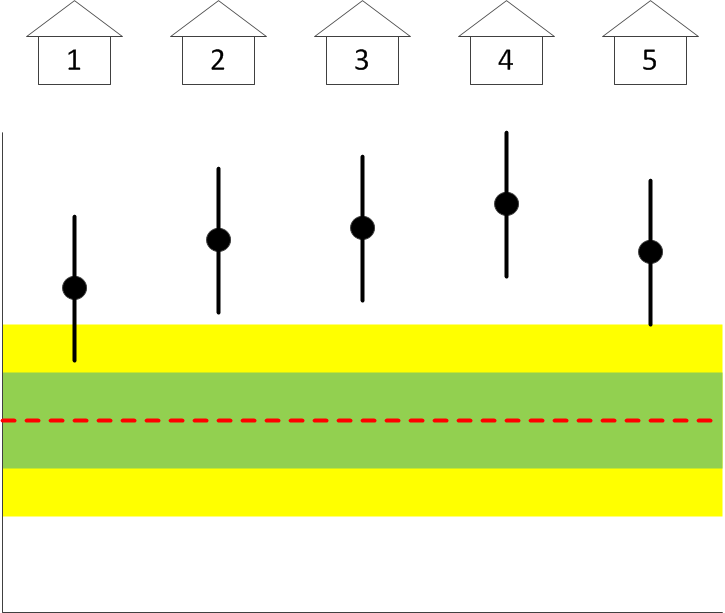
If we have an a priori reason to believe that, for whatever reason, the players are indeed spread out across several buildings, then we can indeed not expect to see a sharp peak at #4 (or whichever building is assigned to the Globetrotters); instead, we should see a broad excess, just what the CMS experiment is seeing when it measured the decay of the presumed Higgs boson into a τ+τ− pair.
So is there an a priori reason for the data to be spread out like this? I believe there is. No instrument detects τ leptons directly, as their lifetime is too short. Instead, τ events are reconstructed from decay products, and all forms of τ decay involve at least one neutrino, which may carry away a significant portion of the lepton’s energy. So the final uncertainty in the total measured energy of the τ+τ− pair can be quite significant.
In other words, many of the Globetrotters may indeed be sleeping in the wrong building.
Nonetheless, as my copy of the venerable 20-year old book, The Higgs Hunter’s Guide suggests, the decay into τ leptons can be a valuable means of confirmation. Which is perhaps why it is troubling that for now, the other major detector at the LHC, ATLAS, failed to see a similar broad excess of τ+τ− events near the presumed Higgs mass.
 Yesterday, when I logged on to Google Reader, I was presented with a notice indicating that Reader will be shut down July 1st.
Too bad. I was not using Reader much, but it was the one semi-automated means with which I was reasonably comfortable that allowed me to share my blog posts on Google+. Whether or not I can be bothered to continue with Google+ afterwards remains to be seen. Maybe not… blogs are meant to be a write-only medium anyway (I yell at the world, I do not expect the world to yell back at me), a model which is kind of broken in this era of social networking.
Anyhow, it appears that a number of people are quite upset at Google’s decision, and they even started a petition that is rapidly approaching 100,000 signatures. (Yes, I signed it, too.) So who knows, maybe Google will listen and Reader will get a reprieve.
I have been reading a lot today about the latest news from Europe, the supposed confirmation that the elementary particle observed at CERN may indeed by the Higgs boson.
And while they are probably right, I feel that the strong pronouncements may be a little premature and perhaps unwarranted.
Let me demonstrate my thoughts using a simple example and some pretty pictures.
Suppose you go to a camp site. At that camp site there are five buildings, each of the buildings housing a different team. One may be a literary club, another may be a club of chess enthusiasts… but you have reason to believe that one of the buildings is actually occupied by the Harlem Globetrotters.
Suppose that the only measurement available to you is a measurement of the average height of the people housed in each of the buildings. You of course know what the mean height and its standard deviation are for the entire population. So then, suppose you are presented with a graph that shows the average height, with error bars, of the people housed in each of five buildings:
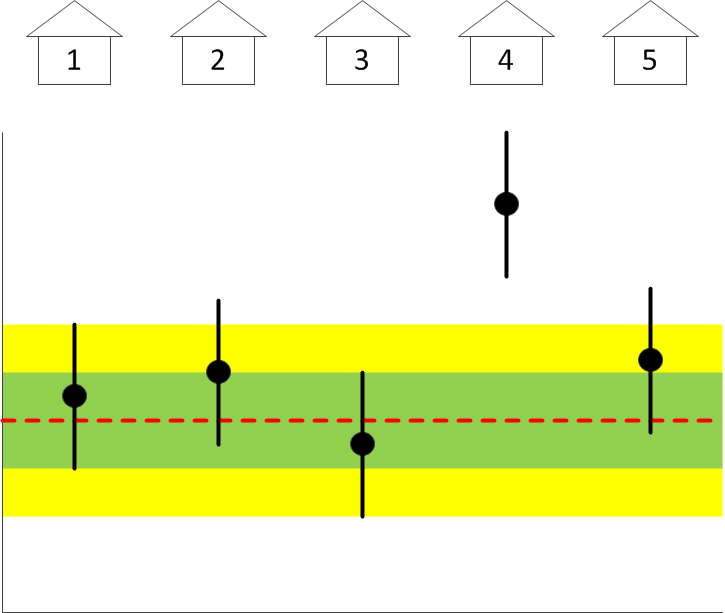
The red dashed line is the population average; the green and yellow shaded areas correspond to one and two standard deviations; and the black dots are the actual data points, with standard deviations, representing the average height of the residents in each of the five buildings.
Can you confirm from this diagram that one of the buildings may indeed be housing the Harlem Globetrotters? Can you guess which one? Why, it’s #4. Easy, wasn’t it. It is the only building in which the average height of the residents deviates from the population (background) average significantly, whereas the heights of the residents of all the other buildings are consistent with the “null hypothesis”, namely that they are random people from the population background.
But suppose instead that the graph looks like this:
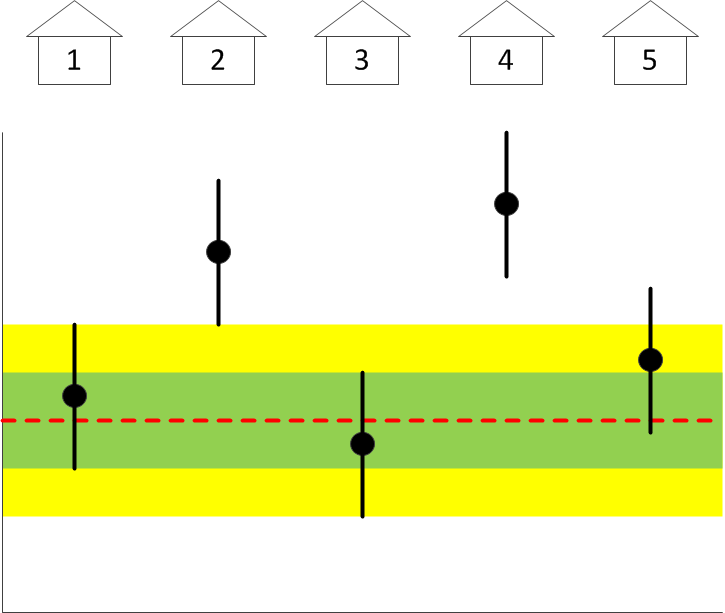
Can you still tell which building houses the Globetrotters? Guess not. It could be #2… or it could be #4. But if you have other reasons to believe that #4 houses the Globetrotters, you can certainly use this data set as a means of confirmation, even though you are left wondering why #2 also appears perhaps as an outlier. But then, outliers sometimes happen as mere statistical flukes.
But suppose instead that you see a plot like this one:
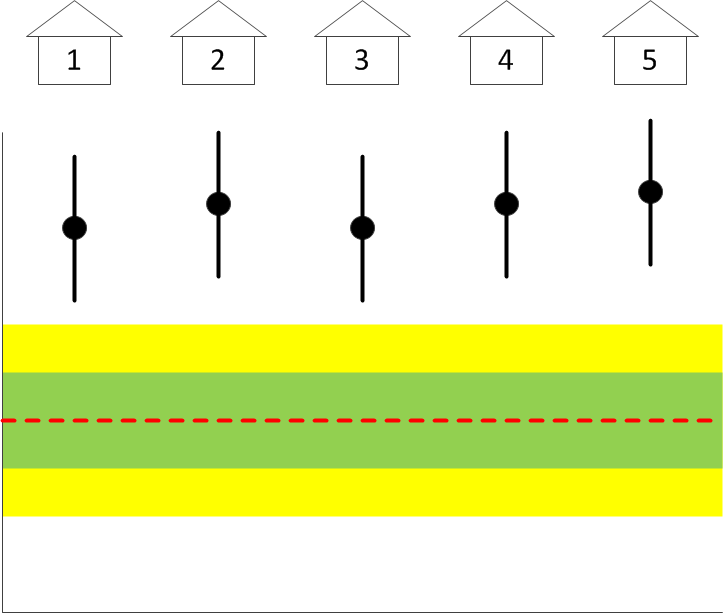
What can you conclude from this plot? Can you conclude anything? Is this a real measurement result and perhaps the entire camp site has been taken over by tall basketball players? Or perhaps you have a systematic error in your measurement, using the wrong ruler maybe? You simply cannot tell. More importantly, you absolutely cannot tell whether or not any of the buildings houses the Harlem Globetrotters, much less which one. Despite the fact that building #4 is still about four standard deviations away from the population average. Until you resolve the issue of the systematic, this data set cannot be used to conclude anything.
But then, why are we told that a similar-looking plot, this one indicating the rate of Higgs boson decay into a pair of τ particles (the heaviest cousin of the electron), indicates a “local significance of 2.9σ”? With a “best fit μ = 1.1 ± 0.4” for a 125 GeV Higgs boson?
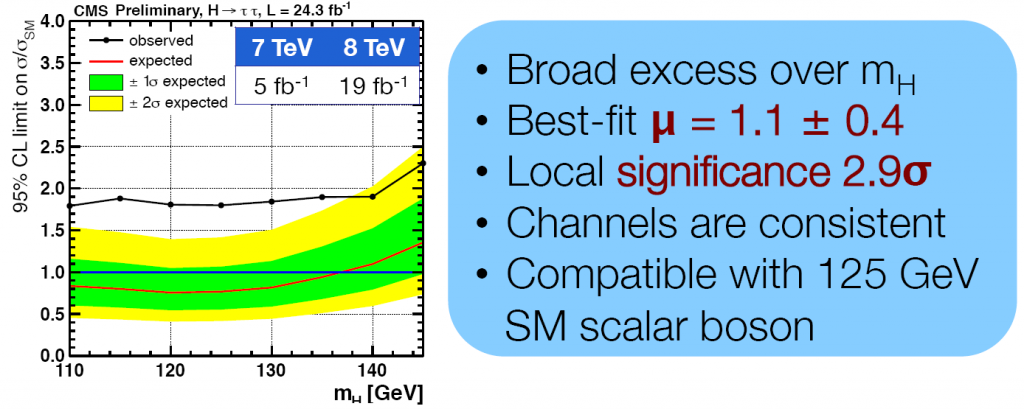
It indicates no such thing. The only thing this plot actually indicates is the presence of an unexplained systematic bias.
Or am I being stubbornly stupid here?
There are two popes in Rome today: Pope Emeritus Benedict XVI, and Pope Francis.

And it is historical: Pope Francis is the first pope from outside of Europe (okay, technically Saint Peter was also from outside of Europe, but it’s not quite the same thing). He seems like a kind, charismatic person who reportedly lives in a lowly apartment, cooking his own meals. He took the name of St. Francis, which may indicate a desire to reform the Church. The first few seconds of his appearance on the papal balcony were seconds of silence. Last but not least, he is a Jesuit, whatever that implies.
Anyhow, the old joke I learned back in grade school (“How do popes greet each other?” The answer, of course, is that they don’t, since there is only one pope) no longer applies. It is very likely that Pope Francis and Pope Emeritus Benedict XVI will have many chances to say hello to each other.
Here are a few things I am not planning to do today:
Last but not least: I am not going to grow up. According to an Internet meme I just came across, if you haven’t grown up by age 50, you don’t have to.
I am getting close to breaking some of my records here. My main server has now been up 70 days longer than the planned trip to Mars:

There really was no need to reboot, and there won’t be any unless a) there is a critical patch to this version of the Linux kernel, b) I decide to carry out a planned upgrade to Slackware 14.0, c) the system crashes, d) the hardware fails, or perhaps most likely: e) I decide to bring down the server in order to remove a few pounds of cat hair, dust bunnies and whatever else may have accumulated in its case over the course of 19 months.
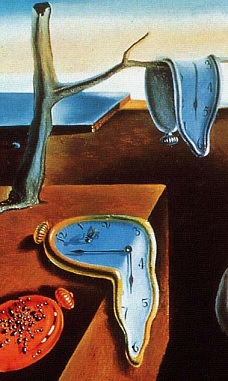 To the esteemed dinosaurs in charge of whatever our timekeeping bureaucracies happen to be: stop this nonsense already. We no more need daylight savings time in 2013 than we need coal rationing.
It is an outdated idea, the benefits of which may have been dubious even at the time of its inception, and are almost certainly nonexistent today. But the harm is real: you are subjecting the entire population to a completely unnecessary one-hour jetlag each spring.
Being self-employed and working mostly from my home, I am among the least affected, but I still find this clock-forwarding business just boneheadedly stupid and annoying.
Oh, and while you are at it… would you please get rid of leap seconds, too? Another harmful solution to a nonexistent problem. So what if our clocks are out of whack by a second with respect to the Earth’s rotation? Does it bother anyone?
Oh wait. The organization in charge of leap seconds is the ITU. The same ITU that is busy trying to place the Internet under international regulation, at the bidding of such champions of Internet freedom like China or Russia. No wonder they have little time left in their busy schedule to abolish leap seconds.
Two days ago, I received the sad news: my good friend George Olah is no longer among us.
I actually have a recent picture of him, courtesy of CBC Ottawa: during a news report last year about smoking prevention, George appeared in a bit of stock footage, standing on a sidewalk somewhere in downtown Ottawa, smoking a cigarette.

Yes, George was a smoker, which may have had something to do with the sudden heart attack that took him from us. Or not. Sometimes, perfectly healthy people with no ill habits die for no reason at all.
George fled Hungary in 1956 after the failed anti-communist revolution and eventually came to Canada. Yet his opinions were never clouded or biased by his personal experiences: he had a sober view of the current political situation in Hungary, and shared many of the concerns my wife and I have regarding the country’s future.
I’ve known George for nearly 26 years. Back in 1987, when I came to Canada, it was George who introduced me at the company where I got my first consulting contract. Thanks to George, I never had to wash dishes or fry hamburgers; within a few weeks of my arrival, I was writing C code for an application at Forestry Canada. A few years later, when I was going through a difficult time, it was again George who got me in touch with a group that hired me for a programming job; the people I worked with there remain my friends to this day.
In recent years, George was busy with a number of interesting projects that involved low power wireless technology and ad-hoc networking. He had high hopes for his inventions. Indeed, he was a true optimist, always full of plans for the future. You couldn’t really tell that he was already past his 70th birthday.
George also liked to cook. Around Christmas, he often made cabbage rolls in quantities that would feed a small army. This past Christmas was no different; and not for the first time, he offered us some, which I duly picked up at his home. It was very tasty. Yum! We have not yet returned the container.
Well, I guess that was the last batch of cabbage rolls George ever cooked. And the aspic jelly, another one of George’s wintertime favorites that he was planning to prepare, won’t be made either.
What else can I say? Thank you, George, for the help, for the memories, for the food, for all the laughs and for all the fun. Szervusz, Gyuri.
 The recent announcement by Dennis Tito about a manned flyby trip to Mars caught my imagination. Thinking about what such a trip would be like, I began writing a blog entry, but it soon became a bit too long for my blog, so I moved it to my Web site instead. Anyhow, here is the link: http://www.vttoth.com/CMS/personal/257.
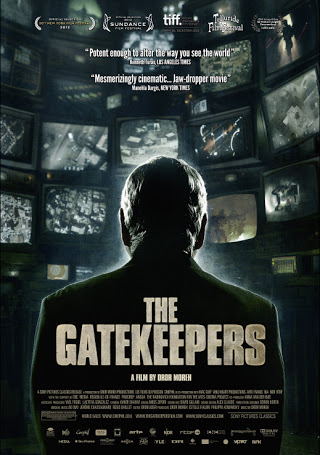 Israel’s occupation of Palestinian territories continues. Nothing infuriates those who believe this occupation is necessary than words like these:
“We’ve become… cruel. The future is bleak. It’s dark, the future. Where does it lead? To a change in the people’s character […] it’s a brutal occupation force, similar to the Germans in World War II.”
or these:
“[W]e win every battle, but we lose the war.”
or these:
“One man’s terrorist is another man’s freedom fighter.”
You might be forgiven if you thought these quotes are from left-wing or Islamist radicals, but that is not the case. These are words uttered by former heads of Israel’s internal security service, the Sin Bet. Avraham Shalom, Ami Ayalon, Yuval Diskin and three other former leaders of this organization appear in a new Oscar-nominated Israeli documentary, The Gatekeepers. (Looks like a must-see.)
I admire their ability to think clearly and their moral courage to make these comments public. I know Mr. Netanyahu is not listening… but I hope some other leaders in Israel are.
 Recently, I needed a bit of cash and I decided to take advantage of one of those “0% interest” loan offers that regularly appears in my mailbox for several of my credit cards. It was very easy to do of course, all I had to do was to deposit a check in my bank account.
But when the credit card statement arrived next month, I was in for a surprise. True, the loan was at 0% interest, just as advertised. However, what I neglected to take into account was that this credit card actually had an insurance contract attached to it. I never kept a balance on this card, so whether or not it had insurance was completely irrelevant to me… until now, when I suddenly noticed that my supposedly 0% interest loan suddenly increased by a full 1% in just a month! (Actually, 1.08% to be precise, because the insurance was also subject to provincial sales tax.)
Needless to say, I called up the bank and immediately canceled this ridiculous insurance, cursing myself for not having done this sooner. (Live and learn.) Another month went by and a new bill arrived. Behold! That 1% of the original loan amount that they added in the form of insurance qualified as a “purchase”, with interest calculated at the standard (albeit rather usurious) rate of 17.99%. And of course you cannot pay off just this amount; any payment you make to the card will be distributed by this particular bank proportionately between the lower and higher interest rate amounts that you owe, so 99% of the payment I made went against the 0% interest original loan amount.
My cash crunch was long over, so I phoned the bank and simply told them that unless they are willing to rectify this situation, I am going to pay of this card immediately and close the account. To their credit, they rectified the problem right away (or so they said; it’s not yet reflected when I check the account over the Internet, but hopefully all will be well when next month’s bill arrives.)
But it got me thinking: how does this scam (for I do not really have a better word for it) work when it involves people less attentive to numbers than I?
So let’s say you start with a $5,000 loan that you take out at the promised 0% interest for, let’s say, 12 months. You naively expect that if you keep paying the minimum payment (1% each month) then by the end of the 12 months, you will have payed off $568.08, with $4,431.92 still owing. Well… not exactly.
What actually happens is that you will have paid a total of $602.64 at the minimum rate. Yet your final balance at the end of the year is $5,094.40, so you now owe $94.40 more than you originally borrowed. In the intervening twelve months, the bank will have charged you $602.52 in credit insurance; $48.14 in sales tax (at the Ontario provincial rate of 8%); and a further $47.99 in interest on these “purchases”.
Lumping it all together, it amounts to an effective interest rate of 14% that you ended up paying on a loan that was advertised at a 0% interest rate.
And this if you did not use your card for anything else. Remember, when you make a payment, this particular bank (and probably, many/most others) applies your payment proportionately to the lower and higher interest rate portions of the total amount you owe. So you cannot just pay off your high interest purchases at the end of the month; they will keep on accruing interest so long as your 0% interest loan remains on your account.
At times like this, I regret not being religious. Otherwise, I could believe as Dante that usurers get what they deserve in the afterlife:
“Philosophy,” he said, “th’ observant mind,
“Teaches this truth, not in one place alone,
“That Nature takes her method and her course
“From the divinte intelligence and art;
“And if thy physics thou hast studied well,
“Then thou before thou readest far shalt find
“That this thy art, so far as it hath pow’r
“Follows as pupil in his master’s steps;
“So of God’s child thine art seems almost child.
“From these two, then, if thou in mem’ry hold’st
“The earlier Genesis, it is decreed
“That life must spring, and man’s increase must come.
“But then the usurer treads another path;
“Nature and her attendant both he scorns,
“Since in another means he places hope.”