Oct 302026
 

They filmed the unfilmable.

I first read 100 Years of Solitude, by Colombian author Gabriel Garcia Marquez, when I was a young teen. I re-read that book many times in the following years. I consider it one of the greatest novels of the 20th century, its author rightfully earning the Nobel-prize in literature.

The genre of the book is often described as “magical realism”: real events, realistic stories interwoven with magical elements. The history of the Buendía family and the fictitious town of Macondo feel real, tangible, rooted in fact in actual Colombian history. Yet many of the characters and events acquire supernatural qualities. Among them the old gypsy, Melquiades, whose nearly undecipherable writings foretell the century-long journey of the Buendías and the town they found.

I shared my thoughts on 100 Years, some cosmic perspective and, well, cats of course with Gemini. This image was the result.

As such, 100 Years of Solitude seemed unfilmable. Until it wasn’t. Netflix, bless their souls, financed a Colombian production, a two-season streaming series of 16 episodes and it is… absolutely superb. I don’t know how they did it, but they captured the spirit of the book with near perfection.

I just finished watching the final episode and I am moved. It’s been decades since I last read the book, so I forgot just how much sorrow, how much suffering, how much pain and petty evil was hiding behind the magic. At times, what I was watching felt almost unbearably sad, yet I kept watching because… because, well for starters, I knew the outcome of course, but also because the series achieved that ultimate measure of success, creating characters you can care about, characters who were believable, who were credible, complex human beings…

What a remarkable series it was. Every once in a while streaming services manage to create masterpieces, films or series of lasting cultural value. 100 Years is one such example.

 Posted by at 2:38 am
Oct 272026
 

A few days ago, I exchanged some e-mails with a fellow volunteer Maxima developer. That exchange reminded me of a pet project of mine, something I’ve been contemplating for quite some time: a computer algebra system, one significantly less ambitious than a frontier-class system like Mathematica, Maple or, I dare include it in that list, Maxima, but one that runs in the browser, with no server-side code and nothing to install on the user’s computer either.

This time around, I decided to test my idea with Claude Opus 5.5, their latest and greatest model. I outlined my ambition in a couple of paragraphs. The result was less than overwhelming: After some 20 minutes, Claude ran out of “thinking” tokens, and returned nothing other than 128,000 tokens wasted.

Never mind, I figured, let’s try it again, with a slightly refined prompt to ensure that Claude doesn’t embark on a project bigger than itself. And that, well, worked. Claude presented a plan and then, following my instructions and my replies to its questions, began to proceed with the implementation one step at a time.

In this past, this is usually where things got derailed. Sometimes, the model got too ambitious and ran into token limits. Sometimes, the model’s code was incoherent, self-contradictory. Sometimes, the initial code was working, more-or-less, but additions did not.

But not this time. Claude kept churning out sensible code and, most notably, starting at the very first stage, included a testsuite. So even though we had no usable system yet, the testsuite was an assurance that the code we’re building is doing what it was supposed to do.

Notice that I am not using Claude as an “agent”. I did not give it carte blanche in a folder of its own, to build code, download libraries, mess around. No. Claude was talking to me. It was then I who decided if the code Claude presented was good enough or not, it was I who incorporated it into the code base. Claude, accordingly, provided helpful, detailed explanations at each stage. The important point is that the role I retained was that of a senior programmer who may delegate subtasks to junior programmers, but retains overall control of the project at a technical level.

And Claude delivered beyond expectations. Soon, I found myself hooked. One module after another, which I added, tested, tried. A rather nice-looking application was beginning to take shape. And there was both breadth and depth: the application was already acquiring features more sophisticated than I ever dared to plan for, while at the same time Claude never forgot to deal with the mundane, such as appropriate visual representation via MathJax or a growing collection of sections in interactive help.

About halfway through the project we got to basic calculus. I was beginning to wonder: When will Claude falter? When will useful code give way to AI hallucinations, code referencing non-existent language features or capabilities? But none of that happened. Claude robustly, methodically implemented basic calculus, one subroutine at a time.
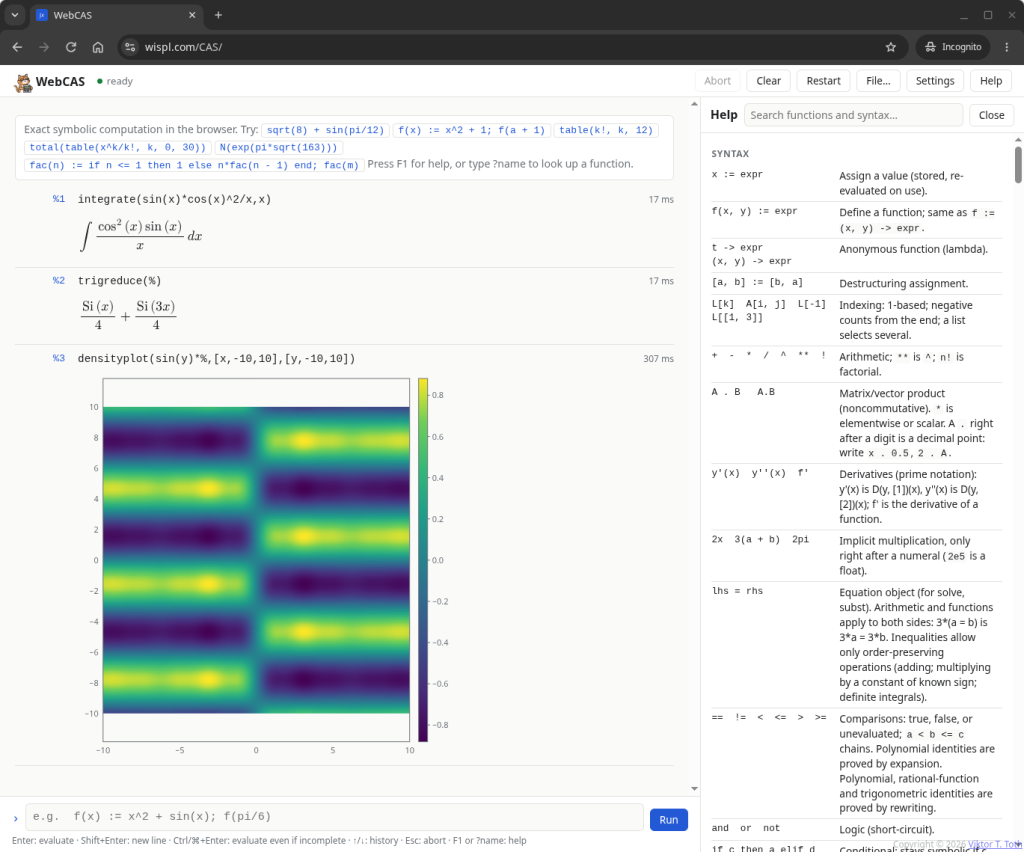
Again, I stress, Claude had no free reign. We were proceeding step by step, I took the code Claude wrote, integrated it into the application, scrutinized it when I had to, looked for testsuite failures, even corrected the trivial ones.

Once we got past linear algebra and multivariate equations, I decided to get really greedy. I asked Claude, can we do ODEs and PDEs? Because even a half-decent differential equation solver makes a world of a difference when it comes to the usability of a CAS. Claude accordingly revised our plan, and then did the grunt work.

Claude remained enthusiastic throughout, but I began to notice that its responses felt… a little less coherent. Nothing big, no real mistakes, just subtle things like harder-to-understand explanations or instructions on where to place a code patch. No wonder: we were by now around 700,000 input tokens per conversational turn, rapidly approaching Claude’s 1 million token limit. (I also noticed the increasing frequency at which I received notifications from Anthropic about additional credit card charges. But, I digress.)

Claude was still eager to proceed with more ambitious additions but I asked it for something else: something genuinely useful in a CAS, a broader class of special functions like hypergeometric functions or Lambert’s W function. Claude delivered.

So roughly 36 hours after I sent my first prompt to Claude, I was in possession of a full-featured, rich, eminently capable browser-based computer algebra application. One that can also be installed on an Android device as an offline computer algebra tool.

This has been an amazing experience. Was it “vibe coding”? I don’t think so. I was not just playing the dumb user, asking the agentic AI to deliver a solution. I was a senior partner with an incredibly capable, knowledgeable junior assistant, but I retained intellectual ownership of the result, indeed I can confidently edit, and fix/expand the code myself when I have to, since I understand what it does.

End result: 26,412 code lines in 163 files, at the cost of 31,006,699 input tokens and 3,048,131 output tokens, consumed over the course of less than two days. And WebCAS — the name picked by Claude — is already my favorite computer algebra application, one that will likely receive regular updates frmo me in the future.


 Posted by at 10:38 pm
Oct 242026
 

Large language models are now everywhere. Whether you consider them helpful or an intrusion, it’s up to you, but everything from Google searches to mundane interactions with an e-commerce site now features an AI component.

And, I realized, most of it is just… well, a form of ephemeral e-waste. I just did a Google search, wanted to get the exact syntax for a curl command example to interact with an AI through the API. Google helpfully responded with a page-long AI-generated answer, which included an example. I copy-pasted the example, edited it to my liking, and used it… and never even read the rest of Google’s response before closing the tab. Perhaps Google caches such responses so they’re not totally wasteful. Otherwise, those words headed straight from GPU to the bit bucket, never read by a human.

They may not have been read by a human, but they were still generated on a GPU somewhere, consuming non-trivial quantities of power. How much power? Well, take my setup. A modest 16 GB GPU, consuming about 180 W of power when running at full steam. It is running the open-weights model Gemma, producing a tad fewer than 50 tokens, or about 30 words per second. In other words, each word consumes about 6 joules of electrical energy. That — taking into account power generation and transmission losses — is very roughly the electrical energy extracted from one milligram of coal in a conventional power plant. Not a lot… just a milligram. But it’s a milligram for every word produced, whether or not it is read.

Scale it up to a planetary scale, say, a billion users and 1000 unread words per user per day, and that’s the equivalent of 1,000 metric tons of coal per day… just to produce words that no one ever reads.

Yes, caching responses helps. Using more efficient algorithms helps, as well as more advanced hardware. Nonetheless, this little calculation perhaps illustrates why our AI boom produced an unprecedented demand for electrical power for the new data centers.

 Posted by at 12:13 pm
Oct 232026
 

I use AI on a daily basis, in my software development work. It is an incredible productivity tool. Things that would take days, even weeks, are often accomplished in mere minutes.

Take this example, just the other day. I received another dire warning from Google, indicating that their existing search services for third-party software will be discontinued. This was bad news: My own WISPL chatbot uses Google’s search API and the snippets it provides as a means for AI models to search the Internet for accurate or up-to-date information. This capability will no longer be available starting in January.

So I consulted with, well, Google. What are the alternatives? Google’s own AI helpfully recommended several, among them a service called Brave Search. I checked it out and it seemed to match my needs perfectly, in fact better than Google ever did. So… let’s do this! I rolled up my sleeves and… fired up Claude in my chatbot, presented the problem, presented the code segments from my chatbot implementation that would likely be affected, and asked Claude to suggest a solution.

In a minute, I had a response from Claude. A nice new function that would connect to Brave Search. A thin compatibility layer that allows my code to use wither Google or Brave. Even a bug fix for something it stumbled across as it reviewed my old code.

I took Claude’s code, incorporated it into the source base, made some minor adjustments, ran some tests and that was it. Less than three hours after I began this exercise, the solution was deployed. Brave Search works perfectly in my WISPL chatbot, and delivers better results than Google ever did, suitable for AI models to digest.

But… notice what I did not do as part of this exercise. At no point did Claude have access to my source code. I was using Claude strictly as a chatbot. I received its output as a recommendation, not as a solution. I scrutinized it, evaluated it, adjusted it, and then integrated it. As a result, by the time I was done, I “owned” the code, figuratively speaking. I know what it is, where it is, what it does and why.

I could have used Claude Code. At the cost of a great many more (pricey) tokens, it’d have mapped the entire code base of my WISPL chatbot. It’d have implemented its changes without a human in the loop. It’d have committed those changes to my git repository, and pushed them to GitHub. It would, quite likely, have also presented a nice explanation of what it did and why, which I could read at my convenience… or not. Because, well, if the solution works, what’s the point?

And that is how we gradually lose agency over our projects when we allow AI systems to act not just as assistants but also as agents.

Yes, I tried. I have a working Claude Code installation. My reaction was negative due to the opacity of the process. Claude goes away, does things… maybe asks for permission to modify the code base, maybe not, depending on the setting… and then comes back when it is done. Chances are the result works, or at least, appears to work. How could I even tell the difference?

And I’ve seen the consequences of this already. There were publicly disclosed cases but I also interacted with folks who let Claude Code go a tad too far.

As for me, I’d prefer to continue using AI systems as assistants. An AI assistant is like an incredibly capable, knowledgeable, tireless junior programmer: I retain the senior programmer role. The junior programmer may be writing the code, but I am the one reviewing it, integrating it, validating it. With a coding agent, the situation changes. The coding agent is not just a junior programmer: it’s an entire development team. My role? That of the detached project manager who know things in PowerPoint slides and KPIs, and no longer has an in-depth understanding, intellectual “ownership” of the code proper.

This is especially dangerous when the project involves unfamiliar code. The coding agent can review, map, “understand” that code base and make changes to it, while I remain in the dark. The AI may offer explanations, but it’s not quite the same as hands-on experience with the code base. I may not be aware of the broader context, and accept the (plausible) explanations at face value.

In any case, the agentic productivity gain is not quite as great as this DALL-E illustration might imply. As my search engine replacement surgery demonstrates, the bulk of the productivity gain comes from writing good quality code fast. The perceived gain with the agent comes at a huge cost: a bird’s eye view of the project is not the same as robust understanding of its architecture and details.

Indeed, paradoxically, the ones who benefit the most from the extra productivity gain offered by coding agents are the ones who should be most wary of it: people with less experience than I have. The biggest productivity gain from agentic behavior is for users who are least equipped to supervise the agent safely. And that, I worry, will lead to many more software development horror stories in the coming years.

 Posted by at 11:00 pm
Oct 232026
 

I began using ChatGPT in late 2022. My initial skepticism turned into amazement, realizing that a new era just began.

While I was of course aware that every interaction I have with a cloud-based chatbot goes… well, somewhere, beyond my control, it did not bother me much. I refrained from disclosing confidential information or excess personal details.

Meanwhile, I built my own chatbot. While this, too, uses cloud services (though it can also utilize models that run locally on my own hardware) the contractual model is different: API (application programming interface) subscriptions usually come with the assurance that interactions are not retained long-term, not disclosed and not used for model training. In any case, whereas commercial chatbot interactions are associated with a specific user, API interactions are only associated with a particular API key; the identity of the user who interacts with the AI is not recorded.

My chatbot works well, and thanks to it I evaded the worst trap: commercial chat services began to be plagued with sycophantic, validating behavior, a result of what is called RLHF (reinforcement learning through human feedback) specifically tuning the language model to be… well, pleasant. Supportive. Agreeable. The more “raw” model versions accessed through the API remained noticeably less sycophantic.

But then… ChatGPT kept improving. The validating behavior was tuned back (wisely.) Meanwhile, the chatbot acquired new capabilities that included building an increasingly elaborate personal profile of the user, a “memory” of past conversations, and a near seamless ability to consult external sources in real time.

As a result, sometime last year I began using ChatGPT more regularly again. In the first three months of 2025, I had a grand total of 20 interactions with ChatGPT; suddenly, this skyrocketed to several chats a day. In fact, it was my own chatbot that I began to neglect. Kudos to OpenAI’s staff: their “engagement” strategy worked!

But then… In mid-September, 2026, 404 Media had a report that should have been viewed as a bombshell: OpenAI not only uses our chats to train or improve their models, they employ an army of outside contractors to review partially anonymized chat segments for certain features or behavior. The project even had a name: Project Lily.

And this made me realize the trap I found myself in. I refrained from disclosing confidential information or personal details in individual chats. Yet the aggregate of thousands of chats allowed ChatGPT to infer things about me that I never stated explicitly. And now this information is not only in OpenAI’s possession, but also sent to outside human contractors!

For me, this was a line in the sand. It also made me take a second look at the psychological dependence on chatbots, even ‘bots that had their sycophantic, validating behavior dialed back.

So I made a decision. Thank you for your service, ChatGPT, it’s been nice knowing you.

Oh no, of course I won’t stop using AI assistants. Just take coding: an AI assistant literally accelerates my productivity by 1-2 orders of magnitude (and that is no exaggeration.) So yes to AI… but no to highly personalized AI, with personalized “memory” and RLHF-aligned validating behavior. And in particular, no to AI that crosses the line when it comes to privacy.

Look, even OpenAI’s own image creator feature “gets” it. I asked for an illustration on the subject and this is what it produced.

No, in case you’re wondering, I was not using commercial ChatGPT. My own chatbot can request and process images.

Of course the thousands of conversations I had with ChatGPT since 2022 are valuable content. But there, with AI assistance (through my own chatbot, of course, this time using Claude through the API) I built a bridge, a layer that allows me to take my (permenantly downloaded and archived) ChatGPT chats and translate them into a form that my chatbot understands. I can even resume those conversations… through my own chatbot, of course.

Even as I was working on this, however, Google Search kept expanding its AI capabilities. Not only do many queries now receive an AI-generated answer (which is not always correct, by the way) those answers can be the start of a conversation. And yes, I was briefly lured… damn convenient! But then I realized that I was about to fall into the same trap with Google that I just extricated myself from with ChatGPT. So… thanks but no thanks.

My own chatbot is a bit more pedestrian. Its search capabilities are somewhat more rigid, and it has no “memory”. No excessive, validating alignment either.

And that is precisely why I like it. That is precisely why I trust it more than I would trust a commercial chatbot.


 Posted by at 8:56 pm
Oct 112026
 

The memes are all over the place, ridiculing Trump and his attempt to appease murderous dictator Putin and get some Russian diesel in exchange. The ridicule is justified, even when the memes sometimes overstate the case. Or understate?

Illustration by DALL-E

What Trump announced is that Russia may be able to supply 300,000 barrels of diesel to global markets in November. Mr. Stable Genius concludes that this will lower fuel prices worldwide.

Now it so happens that 300,000 barrels amounts to… wait for it… about 12-15 hours of diesel consumption in the United States of America. It also happens to be less than the amount of diesel fuel supplied to the United States by, you know, arch-enemy, “worst country ever” Canada, in just twelve* days.

But then, as I think about it, I have to admit: Perhaps Trump does have a spark of genius after all. For it is clear that this is not about lowering global fuel prices or alleviating the hardships of those in the United States whose livelihoods depend on diesel.

Rather, it is an attempt to deflect responsibility: to hide the fact that high diesel prices are a direct consequence of Trump’s disastrous war with Iran and blame Ukraine’s president Zelensky instead.

And the sad part is that no matter how transparent, Trump’s cheap sleight of hand may very well work with the MAGA crowd just as it has in the past, on everything from COVID vaccines to tariffs.


*In the first version of this post, I used the figure of two days; that was a miscalculation, a mixup of tons vs. barrels.

 Posted by at 1:36 pm
Oct 102026
 

Violence is the last refuge of the incompetent. — Framed statement seen on the office wall of Salvor Hardin, mayor of the planet Terminus, in Isaac Asimov’s Foundation.

Illustration by DALL-E

I was reminded of this quote repeatedly in recent days.

  • I was reminded of this when I was thinking about Putin and his murderous war in Ukraine.
  • I was reminded of this as I was thinking about Trump and his ICE thugs shooting people in American cities.
  • Or when I heard that Hegseth plans to livestream an upcoming public execution.
  • Or, as I was thinking about Modi and the Indian crackdown on the “cockroach” protests.
  • Or thinking about Netanyahu’s choice of perpetual conflict over the humiliation of being voted out of office and having to face punishment for corruption.
  • Or the Saudis and their Yemeni friends vs. the Houthis, beating the crap out of each other in yet another pointless war.
  • Or Trump’s on-again, off-again war in Iran against a regime that, when it’s not busy pissing off Trump, goes into overtime repressing and executing its own citizens.

Asimov was right. We may yet see a far future (if our AI creations don’t eat us first) in which humanity will rule over a Galactic Empire. But, chances are, we won’t be one iota smarter than we are today, just as we are not any smarter today than we were at the dawn of civilization. Just consider the motto of my favorite computer game franchise, Fallout: “War. War never changes…”

 Posted by at 2:04 pm
Oct 102026
 

I’ve now read several articles condemning Hegseth’s statement that the planned execution of the Fort Hood attacker will be publicly streamed. Arguments against included psychology (it’s revenge), politics (terrorists are not deterred), history (racism, lynchings in America) and ethics.

I say nonsense.

No, it does not mean that I suddenly became a fan of the barbaric practice of calling the killing of a human being, however wretched and evil, a form of “justice”. What I do mean is that the arguments listed are really arguments against executions in general, not arguments against making the event a public spectacle.

And you know what… if your proud society feels entitled to terminate a human life, damn it, make it public! Face the reality of what you are doing! In fact, make sure it’s livestreamed in all schools, shown on big screens in public places! I mean after all, you should not be ashamed of administering “justice”, right?

Illustration by DALL-E

I, for one, am glad to live in a country that has not executed a single person since before I was born, removed the death penalty from the criminal code half a century ago, and from the National Defence Act in 1998.

 Posted by at 12:34 pm
Oct 022026
 

I first read this novel, The Prometheus Crisis, by Thomas N. Scortia and Frank M. Robinson (known also for the book, The Glass Inferno, which was one of the novels on which the 1974 disaster flick The Towering Inferno was based), in the late 1970s. Originally published in 1975 in the United States, it was eventually translated into Hungarian and published there. I still recall vividly that I could not put the book down: I spent most of the night reading it, and as a result, I was rather sleepy throughout the next day.

The novel tells the story of a nuclear disaster at a fictitious California nuclear power plant near Los Angeles. It follows several protagonists, including the plant manager, townspeople and others as they struggle (and sometimes fail) to survive.

Recently, I managed to grab a copy of the original paperback and I read it again. I was, I must say, rather taken aback by how fresh the book still felt, despite being half a century old. More importantly, how closely the fictitious events of the meltdown and environmental consequences matched the reality of Chernobyl, which took place just over a decade after The Prometheus Crisis was published.

And no, I don’t mean the technical details, though they are impressive. No, what I mean is the initial response to the disaster, botched evacuations, and above all, the political cover-up, the lies, all the plausible deniability. In fact, if anything, the ficititious anti-heroes of the novel are worse than the Soviet-era apparatchiks who were responsible for the initial lies, news blackouts and delayed evacuation following the meltdown of reactor 4 at the Chernobyl NPP. The evacuations depicted by the novel are also far less humane than what actual eyewitness accounts tell us from Pripyat and Chernobyl.

The authors explain that their unflattering view of the political response was based in no small part on what America witnessed in the wake of Watergate and ultimately, Nixon’s resignation. Those were indeed strange times, though I admit that those events look surprisingly tame from the perspective of 2026.

Either way, the novel is still good. Too bad it was never turned into a movie; it’d have made one heck of a disaster flick.

 Posted by at 5:34 pm