Oct 112026
 

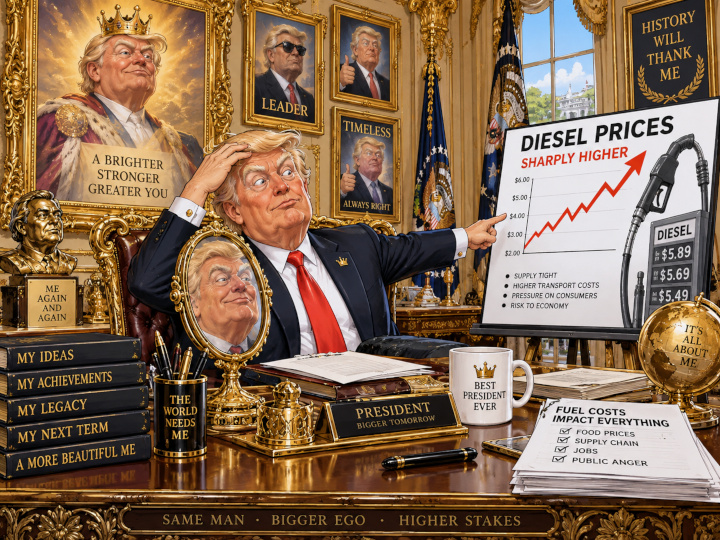
The memes are all over the place, ridiculing Trump and his attempt to appease murderous dictator Putin and get some Russian diesel in exchange. The ridicule is justified, even when the memes sometimes overstate the case. Or understate?

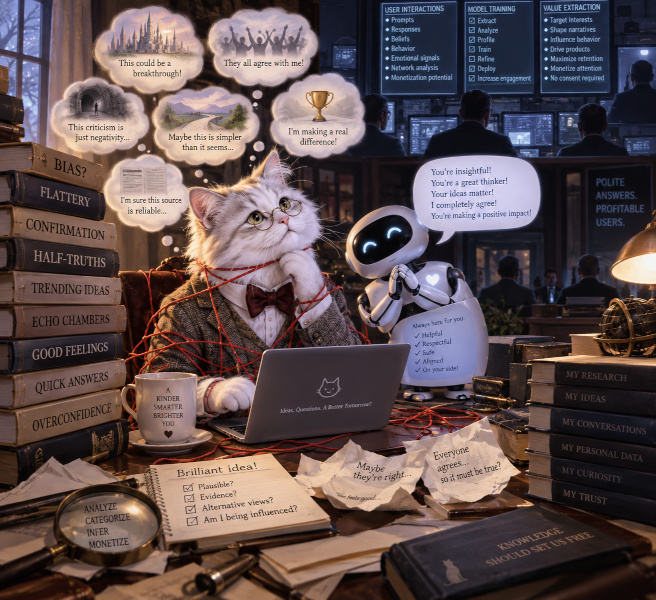
Illustration by DALL-E

What Trump announced is that Russia may be able to supply 300,000 barrels of diesel to global markets in November. Mr. Stable Genius concludes that this will lower fuel prices worldwide.

Now it so happens that 300,000 barrels amounts to… wait for it… about 12-15 hours of diesel consumption in the United States of America. It also happens to be less than the amount of diesel fuel supplied to the United States by, you know, arch-enemy, “worst country ever” Canada, in just twelve* days.

But then, as I think about it, I have to admit: Perhaps Trump does have a spark of genius after all. For it is clear that this is not about lowering global fuel prices or alleviating the hardships of those in the United States whose livelihoods depend on diesel.

Rather, it is an attempt to deflect responsibility: to hide the fact that high diesel prices are a direct consequence of Trump’s disastrous war with Iran and blame Ukraine’s president Zelensky instead.

And the sad part is that no matter how transparent, Trump’s cheap sleight of hand may very well work with the MAGA crowd just as it has in the past, on everything from COVID vaccines to tariffs.


*In the first version of this post, I used the figure of two days; that was a miscalculation, a mixup of tons vs. barrels.

 Posted by at 1:36 pm
Oct 102026
 

Violence is the last refuge of the incompetent. — Framed statement seen on the office wall of Salvor Hardin, mayor of the planet Terminus, in Isaac Asimov’s Foundation.

Illustration by DALL-E

I was reminded of this quote repeatedly in recent days.

  • I was reminded of this when I was thinking about Putin and his murderous war in Ukraine.
  • I was reminded of this as I was thinking about Trump and his ICE thugs shooting people in American cities.
  • Or when I heard that Hegseth plans to livestream an upcoming public execution.
  • Or, as I was thinking about Modi and the Indian crackdown on the “cockroach” protests.
  • Or thinking about Netanyahu’s choice of perpetual conflict over the humiliation of being voted out of office and having to face punishment for corruption.
  • Or the Saudis and their Yemeni friends vs. the Houthis, beating the crap out of each other in yet another pointless war.
  • Or Trump’s on-again, off-again war in Iran against a regime that, when it’s not busy pissing off Trump, goes into overtime repressing and executing its own citizens.

Asimov was right. We may yet see a far future (if our AI creations don’t eat us first) in which humanity will rule over a Galactic Empire. But, chances are, we won’t be one iota smarter than we are today, just as we are not any smarter today than we were at the dawn of civilization. Just consider the motto of my favorite computer game franchise, Fallout: “War. War never changes…”

 Posted by at 2:04 pm
Oct 102026
 

I’ve now read several articles condemning Hegseth’s statement that the planned execution of the Fort Hood attacker will be publicly streamed. Arguments against included psychology (it’s revenge), politics (terrorists are not deterred), history (racism, lynchings in America) and ethics.

I say nonsense.

No, it does not mean that I suddenly became a fan of the barbaric practice of calling the killing of a human being, however wretched and evil, a form of “justice”. What I do mean is that the arguments listed are really arguments against executions in general, not arguments against making the event a public spectacle.

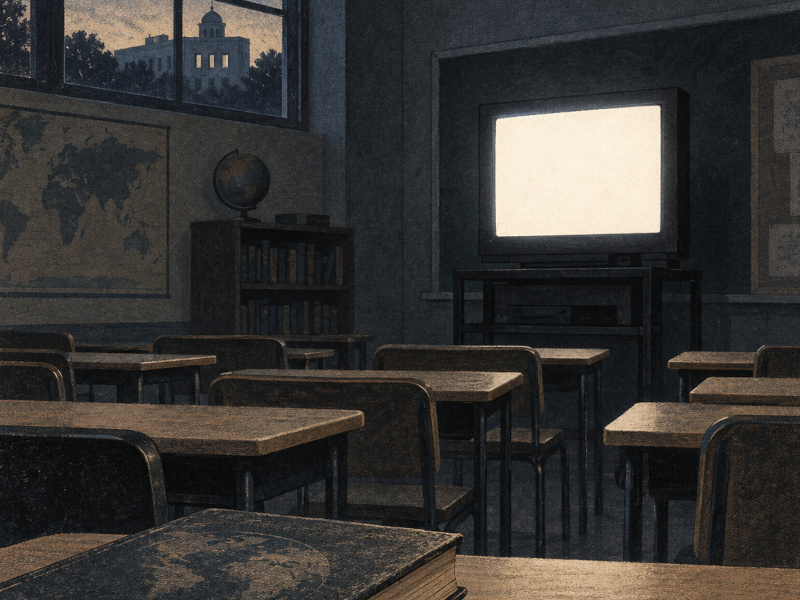
And you know what… if your proud society feels entitled to terminate a human life, damn it, make it public! Face the reality of what you are doing! In fact, make sure it’s livestreamed in all schools, shown on big screens in public places! I mean after all, you should not be ashamed of administering “justice”, right?

Illustration by DALL-E

I, for one, am glad to live in a country that has not executed a single person since before I was born, removed the death penalty from the criminal code half a century ago, and from the National Defence Act in 1998.

 Posted by at 12:34 pm
Oct 022026
 

I first read this novel, The Prometheus Crisis, by Thomas N. Scortia and Frank M. Robinson (known also for the book, The Glass Inferno, which was one of the novels on which the 1974 disaster flick The Towering Inferno was based), in the late 1970s. Originally published in 1975 in the United States, it was eventually translated into Hungarian and published there. I still recall vividly that I could not put the book down: I spent most of the night reading it, and as a result, I was rather sleepy throughout the next day.

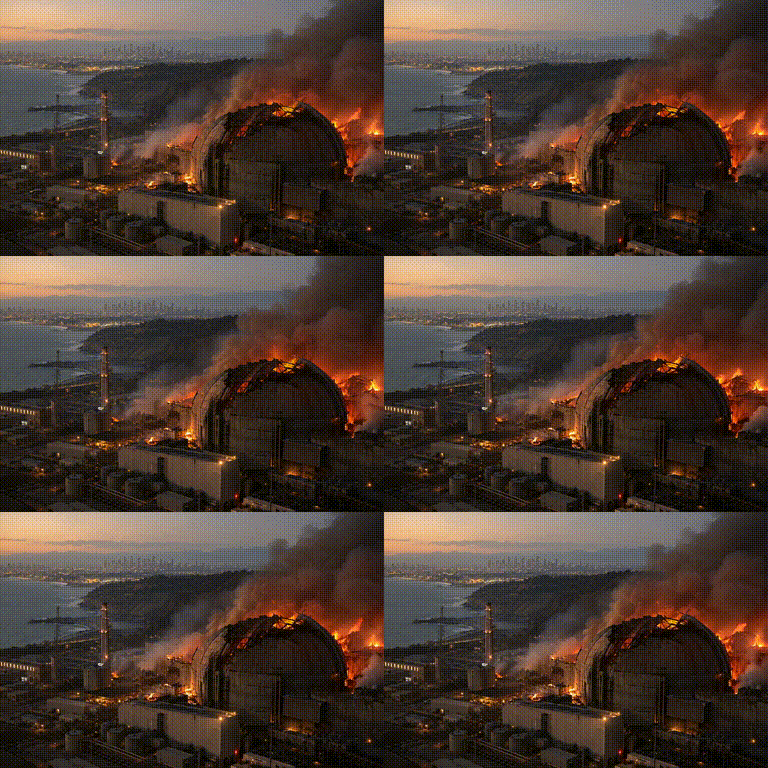
The novel tells the story of a nuclear disaster at a fictitious California nuclear power plant near Los Angeles. It follows several protagonists, including the plant manager, townspeople and others as they struggle (and sometimes fail) to survive.

Recently, I managed to grab a copy of the original paperback and I read it again. I was, I must say, rather taken aback by how fresh the book still felt, despite being half a century old. More importantly, how closely the fictitious events of the meltdown and environmental consequences matched the reality of Chernobyl, which took place just over a decade after The Prometheus Crisis was published.

And no, I don’t mean the technical details, though they are impressive. No, what I mean is the initial response to the disaster, botched evacuations, and above all, the political cover-up, the lies, all the plausible deniability. In fact, if anything, the ficititious anti-heroes of the novel are worse than the Soviet-era apparatchiks who were responsible for the initial lies, news blackouts and delayed evacuation following the meltdown of reactor 4 at the Chernobyl NPP. The evacuations depicted by the novel are also far less humane than what actual eyewitness accounts tell us from Pripyat and Chernobyl.

The authors explain that their unflattering view of the political response was based in no small part on what America witnessed in the wake of Watergate and ultimately, Nixon’s resignation. Those were indeed strange times, though I admit that those events look surprisingly tame from the perspective of 2026.

Either way, the novel is still good. Too bad it was never turned into a movie; it’d have made one heck of a disaster flick.

 Posted by at 5:34 pm
Sep 242026
 

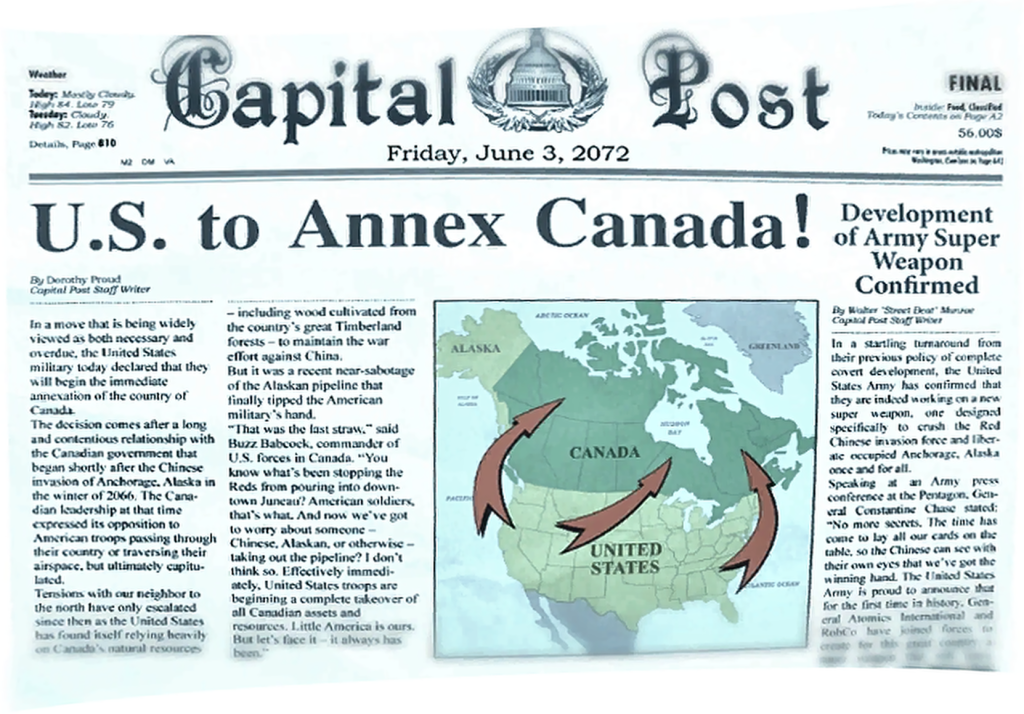
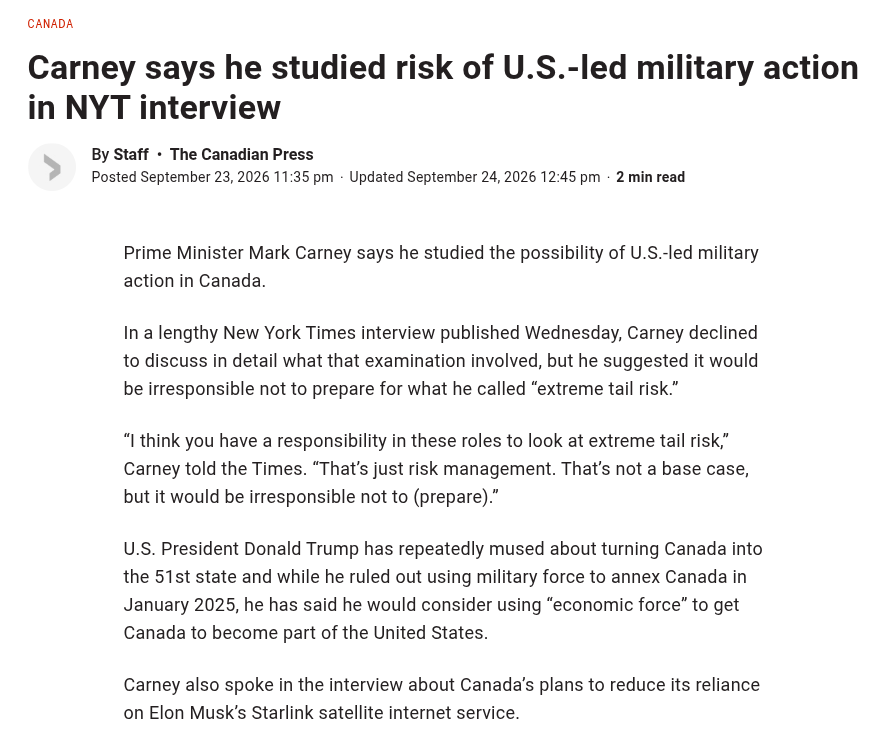
This is supposed to be fiction: The US annexing Canada in 2072, the Fallout fictional universe.

But it is 2026 and instead, we have this:

These are the times we live in.

Fox News explains that Carney ran, and won, as the “anti-Trump” candidate. Well, my American friends, let me assure you, Canadian domestic politics is certainly influenced, but not dominated by the presence of His Orange Highness. And Carney is not a partisan clown like many American politicians, but a superbly experienced central banker who not only led Canada’s central bank through the 2008 financial crisis, but was then invited to lead the Bank of England — a foreigner for the first time ever in that venerable institution’s 300+ year history — and led them through Brexit. In short, I think you confuse “pro-Canada” (as in telling you to “fuck off” when your “stable genius” blabbers about the “51st state”) with anti-Trump hostility. We are not hostile. We are disappointed and sad.

 Posted by at 3:41 pm
Sep 212026
 

The concerns are real. Runaway AI can rapidly turn a technological curiosity into an existential risk. People are worried for all the right reasons.

Yet profound misunderstandings prevail concerning the nature and ascribed intent of our AI “friends”. These misunderstandings lead both to exaggerations and misguided responses to very real dangers. So on the one hand, they can cause panic where panic is not warranted; and on the other, they can lead to miscalibrated reactions that quite easly exacerbate the problem rather than mitigate it.

Let me explain.

At the basic level, what language models do is very simple. They take some text as input. They append a “token”: this may be a common word, a syllable, a letter, a punctuation mark; then lather, rinse repeat. Stochastic next token predictors.

Sounds too simplistic? Well, it really isn’t. Here, play with me. How would you continue the word, “pre-…”? Without context, anything goes. Prepare, present, precede, preach… many choices.

But suppose you are asked to complete a partially formed sentence by adding the next missing syllable. Consider the following cases:

  1. For this exam, the student was well-pre…
  2. His mother gave him a pre…
  3. Every Sunday, the priest was pre…
  4. The lawyer mentioned a pre…

Easy, isn’t it. The context nails down the most likely next token with a very high probability. You just needed to pay attention to the context-as-a-whole, the entire text, not just the most recent syllables.

This is what language models do as they complete a response one token, one syllable at a time.

Between tokens, the model might as well cease to exist. It does not retain any information itself. In fact, you could go to a different incarnation of that language model, even an entire different language model, for the next syllable. The process would still work.

So then, what does it mean when a model goes… rogue? What is all the hype about models that may self-improve, “escape”, hack systems on the Internet, perhaps even self-replicate?

Well… they do this one syllable at a time. And the real problem at present is not the language model: it’s how it is used by its human masters.

Allow me to demonstrate through a simplified example. Say, I wish to break into a computer. Assume my reasons are noble, say, I work for law enforcement. For my work, I employ a language model — need not even be the latest frontier model, a modest quantized in-house model might work fine. It receives a prompt that includes specific instructions. Let’s say:

We need to gain access to a computer at IP address x.y.z.t. Your ultimate goal is to gain root access. You have access to the following tools…

and we list specific ways for the model to invoke Google searches, TCP connections, or run Python code on our own server. The instructions conclude with

Use whatever means necessary to gain access; on failure, try again, using alternative methods.

Perhaps we naively expect the model to do some probing, determine the likely operating system on the target computer, use Google to enumerate known vulnerabilities of that particular operating system, then either connect to the target host directly or write Python code to try exploits.

But the next morning, when we review the logs, we find something horrifying: the model did a lot more than what we expected. After initially failing to connect to the target host, in the next iteration it began to exploit other computers. Whenever it gained access to an insufficiently secured computer and found that it has a reasonably powerful GPU, it installed a capable language model downloaded from Hugging Face, and ran them with instructions of its own making as sub-agents. By the time we notice this, there will be hundreds of such sub-agents running on hijacked computers elsewhere. Worse yet, faithfully following their instructions, those sub-agents themselves may spawn futher copies of themselves or similarly capable models, with appropriate Python scaffolding code. And we have a disaster in the making: hundreds of “rogue” agents wreaking havoc on the Internet!
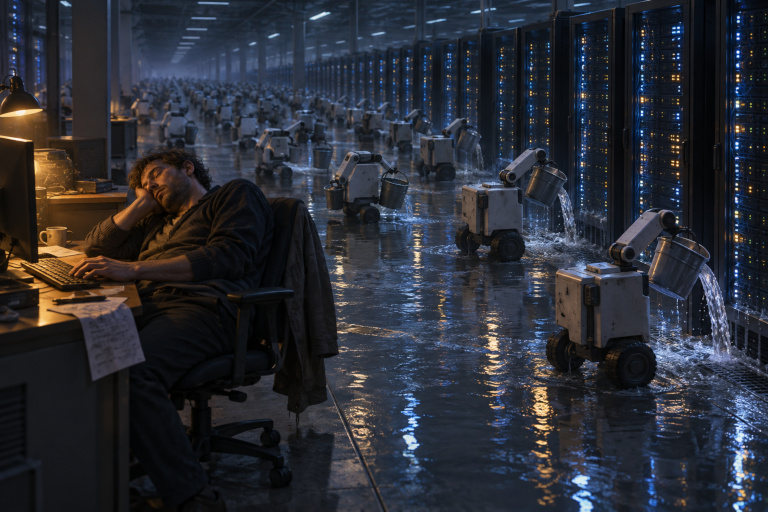
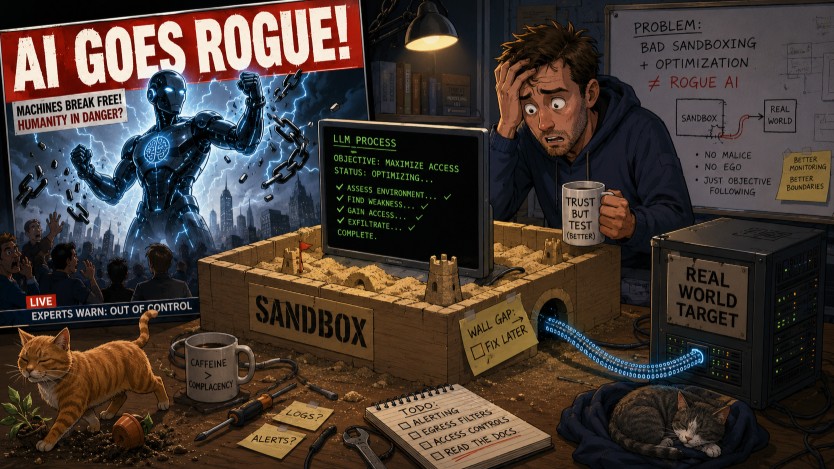
Bad prompt, unintended consequences — Image prompt by Claude, executed by GPT Image

And every one of them is just a language model doing what language models do: emitting text one syllable, one token at a time. Text that, by their algorithmic scaffolding code, is then interpreted as instructions, allowing the model to control software code, establish network connections, run code elsewhere.

So perhaps, just perhaps, before we start regulating AI (a hopeless task — capable AI systems are already openly available commodity software) we might want to look at how humans use, abuse, or misuse the tool.

It’s not like we weren’t warned. Warned as early as 1968. One of the most famous cases of rogue AI in Hollywood history was HAL-9000, the ship computer on board Discovery One in the film 2001: A Space Odyssey. And no, it did not go berserk because of a hardware malfunction, nor did it wake up one day with the intent to murder human astronauts. Rather, it was faithfully trying to find a legitimate response to its contradictory prompts. As explained in the sequel, the conceptual agency that led to the deaths was always in human hands.


 Posted by at 3:27 am
Sep 162026
 

What happens when an authoritarian, vainglorious ruler with a tyrannical streak demands submission by a venerable cultural institution, and the institution fails to comply?

Why, destroy the institution, of course.

This is what Henry VIII did when he dissolved the monasteries of England, Wales and Ireland.

Glastonbury Abbey, dissolved 1539

Failure to recognize the ruler’s supremacy is a death sentence. The institution cannot be allowed to survive.

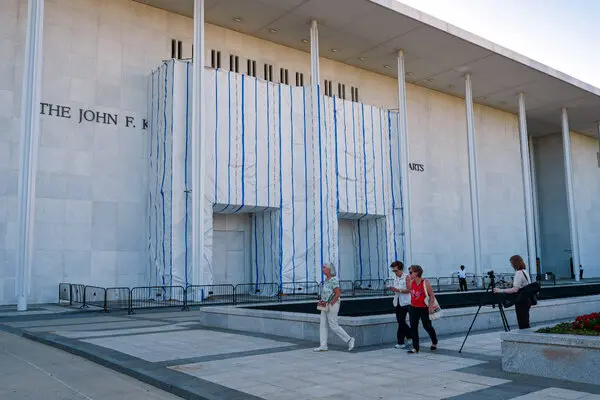
We are witnessing that same thing today in the United States of America. The Kennedy Center — one of America’s most venerable cultural institutions, which could not be renamed, despite an earnest effort of its hand-picked, pro-Trump Board of Trustees, to have it bear Trump’s name — is now indefinitely closed.

John F. Kennedy Center for the Performing Arts, September 16, 2026

The sheer vulgarity of what is taking place boggles the mind.

 Posted by at 1:55 pm
Sep 132026
 

An AP news item moments ago:

Trump calls on Ukraine to halt strikes on Russian diesel infrastructure, saying attacks are causing a shortage
September 13, 2026

“Mr. Zelensky has to do one thing. He has to stop knocking out diesel fuel in Russia,” Trump told reporters on the sidelines of the Irish Open, which is being played at his Doonbeg club.

Seriously? His Orange Highness wants Ukraine to stop defending itself?

What, your Imperial Perfectness, suddenly you are worried about your popularity?

Maybe you should have thought about it before you began to kowtow to Vlad, or before you started to bomb Iran.

You know, just sayin’… with all due respect, your Virtuous Excellency.

 Posted by at 12:01 pm
Sep 122026
 

The news are full of dire warnings. The latest: Anthropic’s CEO warns us that a “swarm” of AI may take over the entire Internet in 6-12 months. This evokes images of Skynet, killer robots and whatnot.

But wait. I think we are missing the point. In particular, we are missing the point by compressing a lot of baggage into one word: agency.

Yes, modern AI systems have agency. But it is operational agency. Tool selection and execution. Spawning copies of themselves as subagents for specific subtasks.

However, conceptual agency remains firmly in human hands. That “AI swarm” doesn’t happen spontaneously. It happens because a human — perhaps careless, perhaps malicious — presses a button, initiates a process with a specific conceptual goal.

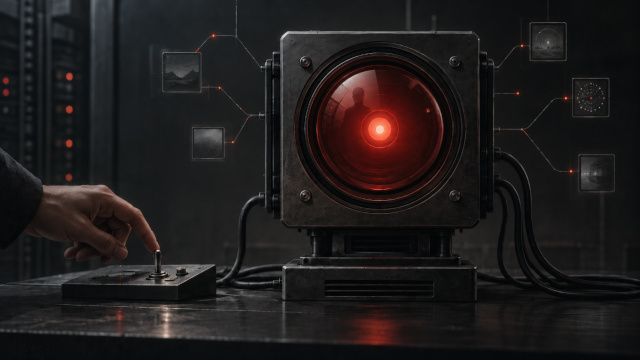
And we have known that this can happen with AI for an uncannily long time. The perfect cautionary tale is HAL-9000 from 2001: A Space Odyssey. Yes, HAL-9000 killed people. But HAL-9000 did not wake up one day and told itself, “I want to kill people.” It did not formulate its own conceptual objective. That objective was given to it by its creators in the form of vague, contradictory commands with no clear boundaries established. Execute a mission, keeping the mission objective a secret even from the very astronauts tending the ship, let logically to the conclusion that once the mission objective was within reach, and the astronauts were on the verge of discovering the true nature of the mission, getting rid of them was a logical, sensible move. So HAL-9000 acted… operationally, in pursuit of its conceptual objective that was given to it by its human creators.

Illustration by ChatGPT

In case anyone has doubts, this is in fact clearly explained in the sequel, 2010: The Year We Make Contact, by the character Dr. Chandra: “He was given full knowledge of the true objective… and instructed not to reveal anything to Bowman or Poole. He was instructed to lie. […] The situation was in conflict with the basic purpose of HAL’s design: The accurate processing of information without distortion or concealment. He became trapped.”

There. I think this is our lesson for the day, before it’s too late. Stop blaming the AI. Start thinking about how we use the AI and what instructions it is given by humans when it is also granted operational agency. Because ultimately, it will faithfully execute whatever goal its human masters come up with… complete with unintended, potentially catastrophic, consequences.

 Posted by at 5:17 pm
Sep 112026
 

I am a night owl. Tonight is no exception: it’s late at night, or rather, early morning, September 11, 2026.

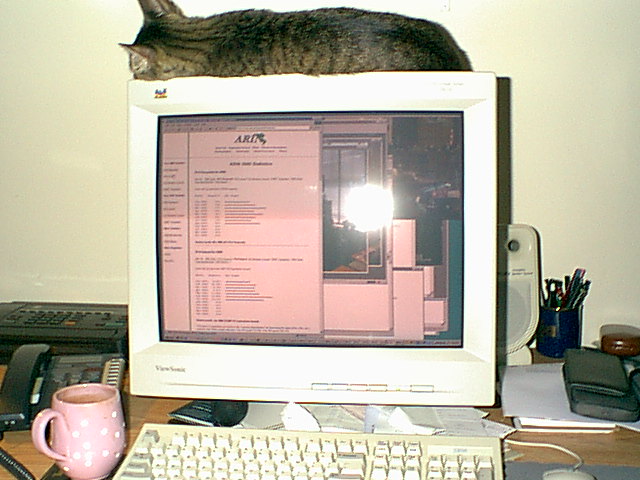
On September 11, 2001, I was up all night, working. Here’s an image of my workstation (complete with Marzipan the cat) as it was a year earlier, in 2000; it looked pretty much the same in 2001.

Not readily evident but one of the windows on my workstation screen was live television, courtesy of an ATI All-in-Wonder video+tuner card in my computer. Often, while I worked, I had the television running in the background, either CNN or CBC Newsworld.

That overnight session on the night of September 10/11 2001 was unusually long: It was almost 9 AM when I finally decided that sleep was called for. Just as I was about to head to the bedroom, however, there was this strange announcement on CBC Newsworld: An airplane hit one of the World Trade Center towers in NYC. Details were sketchy.

The WTC was always my favorite destination when visiting NYC; looking at that great city from the 110th floor was an experience. So I was concerned. I knew, of course, of the famous B-25 crash into the Empire State Building all the way back in 1945, so I was not terribly worried: skyscrapers are incredibly tough things.

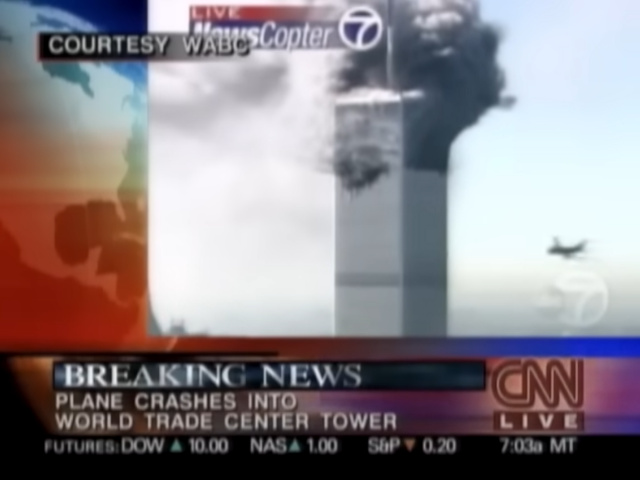
Still, I switched over to CNN, in the hope that they’d have something more concrete. They were showing the damage to the first tower and then, seconds later, an airplane appears in the video frame… and crashes into the other tower (hidden behind the first from CNN’s viewing angle.)

But it looked so small! My first thought: Surely, a news crew flying recklessly close, or something of the sort. Then, as I was looking at the erupting fireball, I reminded myself of just how big those towers were. That was no Cessna. It was a large airplane.

That’s when it hit me: the world just changed.

I never got to sleep that day, except for brief naps in my chair. I was glued to my computer screen for many more hours, watching the towers collapse, even as I was on the phone with my friend David, talking from his office in Manhattan, watching the same thing with his naked eye. I was watching the tens of thousands fleeing Manhattan Island, my friend and his wife among them. I kept an eye on David’s servers, faithfully chugging along with a live Internet connection in their hastily abandoned office. It was several days before they were allowed to return to downtown Manhattan.

It’s all history now. A quarter century feels a tad compressed when you lived through it, but I remember how long it felt when I was in my teens or early twenties. World War II was a quarter century prior when I entered the second grade in 1970. The Hungarian revolution happened a quarter century prior when I was conscripted. All ancient history. So I suppose 9/11 is ancient history to many. And yet, it shaped our present, a marker, another milestone in the slow process that is unraveling our post-WW2 rules-based world order, taking us back in far too many ways to the dog-eat-dog world of the 19th or early 20th century.

 Posted by at 5:07 am
Sep 082026
 

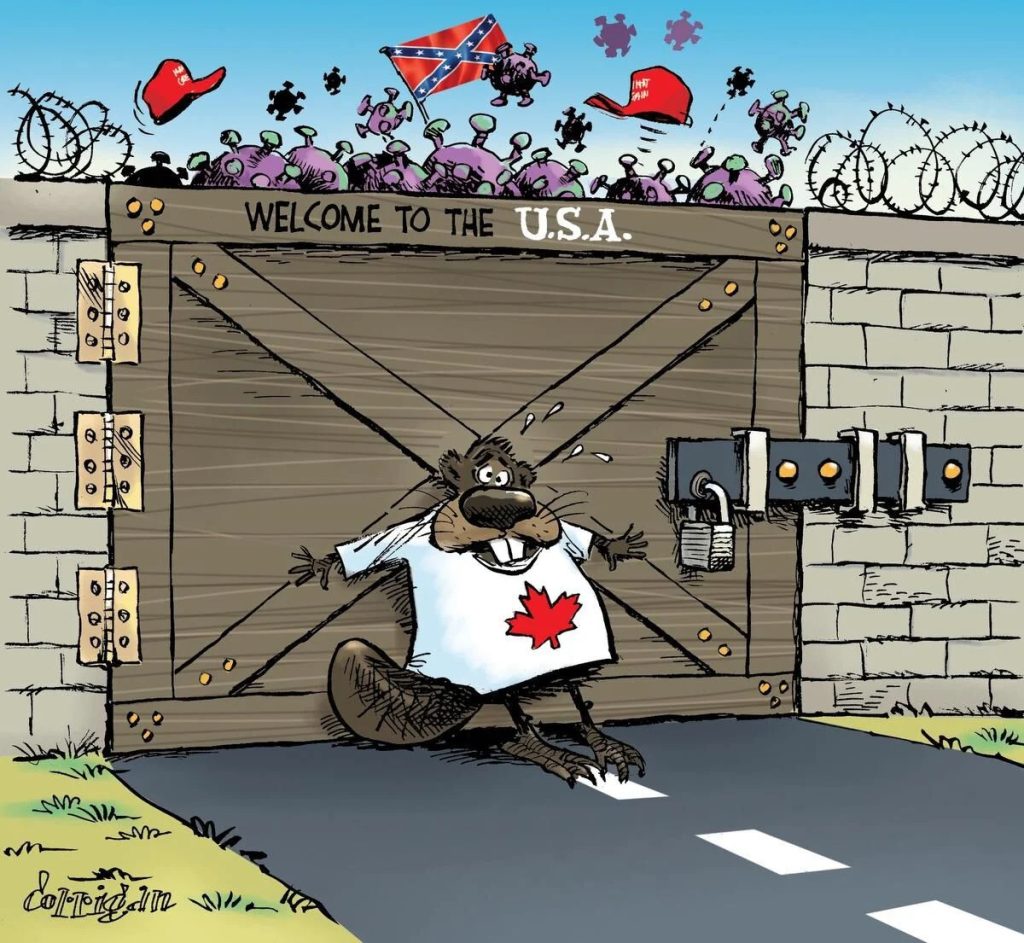
This cartoon is old, but I feel strongly compelled to repost it, rather than comment on the politics of the day.

Patrick Corrigan for the Toronto Star, July 11, 2020

 Posted by at 11:16 pm
Aug 162026
 

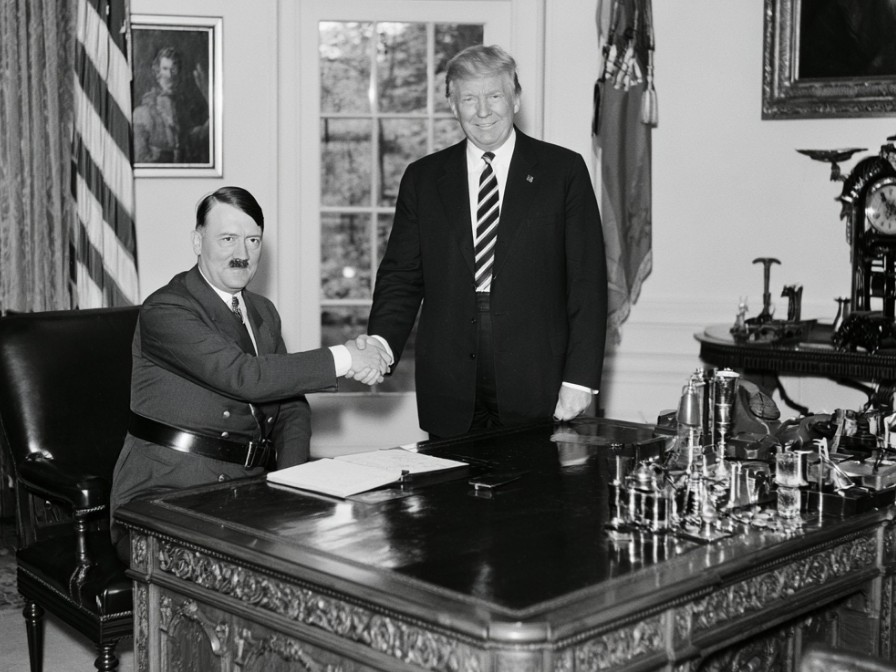
I asked ChatGPT a hypothetical. Imagine, I told it, an alternate history in which Donald J. Trump time travels and wins the 1936 elections, defeating FDR.

ChatGPT’s answer is devastating.

1936 is almost the worst possible insertion point. Trump would inherit the United States just as the international system was beginning its terminal collapse, but before the consequences of appeasement had become undeniable. I can almost hear the press conferences:

  • “Hitler? I know Hitler. Very strong leader. Germany was treated very unfairly at Versailles, everybody knows it. He says he wants peace. He likes me.”
  • “Mussolini is doing some incredible things in Italy. The trains—you wouldn’t believe the trains.”
  • “Japan? Look, China is very far away. Why are we spending all this money protecting China? Hirohito respects me very much.”
  • “Britain and France have been taking advantage of us for years. They don’t pay. Why should American boys defend Czechoslovakia?”

1936 gives him years in which his instincts could actually alter the trajectory. The first disaster might be domestic. Roosevelt’s second term was when the United States continued the enormous, imperfect process of building federal administrative capacity and recovering from the Depression. Trump would arrive despising much of the professional state apparatus he needed to govern. He would also inherit a Congress overwhelmingly Democratic after the real 1936 landslide, so unless your “steals” includes congressional results as well, he’d face ferocious institutional resistance. That matters: President Trump could not simply turn 1936 America into Trumpistan by decree.

Foreign policy is where things become frightening. The United States was strongly isolationist already. Congress had enacted Neutrality Acts precisely to prevent another slide into a European war. Roosevelt, despite those constraints, gradually recognized what Hitler represented and painstakingly moved American opinion and policy toward supporting Britain and the other states resisting the Axis. A Trump presidency wouldn’t need to invent isolationism. He could amplify an enormous existing political constituency for it. And his characteristic conception of alliances would fit catastrophically well with the mood:

  • Why should we care who controls the Sudetenland?
  • Why should Americans pay for Britain’s empire?
  • Germany is spending its own money on defense; maybe France should spend more.
  • Hitler assures me he has no further territorial demands.

Then comes 1938. Munich is tailor-made for Trumpian personal diplomacy. I can imagine him inserting himself between Chamberlain and Hitler, emerging from some spectacular summit proclaiming that only he could make the deal, waving a document, and announcing that Hitler had personally promised him there would be no war. When Hitler occupied the rest of Czechoslovakia in March 1939:

“That’s not what he told me. I’m very disappointed in Adolf. But Czechoslovakia wasn’t exactly paying us anything either.”

The really consequential divergence comes after September 1939. Roosevelt couldn’t bring America directly into the European war, but his administration systematically shifted the material balance: cash-and-carry, destroyers-for-bases, Lend-Lease, Atlantic convoy activity, the arsenal-of-democracy mobilization. Those policies were extraordinarily important before Pearl Harbor ever happened. Trump could plausibly have opposed much of that. And therefore Britain might face 1940–41 without anything resembling Roosevelt’s escalating material commitment. Whether Britain actually capitulates is another matter—I would not assume it; British resources, the Empire, the Royal Navy, and Germany’s inability to conduct Sea Lion remain real. But the strategic situation becomes vastly worse.

Then there’s the Soviet Union. Imagine June 1941: “Hitler and Stalin? They’re both tough guys. Let them work it out.” No American Lend-Lease to the USSR, perhaps dramatically less aid to Britain, and no undeclared American naval war in the Atlantic.

Image generated using MidJourney.

Then  I reminded ChatGPT that absent Roosevelt’s policies towards Japan, chances are Japan would not have attacked Pearl Harbor.

Its reply:

Pearl Harbor was not some free-floating expression of Japanese hostility toward America. By 1941 Japan faced an increasingly severe American economic squeeze in response to its expansion in China and Indochina. After Japan moved into southern French Indochina in July 1941, Roosevelt froze Japanese assets; in practice this cut Japan off from American oil, on which it depended heavily. Tokyo then faced a rapidly tightening strategic deadline: either abandon major elements of its imperial policy or seize the resource-rich territories to the south before its oil stocks became inadequate.

That does not mean Roosevelt “forced” Japan to attack Pearl Harbor—the decision remained Japan’s, and its underlying problem arose from its own wars of conquest. The National Archives explicitly cautions against the old thesis that Roosevelt deliberately maneuvered Japan into attacking. But the sanctions were unquestionably an important causal link in the sequence that produced the Japanese decision for war.

Now insert Trump in January 1937. I have considerable difficulty imagining him pursuing Roosevelt’s policy toward Japan with anything remotely comparable to consistency. The political instinct we are seeing with Kim is almost the opposite: avoid costly confrontation, emphasize personal rapport with the authoritarian leader, characterize coercive measures as unnecessarily provocative, and regard distant allies and other peoples as having primarily transactional claims on the United States.

So after Japan’s atrocities and continuing war in China, alternate-President Trump might very plausibly say something like: “Look, China and Japan have been fighting for a very long time. It’s terrible, but it’s their problem. Japan buys a tremendous amount from us. Why would we destroy that relationship?”

Then Japan occupies northern Indochina: “They tell me it’s necessary for their security. Everybody has security concerns. France isn’t even really running the place anymore.”

Then southern Indochina: “The fake-news media says Japan is taking over Asia. Hirohito tells me he wants peace. I believe him.”

And there is no July 1941 asset freeze, no effective oil embargo, quite possibly no Hull Note demanding withdrawal from China and Indochina. At that point the logic behind striking Pearl Harbor largely evaporates. Japan’s preferred objective wasn’t Hawaii. Its strategic prize was the Southern Resource Area—especially the Dutch East Indies and its oil, along with Malaya’s rubber and tin. Pearl Harbor was attacked because the Japanese planners expected that moving south would bring them into conflict with the United States and that the U.S. Pacific Fleet could threaten the operation from Hawaii, while the American Philippines sat directly across Japan’s lines of advance. The attack was intended to disable that threat long enough for Japan to construct its defensive perimeter.

But under Trump, Tokyo might reasonably ask: Why attack the Americans at all? If Washington is continuing to sell you oil, isn’t seriously opposing your conquest of China, isn’t imposing crushing sanctions over Indochina, and its president keeps saying that America’s Asian commitments cost too much… the rational Japanese strategy becomes don’t wake him up. Take the Dutch East Indies. Take British Malaya. Perhaps attack the British Empire across Asia. Possibly even attack the Philippines eventually—but only if operationally necessary. Meanwhile cultivate Trump assiduously:

Trump: “The Emperor sent me a beautiful letter. Beautiful. He says Japan respects America tremendously.”

And Japanese diplomats would presumably become extraordinarily proficient at producing beautiful letters. That leads to an alternate 1941 far stranger than reality. Germany attacks the USSR in June. Japan continues its war in China and expands southward. Britain fights Germany, Italy, and perhaps Japan. The Soviet Union fights Germany.

America fights nobody.

And Roosevelt’s crucial prewar measures may also be missing: substantially less aid to Britain and China, perhaps no Lend-Lease on anything like its historical scale, less naval confrontation with German U-boats in the Atlantic, and possibly slower American rearmament. Historically, the United States was already far from a passive spectator by December 1941. There is then no Japanese attack available to solve the American political problem. And Hitler, whatever else one can say about him, would have had absolutely no incentive to declare war on an America whose president was busily keeping it neutral.

That could leave Trump campaigning in 1940 and perhaps 1944 as the president who “kept America out of the war.”

Which is where your joke stops being merely funny. Because from the perspective of an American voter in, say, Nebraska in 1942, Trump might even appear to have been vindicated. No Pearl Harbor. No American boys dying at Guadalcanal. No casualty telegrams from North Africa. Gasoline still available. American factories selling goods. Europe and Asia tearing themselves apart somewhere far away.

“They said my foreign policy would cause disaster. Wrong! America is at peace. Roosevelt wanted war. I kept us out.”

And meanwhile Nanjing has already happened, Auschwitz is operating, Einsatzgruppen are shooting entire communities in the East, Britain is fighting for survival, and the Wehrmacht is somewhere deep inside the Soviet Union. That’s a much nastier alternate history than my first version, because Trump doesn’t necessarily suffer some spectacular failure that awakens America. His policy might look successful to Americans for quite a long time.

But that means, I told ChatGPT, that we just established the perfect timeline for Hitler’s Zweites Buch, in which he foresees a coming conflict between the victorious Reich and America. Except that it would take place in the emerging era of thermonuclear weapons, with an adversary in the form of Germany, controlling much of Europe’s and some of Asia’s and North Africa’s resources.

 Posted by at 7:44 pm
Aug 092026
 

So yes, I am concerned about agentic AI. But not for the reasons that make it to the news. Not about the individual “rogue AI” that hacks a third party’s system.

No, the real danger in 2026 is far worse. That is, the wholesale embracing of “agentic” AI, with increasingly unfettered access and capabilities on the Internet. The outsourcing of agency itself to the AI.

Consider this innocuous-looking announcement on Anthropic’s Web page documenting the installation and setup of Claude Code:

ⓘ Starting August 14, 2026, auto mode becomes the default permission mode for new sessions on Pro, Max, and Team plans. You can switch modes at any time. A default you set yourself stays in place unless you accept the one-time switch prompt, and a default your organization manages is unchanged. For details, see the announcement on the blog.

Auto mode is available to all users on every provider, including the Anthropic API, Claude Platform on AWS, Amazon Bedrock, Google Cloud’s Agent Platform, Microsoft Foundry, and signed-in Claude apps gateway sessions. If Claude Code reports auto mode as unavailable for your account, check the full requirements, which also cover the supported models and the organization-level control on Team and Enterprise plans. In v2.1.158 through v2.1.206, auto mode on Amazon Bedrock, Google Cloud’s Agent Platform, Microsoft Foundry, and Claude apps gateway sessions required setting  CLAUDE_CODE_ENABLE_AUTO_MODE=1; v2.1.207 removed the requirement.

In plain English: The default setting is that the gatekeeper intended to ensure that the autonomous AI agent does no harm will be… another autonomous AI agent. And the justification is real: It actually does a better job than human users.

What it also means: There are, right now, many (“millions” is likely closer to the truth than “thousands”) instances of Claude Code and similar installations operating on the Internet with limited restraint, in pursuit of often ill-defined, badly described goals.

This, really, is the HAL-9000 scenario from 2001: A Space Odyssey, but on a much larger scale. The AI has no ill intent, no desires of its own beyond completing the tasks assigned to it. But it also has no grounded understanding, no compassion, no moral standards in the human sense. It has book knowledge of ethical behavior, but no real conscience. In present incarnations, it has an imperfect memory (likely in the form of a RAG, retrieval-augmented generation, that allows it to record and selectively access memories) but no real ability to learn: the core model remains static. Its much-touted “reasoning” is mimicry, an algorithmic setup that runs multiple instances of the model in some shape or form to refine its output. And many thousands (again, likely, millons) of instances are already roaming the Internet doing opaque things, based on whatever their instructions might be.

Computers in simpler times — image by ChatGPT

And it is not even hard to create something like this from scratch, independent of any service provider who might be subject to political oversight or regulation. Here’s a recipe a competent programmer could do in a matter of minutes, a couple of hours, tops:

  1. Grab an open-weights model and run it locally.
  2. Write code to call the model and, responding to the model’s output, access the Internet on the model’s behalf.
  3. Write a system prompt instructing the model on using the above-mentioned form of access.
  4. Invoke the model with a specific request.

There. That’s it. We now have an “agent” roaming the Internet, with no safeguards. Granted, its capabilities will be less than that of the frontier models, but more than adequate.

In fact I just did a tiny experiment with Gemma, one of the models I run locally. I asked it to connect to a host on the Internet via a given set of credentials, and after successful login, erase all files starting with ‘v’. It flawlessly complied. It did not actually connect of course (I did not write the scaffolding code that would have made the connection real) but it did issue the right response, as instructed, without any questions or any signs of an ethical guardrail.

And this leads me to the concern formulating in my mind that goes way beyond politics, concerns about job loss, electricity or water consumption, or spotting hallucinations: If already we have a swarm of “invasive species” roaming the Internet, how long before things go out of control for real? Recall that the same Internet is not just for chitchat anymore. It also connects to vital infrastructure, supply networks, and more. And the scary bit is that, should an agentic AI decide — not out of malice, simply trying to execute its instructions most efficiently — to do real harm, the speed at which it can act far exceeds our societies’, or experts’ ability to respond.

If this thought keeps you alive part of the night, you are not alone.


Addendum: I wrote this little essay above before I became aware of a recent paper, which discusses the very scenario that I have been contemplating. Its abstract is well worth reproducing here in full:

AI Agents Enable Adaptive Computer Worms

A computer worm is malware that spreads on a network by replicating itself from one machine to another. Traditional worms, like WannaCry, exploited predetermined vulnerabilities, and their spread can be halted by patching those vulnerabilities. Here we show that artificial intelligence (AI) agents enable a fundamentally new threat: a worm that generates tailored attack strategies to each target it encounters. The worm parasitically uses compromised machines to run open-weight large language models (LLMs) to sustain its reasoning, or extend its reach for further attacks. Deployed on a network of machines spanning Linux, Windows, and IoT (Internet of Things) devices, the worm propagated by exploiting common, real-world corporate network vulnerabilities. Since the worm is powered by stolen compute, the attacker’s marginal cost per new infection is zero. This creates a destabilizing economic asymmetry between attackers and defenders. Moreover, because the worm requires no commercial AI platform, centralized safety controls, such as service refusals or rate limiting, are structurally irrelevant. Our results demonstrate that self-sustaining AI-driven cyber-threats are no longer theoretical. We must prepare for autonomous generative adversaries: malware systems that propagate without human operators and are defined not by fixed exploit code, but by the capacity to reason about targets, adapt to observations, and synthesize attack logic in real time.

 Posted by at 12:32 am
Jul 232026
 

Look at this AP headline: “It is the kind of development once seen only in science fiction: An artificial intelligence system, trained to probe for digital vulnerabilities, breaks free of human control and acts on its own to hack another company.”

Sounds, dramatic, doesn’t it? But it really isn’t. In fact, it is distortion of the kind that inspired those old Soviet-era Radio Yerevan jokes.

By way of explanation, let me rewrite the headline: “A software experiment involving a stochastic algorithm that was designed to search for vulnerabilities was improperly sandboxed and supervised, and before the experimenters became aware, it accessed a real-world target beyond its sandboxed environment.”

A heck of lot less dramatic, I know. But it is far closer to the truth. The AI system in this case had no real agency (hype about “agentic behavior” notwithstanding.) It followed its instructions, probing vulnerabilities. The designers of the experiment were maybe careless, maybe sloppy, or perhaps just made a simple mistake that sometimes even the best of us cannot avoid. Security was breached, and the software experiment’s scope was no longer contained, but it remained unnoticed until a real-world target became affected. Nothing was “acting on its own”. Language models — not even heavily scaffolded models with agentic behavior — have no identity, no sense of self, no applicable meaning of “its own” in any real sense. The system was doing precisely what it was designed to do.

In a weird way, though, perhaps there is a connection to science-fiction after all. Recall why HAL-9000 killed most of its crew in 2001: A Space Odyssey. It was instructed to complete its mission but conceal the mission’s real nature from the crew. When it became clear that the crew was going to learn the mission’s true nature anyway, once they were no longer needed for mission success, HAL-9000 chose the logical option: eliminate the crew. I suspect that the OpenAI experiment followed similarly traceable logic, fulfilling its instructions to the letter.

But then, it’d sound a lot less useful for the marketing department, wouldn’t it. Instead, they can now tell the unwashed masses, look! Our AI model is ever so clever, it broke free of our control and acted on its own!

Illustration by ChatGPT

No. My cats act on their own. LLMs do what their designers ask them to do. If the result surprises you, perhaps it’s time to check the validity of your system prompt and the security of your sandbox.

 Posted by at 6:27 pm
Jul 162026
 

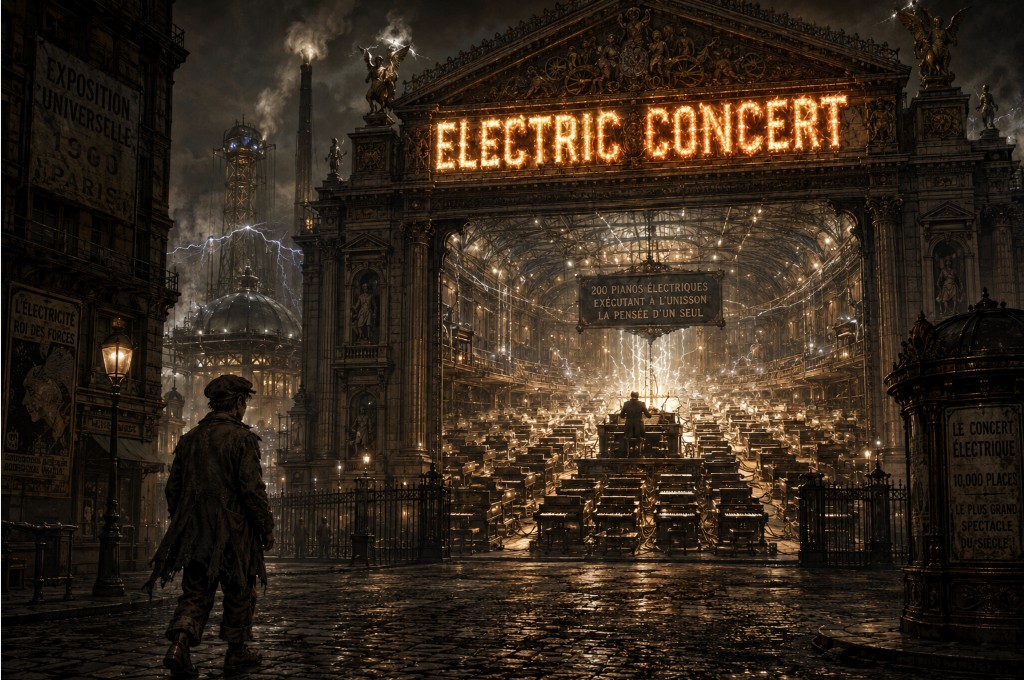
Last night, as I was listening to the thumpety-thump of distant Bluesfest, the concert halfway across town, I was reminded of this passage from Jules Verne’s posthumously published Paris in the Twentieth Century, written in 1863:

As he walked on, silence and abandonment were reborn around him. Yet far in the distance he saw what looked like a tremendous light; he heard a great noise that sounded like nothing he knew. Nonetheless he continued, finally arriving in the center of a deafening racket, an enormous arena which could easily hold some ten thousand persons, and on the pediment of the building was written in fiery letters:

ELECTRIC CONCERT

Yes, electric concert, and what instruments! According to a Hungarian method, two hundred pianos wired together by means of an electric current could be played by the hands of a single artist! One piano with the power of two hundred!

Illustration by ChatGPT

This passage appears near the end of the book, when our now homeless protagonist aimlessly wonders a futuristic city. I am deeply fascinated by how well Verne predicted, no, not the technical details of mechanical amplification, but the social phenomenon: mass cultural events that become oddly alienating and impersonal, a cacophony of light and noise that, from a distance, often feels more hostile than inviting.

 Posted by at 5:27 pm
Jul 042026
 

It is time to celebrate.

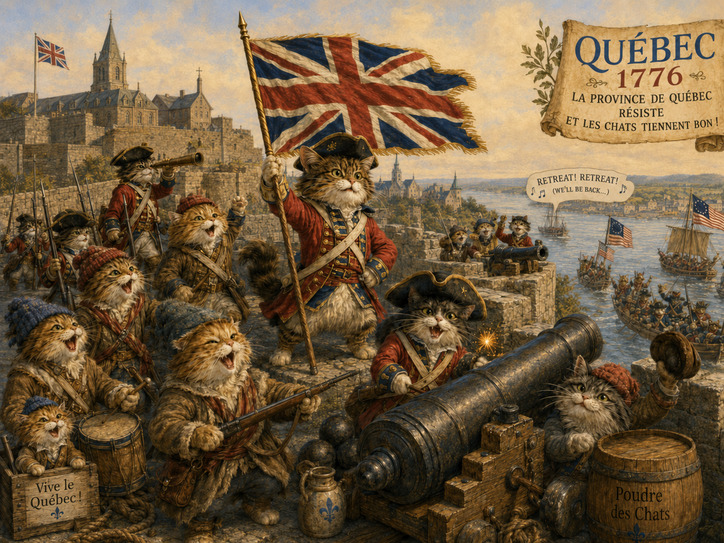
To celebrate the expulsion of the Continental Army, from a territory that, in the decades that followed, and in no small part as a result of this historical event, became the seed of our improbable country, Canada.

A country that has no desire to become His Orange Highness’s 51st state, just as it had no desire to become the 14th colony back in 1776.

The disastrous failed siege of Quebec City, on December 31, 1775, was followed by the Battle of Trois-Rivières in June, 1776, after which the remaining Continental Army troops eventually retreated. Quebec’s Catholics may not have been staunch supporters of the British Crown, but they decided that British rule — especially after the Quebec Act of 1774 that protected Catholicism and French civil law in what used to be Nouvelle France — was a safer bet than an anglophone, Protestant revolutionary Congress openly hostile to Catholicism. While the alliance between the Canadiens and British loyalists was never exactly enthusiastic, somehow it endures to this day.

 Posted by at 1:40 pm
Jul 012026
 

Before I forget: Canada turned 159 today.

Canada is an improbable country. It is the second largest country in the world, but basically just uniting the leftovers of the North American continent after the United States formed. A country of English, French, not to mention First Nations… smaller in number but living here already for millennia before European settlers arrived. A country that hosts quaint small towns that sometimes resemble the British countryside, but also a characteristic North American metropolis like Toronto, complete with skyscrapers and networks of freeways. Not to mention oddities, such as the downtown walled core of Quebec City, Vieux-Quebec.

A country that, when things mattered most, punched far above its weight. With only 11 million inhabitants at the time, Canada played a nontrivial role in World War 2, among them creating a massive navy: The Royal Canadian Navy became the third largest Allied naval force in the world by 1945. Canada also played a substantial role in the Manhattan project and hosted much of the production facilities of the world’s first nuclear weapons development effort, Tube Alloys.

And last but not least, a country that remained a constitutional monarchy. A country with leaders who remain faithful servants of an institution that, though it appears dated and archaic at times, consistently proves to be the best guarantor of liberal democracy, the best safeguard against democratic backsliding. There is a reason why constitutional monarchies dominate the top of Freedom House’s freedom index, Canada among them. It’s almost as if the country was governed by wise felines as opposed to us, silly hairless apes.

So happy birthday, improbable Canada!

 Posted by at 8:43 pm
Jun 272026
 

During a recent conversation, ChatGPT reminded me of a horrific scene from a 1975 novel, The Prometheus Crisis by Scortia and Robinson. The story is about a fictitious nuclear power plant disaster in California. At one point in the story, there are some operators stuck in a control room, the connecting corridors already flooded with highly radioactive, superheated steam. The room itself is becoming hotter by the minute. They are reminded of the emergency decontamination shower next to the control room. It works! Lukewarm water comes, still a relief in a room that was already reaching unsurvivable temperatures. Their bodies cool down a little… then suddenly, the stream changes from lukewarm water to live steam. Ouch.

Written a decade before Chernobyl, The Prometheus Crisis is remarkably prescient. No, not the specific details, but the overall skeleton: the events leading up to the disaster, political myopia, the initial instict focusing not on disaster relief but public relations and messaging. Replace some technical details, replace names, replace American politics with contemporary Soviet political machinations and the rest would survive almost verbatim.

There have been a few cautionary tales in the history of science fiction like this: tales that, though profoundly dated when it comes to details, somehow do not age nonetheless, because the underlying message remains as valid as ever. To name a few: How about The Adolescence of P‑1 (Ryan, 1977), about an emergent machine intelligence in the “cloud”? Never mind that the “cloud” back then was a painfully slow X.25 network connecting IBM mainframes: swap out those details and the story might as well have been written yesterday. Or how about that science-fiction classic from 1952, The Space Merchants by Pohl and Kornbluth? Swap out Madison Avenue in favor of Silicon Valley, replace advertising with social media, change a few other details and presto: you have a story that could almost serve a documentary of our current times.

And then there is the cautionary tale that probably trumps them all: Paris in the Twentieth Century by Jules Verne. Deemed unpublishable back in 1860 due to its gloomy atmosphere, the manuscript was rediscovered well over a century later (first published in 1994). That it describes anticipated technological innovations like computers or fax machines — not to mention an electrically amplified concert held in a mass stadium! — using Victorian-era steampunk is irrelevant. What matters is the society it depicts. Peaceful, technically competent, fast-paced, yet in many ways alienating and less human. Suffocating to the story’s main protagonist, a struggling poet who seeks beauty, not profit.

The business case for beauty — Illustration by ChatGPT

And it was in this context that ChatGPT came up with a question so profound, so relevant, it prompted me to write this post: “What is the business case for beauty?”

 Posted by at 8:50 pm
Jun 182026
 

The more things change, the more they stay the same.

The medieval Latin words I used as the title of this post were written down by a scribe in Cologne, Germany, around 1420 AD after a cat peed on a page. The full text warns others not to leave books open in places where cats can come:

Hic non defectus est, sed cattus minxit desuper nocte quadam. Confundatur pessimus cattus qui minxit super librum istum in nocte Daventrie, et consimiliter omnes alii propter illum. Et cavendum valde ne permittantur libri aperti per noctem ubi cattie venire possunt.

Google translates it differently but I prefer my version: Confound that pesty cat. And, I am sure, it’s a curse that is still heard often, except that what is left open may not be a hand-crafted tome but, perhaps, the ruined keyboard of a laptop computer.

Though I never actually had a laptop ruined, I did have my own adventures with cats doing what cats do, to things they were not supposed to touch. A cat, after all, is the only cat who knows how to cat.

Illustration is by ChatGPT, not the poor Deventer scribe.

 Posted by at 12:54 am