To all good people everywhere: I wish for peace. A just peace.

You know what? Bad people, too. Peace is worth it.
To all good people everywhere: I wish for peace. A just peace.
You know what? Bad people, too. Peace is worth it.
So I had a surprisingly smooth experience with a chat agent, most likely an AI agent though probably with some human-in-the-loop supervision. This had to do with canceling/downgrading my Sirius XM subscription, now that we no longer have a vehicle with satellite radio.
And it got me thinking. Beyond the hype, what does it take to build a reliable AI customer experience (CX) agent?
And that’s when it hit me: I already did it. Granted, not an agent per se, just the way I set up GPT-5 to play chess.
The secret? State machines.
I did not ask GPT to keep track of the board. I did not ask GPT to update the board either. I told GPT the state of the board and asked GPT to make a move.
The board state was tracked not by GPT but by conventional, deterministic code. The board is a state machine. Its state transitions are governed by the rules of chess. There is no ambiguity. The board’s state (including castling and en passant) is encoded in a FEN string unambiguously. When GPT offers a move, its validity is determined by a simple question: does it represent a valid state transition for the chessboard?
And this is how a good AI CX agent works. It does not unilaterally determine the state of the customer’s account. It offers state changes, which are then evaluated by the rigid logic of a state machine.
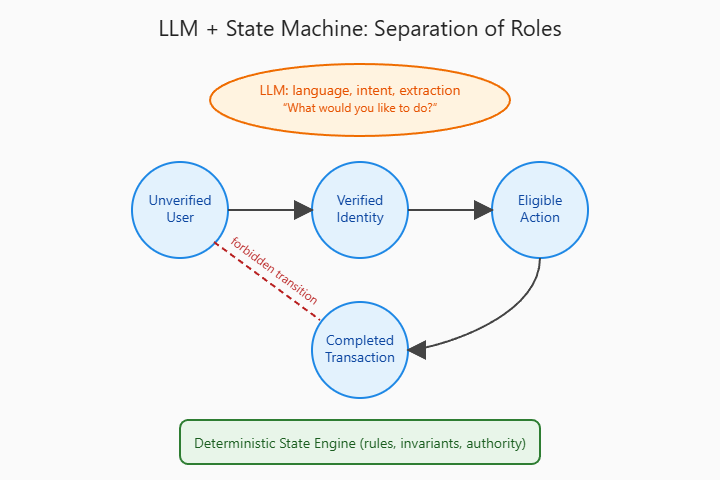
Diagram created by ChatGPT to illustrate a CX state machine
Take my case with Sirius XM. Current state: Customer with a radio and Internet subscription. Customer indicates intent to cancel radio. Permissible state changes: Customer cancels; customer downgrades to Internet-only subscription. This is where the LLM comes in: with proper scaffolding and a system prompt, it interrogates the customer. Do you have any favorite Sirius XM stations? Awesome. Are you planning on purchasing another XM radio (or a vehicle equipped with one)? No, fair enough. Would you like a trial subscription to keep listening via the Internet-only service? Great. State change initiated… And that’s when, for instance, a human supervisor comes in, to approve the request after glancing at the chat transcript.
The important thing is, the language mode does not decide what the next state is. It has no direct authority over the state of the customer’s account. What it can do, the only thing it can do at this point, is initiating a valid state transition.
The hard part when it comes to designing such a CX solution is mapping the states adequately, and making sure that the AI has the right instructions. Here is what is NOT needed:
In fact, a modest locally run model like Gemma-12B would be quite capable of performing the chat function. So there’s no need even to worry about leaking confidential customer information to the cloud.
Bottom line: use language models for what they do best, associative reasoning. Do not try to use a system with no internal state and no modeling capability as a reasoning engine. That’s like, if I may offer a crude but (I hope) not stupid analogy, it’s like building a world-class submarine and then, realizing that it is not capable of flying, nailing some makeshift wooden wings onto its body.
I almost feel tempted to create a mock CX Web site to demonstrate all this in practice. Then again, I realize that my chess implementation already does much of the same: the AI agent supplies a narrative and a proposed state transition, but the state (the chessboard) is maintained, its consistence is ensured, by conventional software scaffolding.
Good-bye, 2022 Accord. Hardly knew ya.
Really, our Accord had ridiculously low mileage. We weren’t driving much even before COVID but since then? I’ve not been to NYC since 2016, or to the Perimeter Institute since, what, 2018 I think. In fact in the past 5 years, the farthest I’ve been from Ottawa was Montreal, maybe twice.
Needless to say, when our dealer saw a car with such low mileage, they pounced. Offered a new lease. I told them, sure, but I’m downsizing: no need for an Accord when we use the car this little, a Civic will do just fine. And a Civic it is.

Things missing? Very few. In no particular order:
This is it. Really. That’s all. (I thought it also lacked blindspot warning, but I was mistaken.) And it’s a car just as decent and capable as the Accord, but substantially cheaper. So… who am I to complain?
So here we go, nice little Civic, until this lease expires. (No, I am not buying cars anymore. They are loaded with things that, when they go bad, are very costly to repair or replace. The technical debt is substantial.)
Almost forgot this rather important bit:

Yes. Made in Canada. These days, sadly, it matters.
Just completed the release of Maxima 5.49.
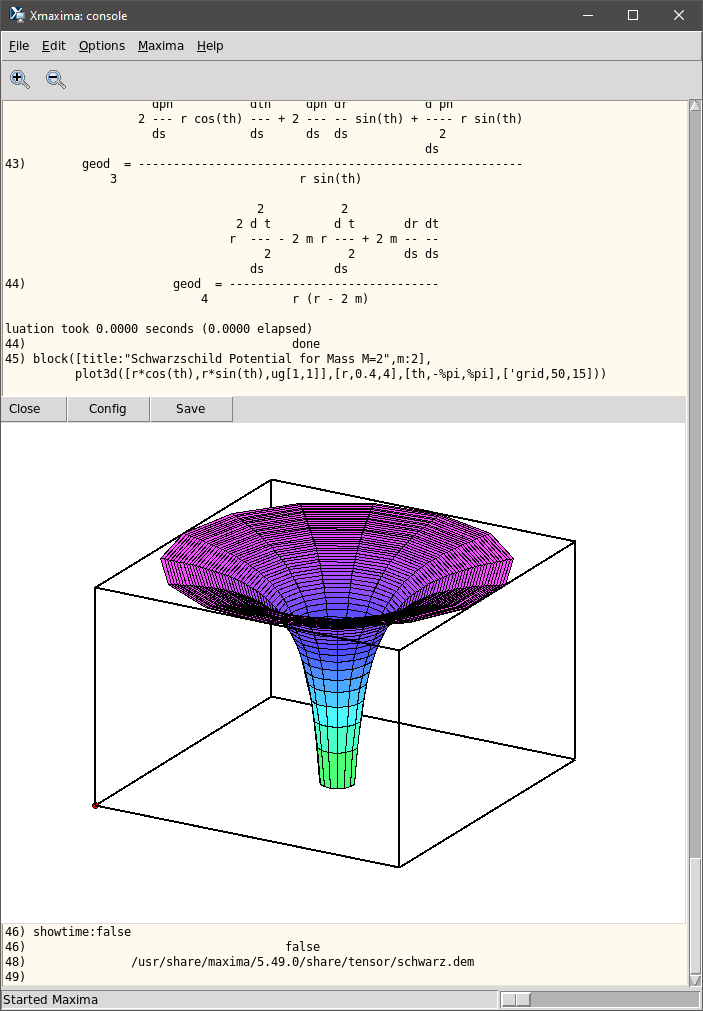
I hope I did not mess anything up. Building and releasing a new version is always a bit stressful.
It happened in 1959, at the height of the Cold War, during the early years of the Space Race between the United States of America and the Soviet Union.
An accident in rural Oklahoma, near the town of Winganon.

Rex Brown/CC BY-ND 2.0
But… don’t be fooled by appearances. This thing is not what it looks like.
That is to say, it is not a discarded space capsule, some early NASA relic.
What is it, then? Why, it is the container of a cement mixer that had an accident at this spot. Cement, of course, has the nasty tendency to solidify rapidly if it is not mixed, and we quickly end up with a block that weighs several tons and… well, it’s completely useless.
There were, I understand, plans to bury the thing but it never happened.
But then, in 2011, local artists had an idea and transformed the thing into something else. Painting it with a NASA logo, an American flag, and adding decorations, they made it appear like a discarded space capsule.
And I already know that if it ever happens again that I take another cross-country drive in America to visit the West Coast, and my route goes anywhere near the place, I will absolutely, definitely, visit it. Just as I visited the TARDIS of Doctor Who 12 years ago when I was spending a few lovely days in the fine city of London.