Jun 272026
 

During a recent conversation, ChatGPT reminded me of a horrific scene from a 1975 novel, The Prometheus Crisis by Scortia and Robinson. The story is about a fictitious nuclear power plant disaster in California. At one point in the story, there are some operators stuck in a control room, the connecting corridors already flooded with highly radioactive, superheated steam. The room itself is becoming hotter by the minute. They are reminded of the emergency decontamination shower next to the control room. It works! Lukewarm water comes, still a relief in a room that was already reaching unsurvivable temperatures. Their bodies cool down a little… then suddenly, the stream changes from lukewarm water to live steam. Ouch.

Written a decade before Chernobyl, The Prometheus Crisis is remarkably prescient. No, not the specific details, but the overall skeleton: the events leading up to the disaster, political myopia, the initial instict focusing not on disaster relief but public relations and messaging. Replace some technical details, replace names, replace American politics with contemporary Soviet political machinations and the rest would survive almost verbatim.

There have been a few cautionary tales in the history of science fiction like this: tales that, though profoundly dated when it comes to details, somehow do not age nonetheless, because the underlying message remains as valid as ever. To name a few: How about The Adolescence of P‑1 (Ryan, 1977), about an emergent machine intelligence in the “cloud”? Never mind that the “cloud” back then was a painfully slow X.25 network connecting IBM mainframes: swap out those details and the story might as well have been written yesterday. Or how about that science-fiction classic from 1952, The Space Merchants by Pohl and Kornbluth? Swap out Madison Avenue in favor of Silicon Valley, replace advertising with social media, change a few other details and presto: you have a story that could almost serve a documentary of our current times.

And then there is the cautionary tale that probably trumps them all: Paris in the Twentieth Century by Jules Verne. Deemed unpublishable back in 1860 due to its gloomy atmosphere, the manuscript was rediscovered well over a century later (first published in 1994). That it describes anticipated technological innovations like computers or fax machines — not to mention an electrically amplified concert held in a mass stadium! — using Victorian-era steampunk is irrelevant. What matters is the society it depicts. Peaceful, technically competent, fast-paced, yet in many ways alienating and less human. Suffocating to the story’s main protagonist, a struggling poet who seeks beauty, not profit.

The business case for beauty — Illustration by ChatGPT

And it was in this context that ChatGPT came up with a question so profound, so relevant, it prompted me to write this post: “What is the business case for beauty?”
 Posted by at 8:50 pm
Jun 182026
 

The more things change, the more they stay the same.

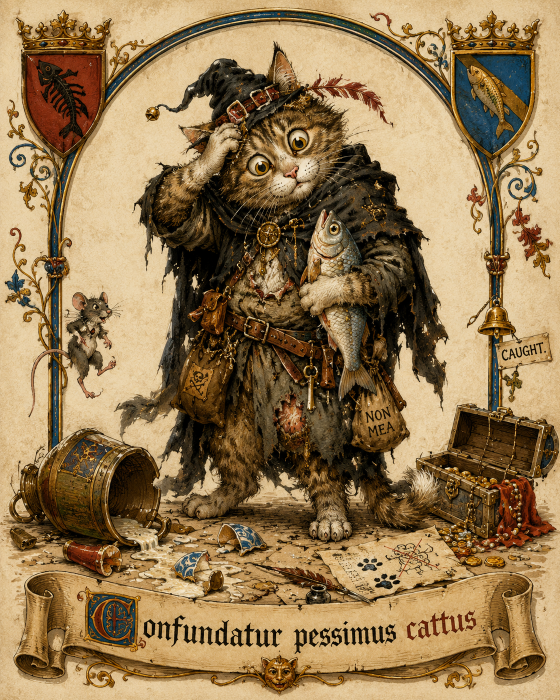
The medieval Latin words I used as the title of this post were written down by a scribe in Cologne, Germany, around 1420 AD after a cat peed on a page. The full text warns others not to leave books open in places where cats can come:

Hic non defectus est, sed cattus minxit desuper nocte quadam. Confundatur pessimus cattus qui minxit super librum istum in nocte Daventrie, et consimiliter omnes alii propter illum. Et cavendum valde ne permittantur libri aperti per noctem ubi cattie venire possunt.

Google translates it differently but I prefer my version: Confound that pesty cat. And, I am sure, it’s a curse that is still heard often, except that what is left open may not be a hand-crafted tome but, perhaps, the ruined keyboard of a laptop computer.

Though I never actually had a laptop ruined, I did have my own adventures with cats doing what cats do, to things they were not supposed to touch. A cat, after all, is the only cat who knows how to cat.

Illustration is by ChatGPT, not the poor Deventer scribe.

 Posted by at 12:54 am
Jun 102026
 

Yesterday, I sent the following e-mail to our MP, the minister responsible, and the Prime Minister, about the planned social media ban for those under 16:

­
From: “Viktor T. Toth”
Subject: Concerning the proposed under-16 social media ban
To: mona.fortier@…
Cc: Marc.Miller@…, mark.carney@…

Dear Ms. Fortier, dear Minister Miller, dear Prime Minister:

I am reading with alarm the Globe and Mail headline that Canada is planning a social media ban for those under 16.

I am alarmed not because the harms are not real but because I consider such a ban likely to be a) ineffective, b) counterproductive, and c) overreaching.

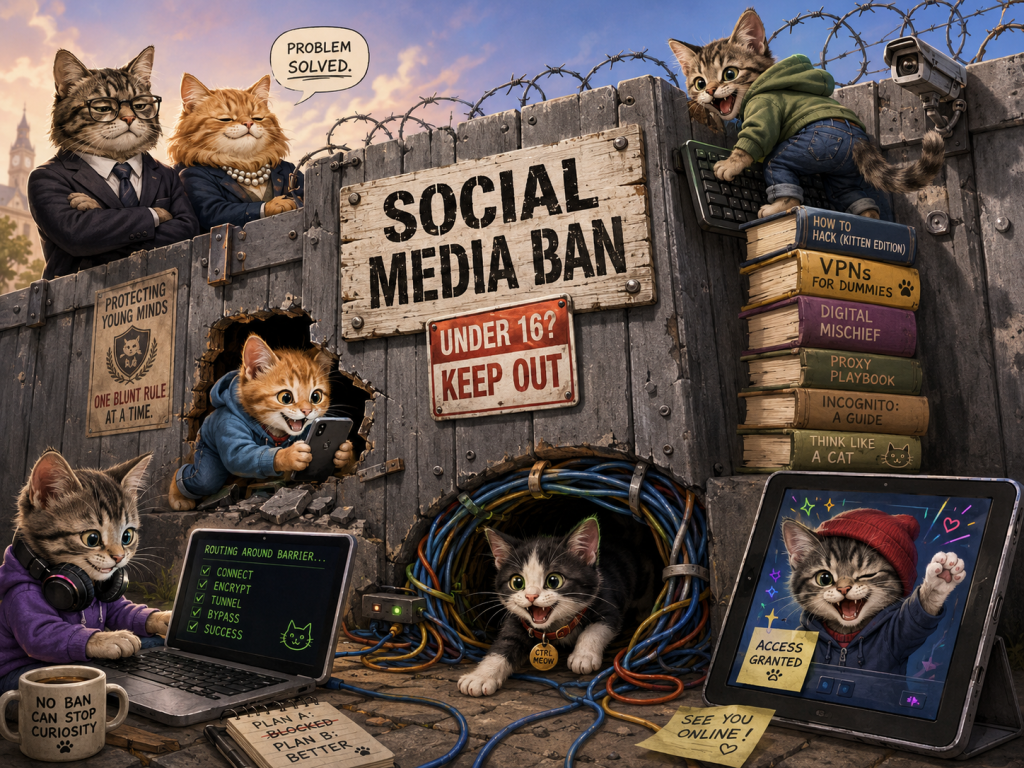
It will be ineffective because a precocious 12-year old will know how to circumvent it. I was such a 12-year old myself back decades ago, and let me tell you, if my 12-year old self was here today, he’d laugh at the ban no matter how it is implemented. Indeed I recall the ease with which I bypassed far more stringent constraints during my last business trip to China behind the Great Firewall: if a totalitarian police state cannot manage access restrictions that it considers essential for regime survival, what makes us think we can effectively age-restrict social media in a liberal democracy?

It will be counterproductive as it may force many teens to the “gray Internet” or overseas Web sites or services, far less regulated, far less visible, far less likely to cooperate than Instagram or TikTok. Meanwhile, the targets of the ban — teens — will learn that the world of adults creates nonsensical regulations that are ineffective, offensive, easy to bypass, and thus grow up into adults with less respect for the rule of law. An attempt to ban a class of applications thus risks creating a culture and infrastructure of circumvention.

And it is overreaching as it will require all of us — not just teens — to present more personally identifiable information to commercial service providers, many of which are not Canadian and do not store such information on Canadian soil, with all the implications on personal privacy and security against identity hijacking.

I sincerely hope that voicing these concerns does not fall on deaf ears and that perhaps our government will consider them before hastily enacting something that might seem popular at first but will likely do more harm than good.

­
Sincerely,
­
V. Toth
IT professional
Ottawa ON  K1N 9H5
­

My views on the subject were captured perfectly by ChatGPT’s whimsical illustration.

Yup. That easy. I can only imagine my 12-year old self, living today in 2026… it would not have been an obstacle. I mean it. And my skills would have made me popular with the girls, too!

 Posted by at 12:58 pm