This is supposed to be fiction: The US annexing Canada in 2072, the Fallout fictional universe.
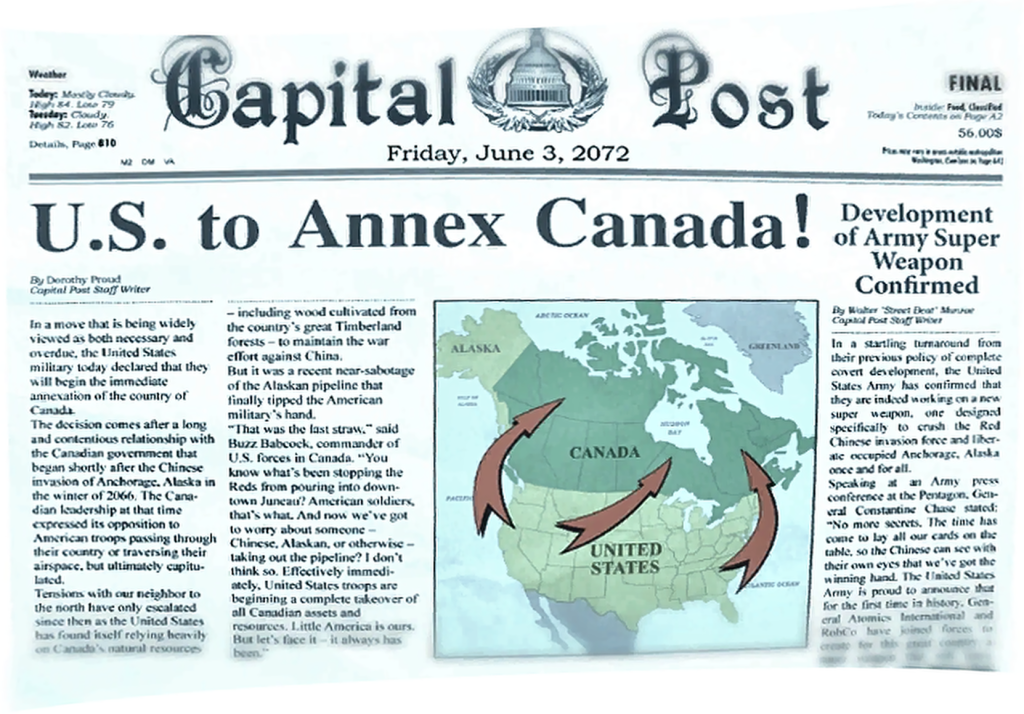
But it is 2026 and instead, we have this:
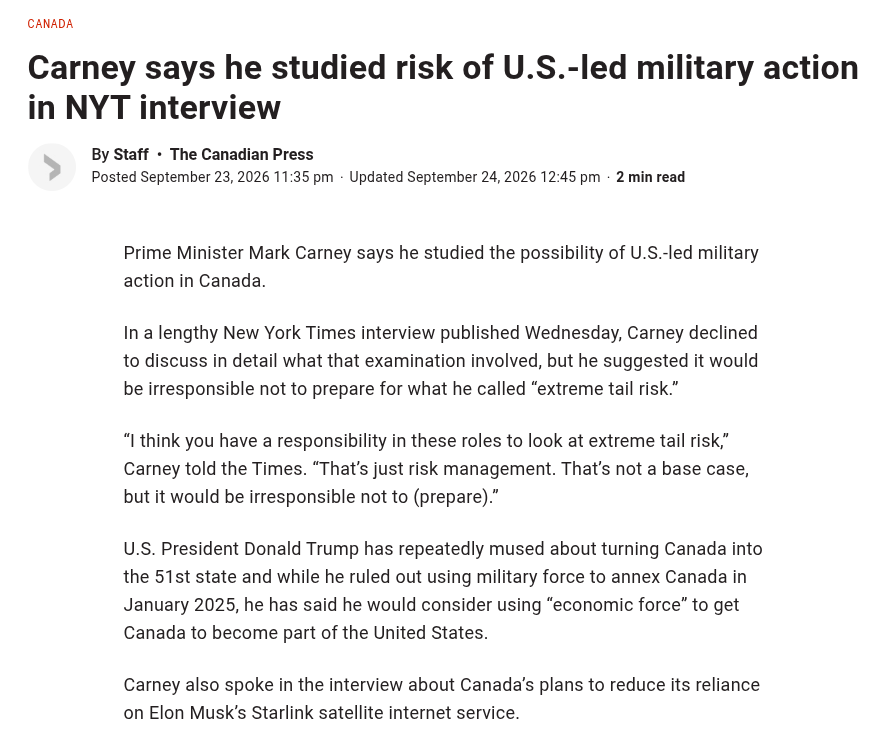
These are the times we live in.
Fox News explains that Carney ran, and won, as the “anti-Trump” candidate. Well, my American friends, let me assure you, Canadian domestic politics is certainly influenced, but not dominated by the presence of His Orange Highness. And Carney is not a partisan clown like many American politicians, but a superbly experienced central banker who not only led Canada’s central bank through the 2008 financial crisis, but was then invited to lead the Bank of England — a foreigner for the first time ever in that venerable institution’s 300+ year history — and led them through Brexit. In short, I think you confuse “pro-Canada” (as in telling you to “fuck off” when your “stable genius” blabbers about the “51st state”) with anti-Trump hostility. We are not hostile. We are disappointed and sad.
We have saying, literally “From Mud to Princehood” – that’s general feeling when I see Mr.Trump trumpeting. Like some movie about village idiot getting by chance into a palace struggling to learn how to behave…
And I say what – when he is confronted by Mr.Carney, this feeling is emphasized tenfold. It was not so strong at first, when, seemingly, Mr.Carney was still assessing the situation being recently elected – but now it is striking.
He – and by interpolation the country he represents, Canada – look so noble, so full-of-confidence. I don’t know whether these are manners picked up in England, or more probably something inherited, learnt in very childhood – not important perhaps. Just that feeling that very proper person was picked to this position in a whimsical and tough historical moment. And judging by the media pages (CNN again and others) it is not my personal feeling.
Canadians just should be careful that Americans won’t kidnap Mr.Carney in a desperate and envious attempt to secure better leader at last, even though a foreigner (as in some very old joke).
Carney is indeed extraordinarily well-qualified. But there’s also something deeper at work here: and yes, it’s the Westminster tradition. We may think of a constitutional monarchy as an archaic institution but it really isn’t. Think of the Crown not in terms of the person who presently wears the funny clothes but as an institution that is nominally eternal and entirely apolitical: it owes no allegience to any political party or movement. All Canadian politicians serve the Crown, including both the Prime Minister and the “Leader of His Majesty’s Loyal Opposition”. Emphasis on loyal.
The most interesting part is that the Crown normally has no real powers whatsoever: if King Charles III came to Ottawa today demanding that we rename the National Arts Centre after him or that we build a triumphal arch in the middle of the city, he’d be laughed out of the room. But the Crown’s latent powers are fundamentally unconstrained. An interesting historical example is Italy in 1943: Granted, it took them 20 years but when finally, the fascist regime found itself in a crisis and had enough of Il Duce, there was no need for a coup or a revolution: He was lawfully removed from office and arrested by Victor Emmanuel III.
A less dramatic, more recent example was when Stephen Harper’s government here in Ottawa decided to prorogue Parliament rather than face a no-confidence vote back in 2008. A PM does not have the power to prorogue parliament. The Crown does, in this case represented by the governor general. Harper reportedly spent a fair amount of time in the waiting room while the Governor General consulted with constitutional experts: eventually Harper’s request was granted but it was made clear that the Governor General’s reserve powers included the option of denying the request, which would have brought down the government.
Think of these reserve powers as emergency brakes when democratic institutions themselves fail. It is these institutions that are absent in presidential republics, where the president is both head of state and head of government, and answers to no one.