May 152015
 

Whenever I travel, I think a lot about Internet security. For purely selfish reasons: I do not wish to become a victim of cybercrime or unnecessarily expose my own systems to attacks.

The easiest way to achieve end-to-end encryption is through a virtual private network (VPN). Whenever possible, I connect to my own router’s VPN service here in Ottawa before doing anything else on the Interwebs. The connection from my router to the final destination is still subject to intercept, but at least my connection from whatever foreign country I am in to my own network is secure.

A VPN has numerous other advantages, not the least of which is the fact that to the outside world, I appear to have an Ottawa-based IP address; this allows me, for instance, to use my Netflix subscription even in countries where Netflix is not normally available.

The downside of the VPN is that I am limited by the outgoing bandwidth of my own connections. But in practice, this does not appear to be a serious limitation. (I was able to watch Breaking Bad episodes just fine while in Abu Dhabi.)

Unfortunately, a VPN is not always possible, as some providers, for reasons known only to them, block VPNs. (I can think of a few workarounds, but I have not yet implemented any of them.) Even in this case, I remain at least partially protected. I have set up my mail server such that both incoming (IMAP) and outgoing (SMTP) connections are fully encrypted. This way, not only are my messages secure, but (and this was my main concern) I also avoid leaking sensitive password information to an eavesdropper.

When it comes to Web sites, I use secure (HTTPS) connections whenever possible, even for “mundane” stuff like innocent Google searches. I also use SSH if necessary, to connect to my servers. These days, SSH is an absolute must; the use of Telnet is just an invitation for disaster.

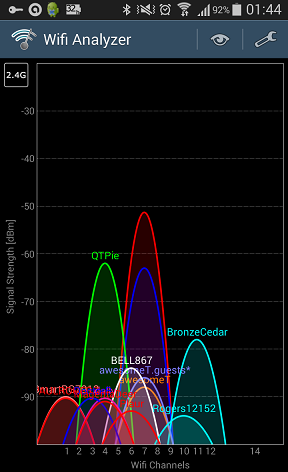
But of course the biggest security risk while one is on the road is the use of a public Wi-Fi network anywhere. Connecting to an HTTP (not HTTPS) server through a public Wi-Fi network and logging in with your password may not be the exact equivalent of telegraphing your password to the whole wide world, but it comes pretty darn close. Tools that can be used to scan for Wi-Fi networks and analyze the data are readily available not just for laptops but even for smartphones.

Once an open Wi-Fi network is identified, “sniffing” all packets becomes a trivial exercise, with downloadable tools that are readily available. Which is why it is incomprehensible to me why, in this day and age, most providers (e.g., hotels, airports) that actually do require users to log in use an unsecure network and just intercept the user’s first Web query to present a login page instead, when the technology to provide a properly secured Wi-Fi network has long been available.

In the future, no doubt I’ll have to take even stronger measures to maintain data security. For instance, the simple PPTP VPN technology in my router has known vulnerabilities. Today, it may take several hours on a dedicated high-end workstation to crack its encryption keys; the same task may be accomplished in minutes or less on tomorrow’s smartphones.

So there really are two lessons here: First, any security is bettern than no security, as it makes it that much harder for an attacker to do harm, and most attackers will just move on to find lower hanging fruit. Second, no measure should give you a false sense of security: by implementing reasonable security measures, you are raising the bar higher, but it will never defeat a determined attacker.

 Posted by at 2:46 pm
May 142015
 

I have been neglecting my blog in the past two weeks, but I had a good reason: I was traveling again.

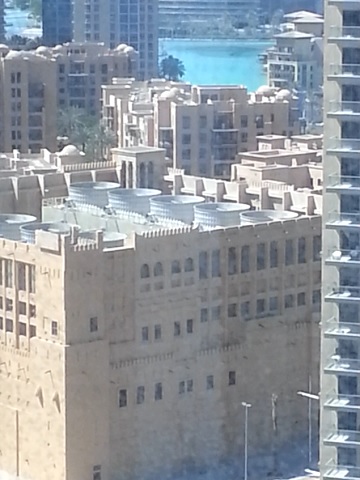
I was once again in Dubai, where I spent some time on the 14th floor of an office building. From that building, I noticed another, very strange edifice with barely a window on its first few floors, and some absolutely giant fans on its roof. I was wondering what it was: a telephone exchange? A data center? No… a central air conditioning plant for a city block. Wow.

Later that evening, we walked to a restaurant in downtown Dubai, and I had a chance to stare at one of the city’s newest attractions (I don’t know how long it has been around, I only just noticed it now), a red streetcar. Lovely.

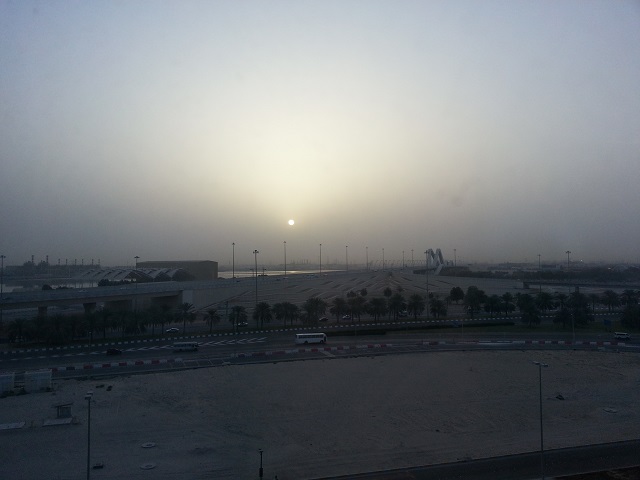
I only spent a day in Dubai before heading off to Abu Dhabi in a rental car. Rather than purchasing a new GPS (or an expensive map for my old Garmin) I decided to rely on Google Maps on my phone. Not that I really needed to; once I found my way out of Dubai, I was quite familiar with the route and the location of my Abu Dhabi hotel. Indeed, I found the hotel without difficulty, and early next morning, I found myself staring at a surprisingly faint desert sunrise, the Sun obscured by sand and fog:

I spent four days in Abu Dhabi, working hard. Having my own transportation really made things easier, not just to commute back and forth between my hotel and my client’s office, but also to do mundane things like going to a supermarket for some fresh fruit or a bottle of Coke purchased at a tiny fraction of the hotel price.

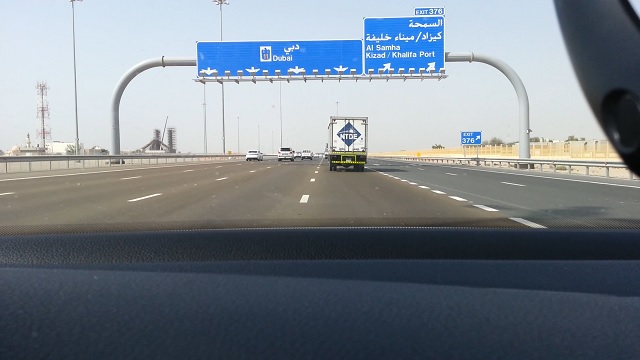
Four days fly by like nothing, and all too soon, I found myself on the highway again, heading back to Dubai. This time around, I used my phone not just for navigation but also as a dash cam:

This turned out to be a big mistake. Barely more than ten miles from my hotel, just as I was entering the thickest parts of the freeway spaghetti in Dubai, my phone went dark. I couldn’t for the life of me figure out why a phone’s battery gets depleted when the phone was plugged in just fine. (I solved the mystery today through some experimentation: the use of two applications, but especially the continuous HD video recording overheated the phone, and it stopped charging the battery as a precaution.) Anyhow, I was left to my own devices, so it was with no small amount of pride when, maybe 20 minutes later, I got out of the rental car in front of my hotel, having found the place from memory, driving through downtown Dubai like a native.

The same evening, I took the rental car back to the Dubai Mall, once again navigating flawlessly to the right parking lot, finding the rental agency’s kiosk, and completing the return of the vehicle exactly as planned, nailing the timing spot on for my next meeting.

The next evening, I once again went to the Dubai Mall, but this time on foot. The hotel is about a mile from the Mall. Normally, walking a mile is no big deal, but try doing it in 36°C weather! I felt very brave. Not only did I walk to the Mall, I also walked back from the Mall, after I did some shopping (some gifts and once again, some groceries). On the way back, I paused for a moment, looking at (and listening to) the cacophony of non-stop large scale construction right across the Mall:

I spent two more days in Dubai, again very busy. On Sunday, I checked out of my hotel, heading to that same 14th floor office again… and en route, I got wet. There was rain! Not a lot of rain to be sure but still, any rain is a delightful experience when you are in one of the driest places of the entire planet.

Finally, Sunday evening arrived and once again I was heading back to Dubai airport. Heading home.

Halfway through the flight, I looked out my window and saw a half moon over a deep blue sky. It was beautiful.

And then, after a grueling 14.5 hour nonstop flight, I was at Washington’s Dulles airport again, going through a surprisingly quick, efficient, and painless border and customs inspection (the concept of international transit does not exist at North American airports.) As I was walking towards my Ottawa departure gate, I encountered a delightful little facility:

Yes, a rest room for canines! As the door was open, I was even able to take a peek, although for some reason, my phone camera was badly out of focus:

Even in this blurry picture though, perhaps it is clear that the room contains a piece of a fence, some fake grass, and a plastic fire hydrant replica, offering maximum comfort for canine companions. It really gave me a good laugh!

And then, after a brief delay (our aircraft was late inbound), I was flying again. Less than 90 minutes later, I was at Ottawa airport, and soon in a taxi, heading home.

And I am still playing catch-up. So many little things pile up in two weeks!

 Posted by at 9:57 pm
Apr 302015
 

OK, I have had some sad good-byes in my blog this month, so here is a bittersweet one.

Earlier this afternoon, NASA’s Messenger probe, the first planetary probe to orbit Mercury, crashed into Mercury’s surface.

Although this means the end of Messenger, it also means that this particular probe fulfilled all expectations and then some: it worked flawlessly until it ran out of fuel and could no longer maintain a stable orbit around Mercury. The information it provided about the Solar System’s innermost planet will no doubt be studied for many years to come.

Good-bye, Messenger, and thanks for all the good work.

 Posted by at 4:50 pm
Apr 302015
 

Yesterday afternoon, my wife and I took a pleasant stroll downtown, visiting the National Gallery. We were specifically interested in their M. C. Escher exhibition, which is set to close in a few days. It was fascinating, though smaller in size than we expected.

Although I am reasonably well acquainted with the works of Escher, there were some prints that I have never seen before. For instance, this street scene from Abruzzi, Italy, which may well be part of the reason why Escher became fascinated with complex systems of seemingly impossible stairs.

Then there was this amusing National Film Board of Canada animation, from 1998, of Escher’s Sky and Water I. My only concern was for the poor museum security guard standing next to it, who had to listen to its soundtrack, endlessly repeated, throughout the day. (But then, he assured me that he is only there for two-hour shifts.)

Did I mention that the exhibition was smaller than we expected? It was housed in a section that also had some fascinating photographs. One of them was of a strange shape, a blistering ball on top of a stick of sorts:

Edgerton-1952

Except that it wasn’t a stick. It was a steel tower, maybe twenty stories high. And the blistering ball was an atomic explosion in the first one 100,000,000th of a second, one of a series of photographs created by Harold Edgerton with his Rapatronic camera in 1952.

Look at the guy wires. They are still taut. But their top sections are already obliterated by the explosion. The only reason they are still taut is that they never had time to relax, nor would they ever: the atomic fireball expands much faster.

I don’t know, to me this is one of the scariest images ever produced by a camera.

 Posted by at 9:39 am
Apr 272015
 

I am listening again to this amazing recording of Gustavo Dudamel and the Simón Bolívar Symphony Orchestra performing Danzón No. 2, by Mexican composer Arturo Márquez.

I enjoy this performance so much, I get goosebumps.

 Posted by at 10:57 am
Apr 222015
 

Alas, Poppy, the 20th century cat, is dead.

We just learned that this beautiful little cat, who stayed with us for a few weeks several times in the past 15 years when her owner was out of town, is gone. She was not young; her exact age was unknown, but she was at least a couple of years old when she was adopted back in 2001. So she was definitely a 20th century cat. While some cats do live 20 years (in rare cases, even 30 years) or more, the average age of a house cat is more like 15 years or so, therefore it is not surprising that it was Poppy’s turn. But sad nonetheless.

Especially sad today, as I learned only a few hours ago that a beloved relative, aunt Éva, wife of my late uncle Jóska, passed away just yesterday, after a brief illness.

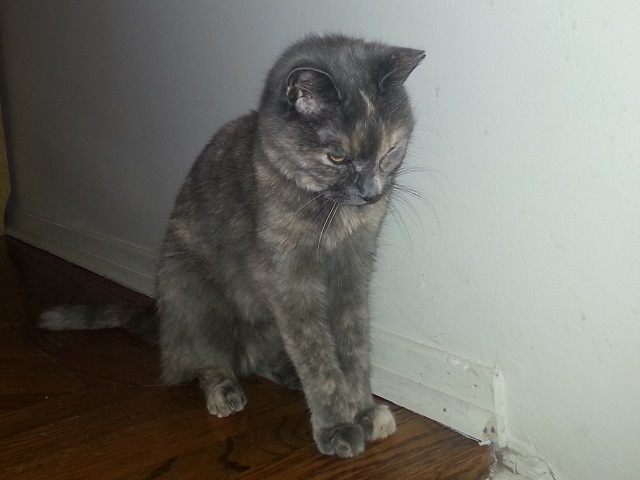
Here is the last picture of Poppy that I took, less than nine months ago when she was in our house for the very last time:

Poppy was one of the most beautiful cats I’ve ever known: tiny, with an asymmetric color pattern dividing her face. It always took a day or two for her to acclimatize (I learned always to release her upstairs, where she felt less trapped) but afterwards, she was friendly, gentle, and got along very well with our own cats, too.

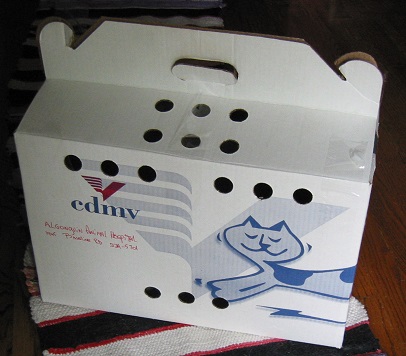
Poppy’s owner used to use a cardboard carrier to transport her. This is what the carrier looked like over 10 years ago:

IMG_0915

In the past ten years, I often repaired this carrier using packing tape and even duct tape. Somehow, it managed to hold together. We were wondering if the carrier would outlast the cat. Now we know.

 Posted by at 7:10 pm
Apr 222015
 

It looks like this is a depressing week of final good-byes in my blog.

I just learned that aunt Éva, wife of my late uncle Jóska, passed away after a brief illness. She was 72.

Aunt Éva was a very private person. I was sure that I had a picture of her somewhere, but I cannot find it anywhere. Perhaps it’s never been digitized? I don’t know.

I last met aunt Éva two years ago, when I was in Budapest for a family visit. We threw a little party at my Mom’s small apartment, and I was delighted when aunt Éva honored us by dropping by briefly. This was a big deal, as she usually avoided such events. I was very grateful that she made an exception to the rule on this one occasion.

I remember her very well, her black hair, her features, her voice. Along with my uncle Jóska, they always treated me like one of their own three children whenever we visited them. I miss both of them.

 Posted by at 6:54 pm
Apr 202015
 

I just learned the tragic news: Less than 24 hours after I uploaded my previous post about the one-time CBC radio program Disc Drive, the program’s former host, Jürgen Gothe, passed away, after a long battle with cancer.

I am deeply saddened. I secretly hoped that one of these days, we will hear him yet one more time on the radio. But that’s not going to happen… his wonderful voice has been silenced forever.

Jürgen was 71.

What a loss.

 Posted by at 3:42 pm
Apr 082015
 

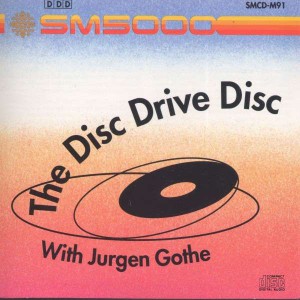
I am listening to The Disc Drive Disc.

The Disc Drive Disc is an audio CD. More specifically, it is an audio CD that was released by the CBC 24 years ago, shortly after the fifth anniversary of my all-time favorite radio program, Disc Drive.

Disc Drive went on for another 17 years or so, until it was unceremoniously dropped from the CBC’s schedule as Radio Two was revamped to cater to a broader audience. I am sure that executives at the CBC are still congratulating each other on such a resounding success, even as the station lost nearly 40% of its audience in the past eight years, in their desperate search for the lowest common denominator, an audience that views “classical” as just a minor, unpopular genre.

And most unfortunately, they lost host Jurgen Gothe and Disc Drive: a unique, eclectic program in which it was not uncommon to hear something from Mozart, followed by Ella Fitzgerald. As Jurgen himself put it on The Disc Drive Disc, this program was unique in the English-speaking (or anything-speaking) world. And Jurgen’s whimsical commentary! It was a joy to listen to his stories about music, food, Herbie the cat or the Willis Point Fire Department. I was looking forward every weekday afternoon to 3 PM, when I could turn on my radio and enjoy a productive few hours at my computer while listening to the program.

Alas, this wonderful, unique, joyful program was taken off the air in 2007. If only I had the presence of mind, I would have recorded as many shows as possible. I didn’t. I did record the very last Disc Drive, which was mainly a replay of the very first Disc Drive, but that’s it.

Except that back in 1991, the CBC did issue the aforementioned CD, The Disc Drive Disc. Of course it is not an easy disc to come by 24 years later. When I searched for it online, second-hand copies were offered for hundreds of dollars on Amazon or eBay. But then, I came across a German music store that claimed to have this CD, still available, for the not so princely sum of 9.99 euros.

I picked, I clicked, and a few weeks later, today that is, I found a nice cardboard envelope in the mail, with The Disc Drive Disc inside. So one very last time, I was able to enjoy something new (to me, that is) from Jurgen Gothe and his team (and cats) from subterranean Studio 20.

Thank you, Jurgen, for the memories.

 Posted by at 3:07 pm
Mar 312015
 

Last evening, I decided to update my rooted Samsung Galaxy S3 smartphone.

I did not expect to stay awake for much of the night, struggling to revive a “bricked” phone.

In the end, though, all is well: my phone is alive and once again, for the first time since the 4.3 update, it is both rooted and encrypted.

 Posted by at 5:18 pm
Mar 312015
 

Social networking sites know a lot about you, and LinkedIn is no exception.

The other day, I noticed a cute tool (for all I know, it was around for years; I don’t visit LinkedIn that often) that graphically summarizes my LinkedIn connections. Here it is:

I was a bit surprised by the number of connections I seem to have from the San Francisco Bay area. I am also wondering about the correct interpretation of the Seniority plot. If you have a lot of senior connections, is it because of your own seniority, or is it because these were all your would-be bosses, but you were never able to find a good position and form good relationships with co-workers?

Then again, as far as I can determine, others may not even be able to view this graphic. That is, unless you are silly enough to post it to your blog for the world to see! Oh… what?!

 Posted by at 5:06 pm
Mar 312015
 

There is this famous quote attributed to Winston Churchill: “You can always count on Americans to do the right thing – after they’ve tried everything else.”

I was reminded of this quote on Sunday, while I watched Fareed Zakaria on CNN discussing the situation in the Middle East.

However, I also feel compelled to add another sentence to the famous quote: “Meanwhile, you realize that they’ve known clearly what the right thing was all along.” Even George W. Bush, presumed to be intellectually challenged by his detractors.

After all, if George W. Bush of all people had such clarity concerning the Middle East, why is the United States of America still meddling and still supporting despotic regimes?

Along with, I am afraid to say, Canada. Our warmongering prime minister just managed to get authorization from Parliament to extend Canada’s anti-ISIS mission to Syria. But who exactly are we fight for there? Syria’s murderous secular dictator? Or Iran’s murderous Shiite proxies? And why is this Canada’s fight anyway?

 Posted by at 4:47 pm
Mar 282015
 

I was quite doubtful about the theory that Germanwings 9525 was brought down intentionally by its co-pilot. I was more inclined to bet on a health problem. Perhaps I could argue that in a sense, I was right: mental illness can be just as debilitating as any physical condition. And a person suffering from severe mental illness can be quite capable of doing unspeakable, irrational things, whether it is due to “voices”, an exaggerated sense of self, or whatever.

In response, airlines around the world are now instituting the “two person rule”, requiring two members of the crew to be present in the cockpit at all times. Like the reinforced cockpit door, I wonder if this recommendation is based on the best scientific analysis available, or if it is another example of knee-jerk “security theater”.

I am especially concerned because in response to a very low probability event (a pilot going berserk and locking the other pilot out), we introduce another possibility, the probability of which may in fact be higher: that a non-pilot member of the crew gains access to the cockpit with nefarious intent.

Arguably, this is replacing one black swan with another black swan but still… think of the reinforced cockpit door itself. It was supposed to prevent another 9/11-like scenario, however unlikely it is for one to occur again; instead, it introduced its own unique dangers, and now claimed 150 lives. Not only that, but I just found out that the door mechanism itself has been responsible for at least one unscheduled landing, when it began smoldering and the resulting smoke caused pilots to divert.

Wouldn’t it make more sense to listen to the professionals, say, at the American NTSB and ask for their informed analysis and opinion before introducing these regulations?

 Posted by at 11:44 am
Mar 272015
 

In an interview with Radio Free Europe, a former employee reveals what is a de facto Orwellian Ministry of Truth operated by Putin’s regime in Russia.

In St. Petersburg’s Internet Research center, professional Internet trolls are employed who post comments on various social media sites. The operation is sophisticated: employees play different roles, creating an impression of genuine debate in which, of course, the government line always prevails. Their activities sometimes become surreal, described as a parody of Orwell’s novel. But wait a cotton-picking minute… wasn’t it Orwell’s novel that was supposed to be the parody? What a strange world we live in.

 Posted by at 10:49 am
Mar 262015
 

One of my all-time favorite movies is the 2012 film Cloud Atlas. I love this film so much, I watched it at least 5-6 times already. Indeed, I went beyond merely watching it: for the first time, I actually contributed to IMDB, by describing some obscure goofs and anachronisms that I discovered in the film by accident.

I find it especially interesting how a high-budget movie can recreate a scene from the past. The movie features a storyline that takes place in 1973 San Francisco. However, it was not filmed in San Francisco, but rather, Glasgow, Scotland. Here is one example of a scene from the film vs. the actual street as seen on Google Street View (the overlap is not exact, but close enough I think):

Some of the changes were physical decorations no doubt; other changes were likely just clever use of CGI. Either way, I am impressed. Of course I loved the old cars, too.

I was somewhat less impressed by the fact that the film’s version of Van Ness Ave was a rather narrow, one-way street. That’s not the Van Ness Ave that I know! Nonetheless, it didn’t take anything away from the film, which for now, and for the foreseeable future, remains on the top of my list. Why? To quote a character from the film, it’s about “just trying to understand why we keep making the same mistakes… over and over.”

 Posted by at 7:53 pm
Mar 262015
 

It’s all over the news this morning: the young, inexperienced copilot (or maybe not that inexperienced: he was recognized by the FAA in September 2013) was in the cockpit, the pilot was locked out, and the copilot deliberately set up the plane for descent with the intent to commit mass murder-suicide.

However, I have lingering doubts. Specifically, I think it’s too early to discard concerns about the copilot’s health.

We learned that in the first 20 minutes, the conversation between the two pilots was cheerful, but during the last 10 minutes, as they reviewed the landing checklist, the copilot’s responses were “laconic”.

Could it not be that the copilot was experiencing a severe health problem, for instance, a stroke?

Nah, how could that be, he was only 28!

Except that I personally knew a 28-year old young man, an engineer in seemingly perfect health, no destructive habits, nice, intelligent, soft spoken, gentle: only to be found dead in his bedroom one day, after he suffered a fatal brain aneurysm.

Confusion caused by the onset of a stroke or aneurysm may also explain why the copilot may have entered incorrect information into the plane’s autopilot. It may also explain why he never said a word.

One thing it does not explain is why the pilot was unable to enter the cockpit using an emergency code. It is not clear to me what procedures were available to the pilot at this point, but if the copilot had to actively prevent the pilot from entering the cockpit, then obviously the suicide theory must prevail.

Regardless of the outcome, I also consider these 150 (or 149) innocent lives victims of post-9/11 hysteria. In our fear over the possibility that hijackers with the ability to pilot a plane might enter the cockpit, we made sure that it is impossible to enter to cockpit in a legitimate emergency… something that is far more likely to happen than another 9/11-style hijacking. Sadly, I fear that this is not the last time that people get killed as a consequence of our thoughtless, knee-jerk response to terrorism that is based on ignorance, not facts and scientific analysis.

 Posted by at 10:20 am
Mar 262015
 

Meet MJ, a neighborhood cat. (Before we learned his name, we called him Pajamas, because of the night attire like appearance of his coat.)

MJ is a famous cat; he even shows up, along with his buddy Misty, on a Google Street View frame.

We’ve known MJ for a decade. He’s a lovely cat. He also likes to explore the neighborhood… even though he lives on the other side of a wider neighborhood street, he regularly appears at our doorstep late evenings, saying hello, sometimes begging for some food.

We haven’t seen MJ since October. He always disappears for the winter months; our guess is that his owners keep him indoors, or perhaps he just doesn’t feel like roaming too far in the dark, icy cold of an Ottawa winter.

But this morning, walking by MJ’s house, I spotted him:

Yay! This is the surest sign yet that spring may happen this year, despite all the snow and ice that still surrounds us. I just hope I’ll soon spot Misty, too. I asked MJ about his buddy, but he wouldn’t say. Hope Misty is okay.

 Posted by at 9:38 am
Mar 252015
 

Curse my suspicious nature.

Here I am, reading a very nice letter from a volunteer who is asking me to share a link on my calculator museum Web site to cheer up some kids:

rachel1

And then, instead of doing as I was asked to do, I turned to Google. Somehow, this message just didn’t smell entirely kosher. The article to which I was supposed to link also appeared rather sterile, more like an uninspired homework assignment, with several factual errors. So I started searching. It didn’t take very long until I found this gem:

Then, searching some more, I came across this:

Or how about this one:

Looks like Ms. Martin has been a busy lady.

So no, I don’t think I’d be adding any links today.

 Posted by at 7:33 pm
Mar 252015
 

Epic tales tend to be one sided. Hobbits: good, orcs: evil. Rebel Alliance: good, Galactic Empire: evil. And so on.

Except that sometimes, we do get a glimpse of the story from the perspective of the other side.

The conversations between orcs that we witnessed in later chapters of the Lord of the Rings kind of humanized them: they were not necessarily nice guys, but they were, well, foot soldiers in an army like foot soldiers in any other army. Russian novelist Kirill Neskov must have been thinking the same thing when he wrote The Last Ringbearer, a novel in which we learn that Mordor is a peaceful country undergoing an industrial revolution, which is threatened by backward, war-mongering imperialists led by Gandalf, who is seeking “a final solution to the Mordorian problem”. Wow.

As for Star Wars, I always wondered: When the Death Star was destroyed, for instance, how many innocent people: children, civilian employees, family members, cooks, nurses, doctors, and so on, were destroyed along with the artifact? More than that, what if the canonical account is really a one-sided, distorted version of the real story, and the Rebel Alliance is just a bunch of terrorists while the Galactic Empire is really a peaceful, progressive civilization representing law and order?

Apparently, I am not the only one with these thoughts. Here is an amazing short animation of a battle between the Empire and the rebels… from the Imperial perspective:

What can I say? Let’s hope the good guys win… whoever they are.

 Posted by at 8:58 am