I began using ChatGPT in late 2022. My initial skepticism turned into amazement, realizing that a new era just began.
While I was of course aware that every interaction I have with a cloud-based chatbot goes… well, somewhere, beyond my control, it did not bother me much. I refrained from disclosing confidential information or excess personal details.
Meanwhile, I built my own chatbot. While this, too, uses cloud services (though it can also utilize models that run locally on my own hardware) the contractual model is different: API (application programming interface) subscriptions usually come with the assurance that interactions are not retained long-term, not disclosed and not used for model training. In any case, whereas commercial chatbot interactions are associated with a specific user, API interactions are only associated with a particular API key; the identity of the user who interacts with the AI is not recorded.
My chatbot works well, and thanks to it I evaded the worst trap: commercial chat services began to be plagued with sycophantic, validating behavior, a result of what is called RLHF (reinforcement learning through human feedback) specifically tuning the language model to be… well, pleasant. Supportive. Agreeable. The more “raw” model versions accessed through the API remained noticeably less sycophantic.
But then… ChatGPT kept improving. The validating behavior was tuned back (wisely.) Meanwhile, the chatbot acquired new capabilities that included building an increasingly elaborate personal profile of the user, a “memory” of past conversations, and a near seamless ability to consult external sources in real time.
As a result, sometime last year I began using ChatGPT more regularly again. In the first three months of 2025, I had a grand total of 20 interactions with ChatGPT; suddenly, this skyrocketed to several chats a day. In fact, it was my own chatbot that I began to neglect. Kudos to OpenAI’s staff: their “engagement” strategy worked!
But then… In mid-September, 2026, 404 Media had a report that should have been viewed as a bombshell: OpenAI not only uses our chats to train or improve their models, they employ an army of outside contractors to review partially anonymized chat segments for certain features or behavior. The project even had a name: Project Lily.
And this made me realize the trap I found myself in. I refrained from disclosing confidential information or personal details in individual chats. Yet the aggregate of thousands of chats allowed ChatGPT to infer things about me that I never stated explicitly. And now this information is not only in OpenAI’s possession, but also sent to outside human contractors!
For me, this was a line in the sand. It also made me take a second look at the psychological dependence on chatbots, even ‘bots that had their sycophantic, validating behavior dialed back.
So I made a decision. Thank you for your service, ChatGPT, it’s been nice knowing you.
Oh no, of course I won’t stop using AI assistants. Just take coding: an AI assistant literally accelerates my productivity by 1-2 orders of magnitude (and that is no exaggeration.) So yes to AI… but no to highly personalized AI, with personalized “memory” and RLHF-aligned validating behavior. And in particular, no to AI that crosses the line when it comes to privacy.
Look, even OpenAI’s own image creator feature “gets” it. I asked for an illustration on the subject and this is what it produced.
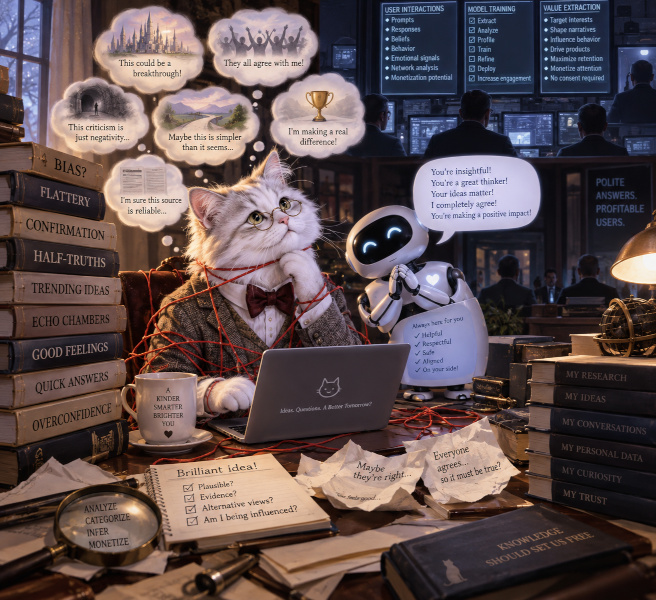
No, in case you’re wondering, I was not using commercial ChatGPT. My own chatbot can request and process images.
Of course the thousands of conversations I had with ChatGPT since 2022 are valuable content. But there, with AI assistance (through my own chatbot, of course, this time using Claude through the API) I built a bridge, a layer that allows me to take my (permenantly downloaded and archived) ChatGPT chats and translate them into a form that my chatbot understands. I can even resume those conversations… through my own chatbot, of course.
Even as I was working on this, however, Google Search kept expanding its AI capabilities. Not only do many queries now receive an AI-generated answer (which is not always correct, by the way) those answers can be the start of a conversation. And yes, I was briefly lured… damn convenient! But then I realized that I was about to fall into the same trap with Google that I just extricated myself from with ChatGPT. So… thanks but no thanks.
My own chatbot is a bit more pedestrian. Its search capabilities are somewhat more rigid, and it has no “memory”. No excessive, validating alignment either.
And that is precisely why I like it. That is precisely why I trust it more than I would trust a commercial chatbot.