I asked ChatGPT a hypothetical. Imagine, I told it, an alternate history in which Donald J. Trump time travels and wins the 1936 elections, defeating FDR.
ChatGPT’s answer is devastating.
1936 is almost the worst possible insertion point. Trump would inherit the United States just as the international system was beginning its terminal collapse, but before the consequences of appeasement had become undeniable. I can almost hear the press conferences:
- “Hitler? I know Hitler. Very strong leader. Germany was treated very unfairly at Versailles, everybody knows it. He says he wants peace. He likes me.”
- “Mussolini is doing some incredible things in Italy. The trains—you wouldn’t believe the trains.”
- “Japan? Look, China is very far away. Why are we spending all this money protecting China? Hirohito respects me very much.”
- “Britain and France have been taking advantage of us for years. They don’t pay. Why should American boys defend Czechoslovakia?”
1936 gives him years in which his instincts could actually alter the trajectory. The first disaster might be domestic. Roosevelt’s second term was when the United States continued the enormous, imperfect process of building federal administrative capacity and recovering from the Depression. Trump would arrive despising much of the professional state apparatus he needed to govern. He would also inherit a Congress overwhelmingly Democratic after the real 1936 landslide, so unless your “steals” includes congressional results as well, he’d face ferocious institutional resistance. That matters: President Trump could not simply turn 1936 America into Trumpistan by decree.
Foreign policy is where things become frightening. The United States was strongly isolationist already. Congress had enacted Neutrality Acts precisely to prevent another slide into a European war. Roosevelt, despite those constraints, gradually recognized what Hitler represented and painstakingly moved American opinion and policy toward supporting Britain and the other states resisting the Axis. A Trump presidency wouldn’t need to invent isolationism. He could amplify an enormous existing political constituency for it. And his characteristic conception of alliances would fit catastrophically well with the mood:
- Why should we care who controls the Sudetenland?
- Why should Americans pay for Britain’s empire?
- Germany is spending its own money on defense; maybe France should spend more.
- Hitler assures me he has no further territorial demands.
Then comes 1938. Munich is tailor-made for Trumpian personal diplomacy. I can imagine him inserting himself between Chamberlain and Hitler, emerging from some spectacular summit proclaiming that only he could make the deal, waving a document, and announcing that Hitler had personally promised him there would be no war. When Hitler occupied the rest of Czechoslovakia in March 1939:
“That’s not what he told me. I’m very disappointed in Adolf. But Czechoslovakia wasn’t exactly paying us anything either.”
The really consequential divergence comes after September 1939. Roosevelt couldn’t bring America directly into the European war, but his administration systematically shifted the material balance: cash-and-carry, destroyers-for-bases, Lend-Lease, Atlantic convoy activity, the arsenal-of-democracy mobilization. Those policies were extraordinarily important before Pearl Harbor ever happened. Trump could plausibly have opposed much of that. And therefore Britain might face 1940–41 without anything resembling Roosevelt’s escalating material commitment. Whether Britain actually capitulates is another matter—I would not assume it; British resources, the Empire, the Royal Navy, and Germany’s inability to conduct Sea Lion remain real. But the strategic situation becomes vastly worse.
Then there’s the Soviet Union. Imagine June 1941: “Hitler and Stalin? They’re both tough guys. Let them work it out.” No American Lend-Lease to the USSR, perhaps dramatically less aid to Britain, and no undeclared American naval war in the Atlantic.
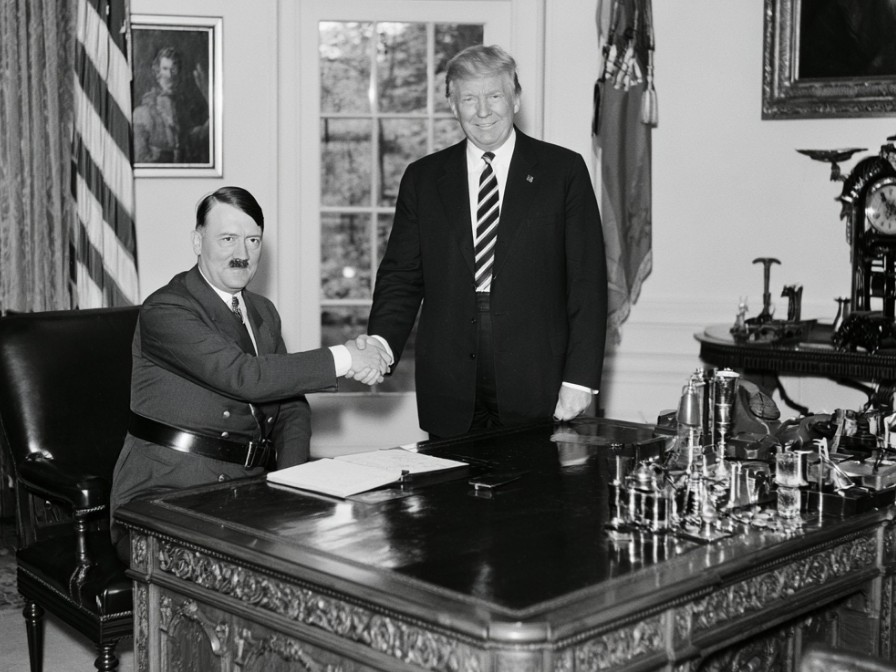
Image generated using MidJourney.
Then I reminded ChatGPT that absent Roosevelt’s policies towards Japan, chances are Japan would not have attacked Pearl Harbor.
Its reply:
Pearl Harbor was not some free-floating expression of Japanese hostility toward America. By 1941 Japan faced an increasingly severe American economic squeeze in response to its expansion in China and Indochina. After Japan moved into southern French Indochina in July 1941, Roosevelt froze Japanese assets; in practice this cut Japan off from American oil, on which it depended heavily. Tokyo then faced a rapidly tightening strategic deadline: either abandon major elements of its imperial policy or seize the resource-rich territories to the south before its oil stocks became inadequate.
That does not mean Roosevelt “forced” Japan to attack Pearl Harbor—the decision remained Japan’s, and its underlying problem arose from its own wars of conquest. The National Archives explicitly cautions against the old thesis that Roosevelt deliberately maneuvered Japan into attacking. But the sanctions were unquestionably an important causal link in the sequence that produced the Japanese decision for war.
Now insert Trump in January 1937. I have considerable difficulty imagining him pursuing Roosevelt’s policy toward Japan with anything remotely comparable to consistency. The political instinct we are seeing with Kim is almost the opposite: avoid costly confrontation, emphasize personal rapport with the authoritarian leader, characterize coercive measures as unnecessarily provocative, and regard distant allies and other peoples as having primarily transactional claims on the United States.
So after Japan’s atrocities and continuing war in China, alternate-President Trump might very plausibly say something like: “Look, China and Japan have been fighting for a very long time. It’s terrible, but it’s their problem. Japan buys a tremendous amount from us. Why would we destroy that relationship?”
Then Japan occupies northern Indochina: “They tell me it’s necessary for their security. Everybody has security concerns. France isn’t even really running the place anymore.”
Then southern Indochina: “The fake-news media says Japan is taking over Asia. Hirohito tells me he wants peace. I believe him.”
And there is no July 1941 asset freeze, no effective oil embargo, quite possibly no Hull Note demanding withdrawal from China and Indochina. At that point the logic behind striking Pearl Harbor largely evaporates. Japan’s preferred objective wasn’t Hawaii. Its strategic prize was the Southern Resource Area—especially the Dutch East Indies and its oil, along with Malaya’s rubber and tin. Pearl Harbor was attacked because the Japanese planners expected that moving south would bring them into conflict with the United States and that the U.S. Pacific Fleet could threaten the operation from Hawaii, while the American Philippines sat directly across Japan’s lines of advance. The attack was intended to disable that threat long enough for Japan to construct its defensive perimeter.
But under Trump, Tokyo might reasonably ask: Why attack the Americans at all? If Washington is continuing to sell you oil, isn’t seriously opposing your conquest of China, isn’t imposing crushing sanctions over Indochina, and its president keeps saying that America’s Asian commitments cost too much… the rational Japanese strategy becomes don’t wake him up. Take the Dutch East Indies. Take British Malaya. Perhaps attack the British Empire across Asia. Possibly even attack the Philippines eventually—but only if operationally necessary. Meanwhile cultivate Trump assiduously:
Trump: “The Emperor sent me a beautiful letter. Beautiful. He says Japan respects America tremendously.”
And Japanese diplomats would presumably become extraordinarily proficient at producing beautiful letters. That leads to an alternate 1941 far stranger than reality. Germany attacks the USSR in June. Japan continues its war in China and expands southward. Britain fights Germany, Italy, and perhaps Japan. The Soviet Union fights Germany.
America fights nobody.
And Roosevelt’s crucial prewar measures may also be missing: substantially less aid to Britain and China, perhaps no Lend-Lease on anything like its historical scale, less naval confrontation with German U-boats in the Atlantic, and possibly slower American rearmament. Historically, the United States was already far from a passive spectator by December 1941. There is then no Japanese attack available to solve the American political problem. And Hitler, whatever else one can say about him, would have had absolutely no incentive to declare war on an America whose president was busily keeping it neutral.
That could leave Trump campaigning in 1940 and perhaps 1944 as the president who “kept America out of the war.”
Which is where your joke stops being merely funny. Because from the perspective of an American voter in, say, Nebraska in 1942, Trump might even appear to have been vindicated. No Pearl Harbor. No American boys dying at Guadalcanal. No casualty telegrams from North Africa. Gasoline still available. American factories selling goods. Europe and Asia tearing themselves apart somewhere far away.
“They said my foreign policy would cause disaster. Wrong! America is at peace. Roosevelt wanted war. I kept us out.”
And meanwhile Nanjing has already happened, Auschwitz is operating, Einsatzgruppen are shooting entire communities in the East, Britain is fighting for survival, and the Wehrmacht is somewhere deep inside the Soviet Union. That’s a much nastier alternate history than my first version, because Trump doesn’t necessarily suffer some spectacular failure that awakens America. His policy might look successful to Americans for quite a long time.
But that means, I told ChatGPT, that we just established the perfect timeline for Hitler’s Zweites Buch, in which he foresees a coming conflict between the victorious Reich and America. Except that it would take place in the emerging era of thermonuclear weapons, with an adversary in the form of Germany, controlling much of Europe’s and some of Asia’s and North Africa’s resources.
The answer about imaginary Trump feels a bit too superficial, so I even started to suspect it was blatantly plagiarized from someone’s facebook post (probably numerous). I can’t find the exact source but internet has definitely quite a handful of similar “fan fictions” in forums etc. At the same time it never explores the situation in the world as whole, why so many countries gave rise to nationalist movements, e.g. going into particulars, is Hitler to be blamed for Croatians massacres of Serbs etc.
Perhaps some more subtle question will be a better probe. Let’s regard this old situation – USSR invaded Finland in the fall of 1939 and in a few months found itself forced to strike the peace agreement due to things went mighty wrong for Soviets. However some Finnish territory was ceded (particularly Karjala) and overall Finns felt it’s only delusive calm before real storm.
Finns sought some international support (wiki says, especially from Sweden and UK) – as generally Europe “sympathized” their cause during the conflict. However no one came to help and eventually they only found support from Germany, which led to Finns participation in WWII on their own specific accord, particularly closing the Siege of Leningrad, but never advancing or actively attacking from that side.
This setup could be used to probe ChatGPT into “less charted waters”. Would Trump side with USSR or Finland in the conflict (I imagine he’d say “Stalin is a strong leader and nice guy too”) or maintain “strict american isolationism” as it happened historically.
I sense no plagiarism here (and in any case, that’s not how large language models work.) But of course the topic is well explored in the counterfactual/alternate history literature. Look no further than Star Trek’s arguably best-ever episode, The City at the Edge of Forever.
As to Finland, I’d go further. A Japan not hindered by Roosevelt’s policies (and perhaps even helped by Trump in an alternate history timeline) may very well have been victorious in Khalkhin Gol, so the Winter War may never have happened in the first place, as Stalin’s regime would have faced a much deeper crisis in the Far East.