Yesterday, I sent the following e-mail to our MP, the minister responsible, and the Prime Minister, about the planned social media ban for those under 16:
From: “Viktor T. Toth”
Subject: Concerning the proposed under-16 social media ban
To: mona.fortier@…
Cc: Marc.Miller@…, mark.carney@…Dear Ms. Fortier, dear Minister Miller, dear Prime Minister:
I am reading with alarm the Globe and Mail headline that Canada is planning a social media ban for those under 16.
I am alarmed not because the harms are not real but because I consider such a ban likely to be a) ineffective, b) counterproductive, and c) overreaching.
It will be ineffective because a precocious 12-year old will know how to circumvent it. I was such a 12-year old myself back decades ago, and let me tell you, if my 12-year old self was here today, he’d laugh at the ban no matter how it is implemented. Indeed I recall the ease with which I bypassed far more stringent constraints during my last business trip to China behind the Great Firewall: if a totalitarian police state cannot manage access restrictions that it considers essential for regime survival, what makes us think we can effectively age-restrict social media in a liberal democracy?
It will be counterproductive as it may force many teens to the “gray Internet” or overseas Web sites or services, far less regulated, far less visible, far less likely to cooperate than Instagram or TikTok. Meanwhile, the targets of the ban — teens — will learn that the world of adults creates nonsensical regulations that are ineffective, offensive, easy to bypass, and thus grow up into adults with less respect for the rule of law. An attempt to ban a class of applications thus risks creating a culture and infrastructure of circumvention.
And it is overreaching as it will require all of us — not just teens — to present more personally identifiable information to commercial service providers, many of which are not Canadian and do not store such information on Canadian soil, with all the implications on personal privacy and security against identity hijacking.
I sincerely hope that voicing these concerns does not fall on deaf ears and that perhaps our government will consider them before hastily enacting something that might seem popular at first but will likely do more harm than good.
Sincerely,
V. Toth
IT professional
Ottawa ON K1N 9H5
My views on the subject were captured perfectly by ChatGPT’s whimsical illustration.
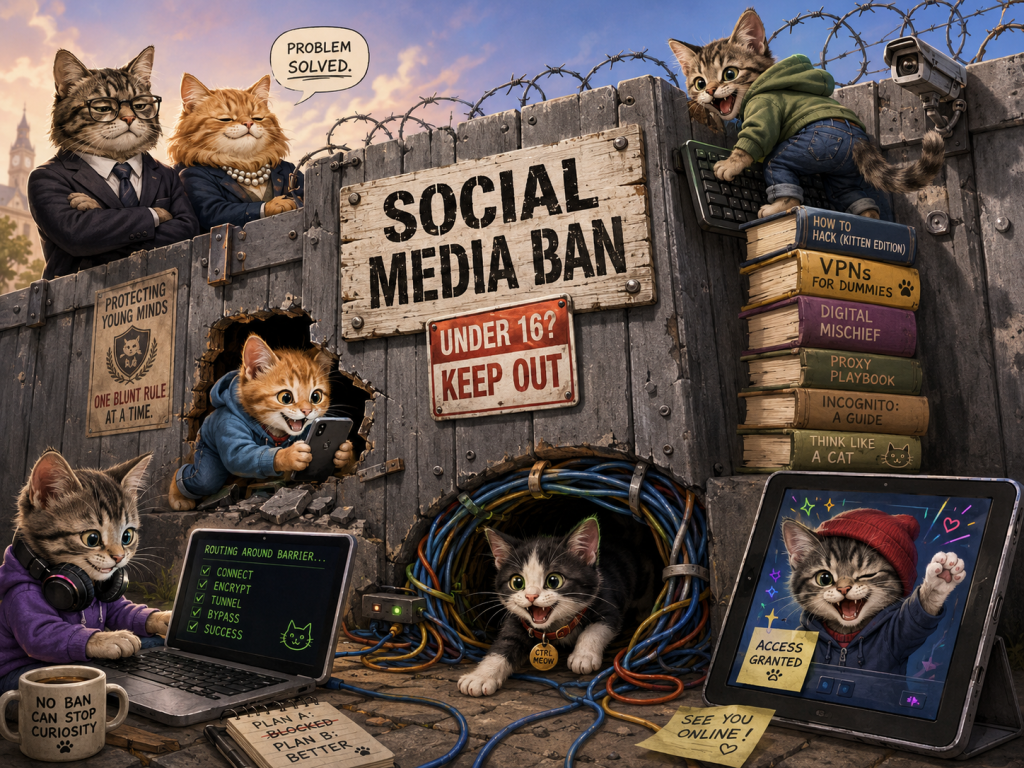
Yup. That easy. I can only imagine my 12-year old self, living today in 2026… it would not have been an obstacle. I mean it. And my skills would have made me popular with the girls, too!
I imagine mr Carney or some of the the recipient looking unto the heap of such messages from various individuals and thinking “why? is it spam?”
It would be curious to know if they (their assistants) react / respond. Though perhaps such things are normally promoted in a form of open letters via some newspapers, I don’t know.
I used Telegram to communicate with my pupils of this year (I don’t like telegram but it appeared quite popular among kids besides others) – and recently it was banned, well, physically. Access now requires tinkering with vpn, and of course there are some efforts to break vpn connections (on the providers’ hardware) etc. However when I manage to post some information there (e.g. term results) – I see that the post is visited by almost the same number of viewers as before banning. Obviously even kids use various paid and free tools to get over the restrictions.
Why politicians are so insistive (seemingly mindlessly) – sometimes I feel they do it not for the sake of “primary cause”, but for vague political reasons.
Probably the only viable idea is to create some appealing kids-targeted social network, carefully crafted for their needs and interests. Regretfully such idea requires much thought, compared to the “let’s ban” laws.