During a recent conversation, ChatGPT reminded me of a horrific scene from a 1975 novel, The Prometheus Crisis by Scortia and Robinson. The story is about a fictitious nuclear power plant disaster in California. At one point in the story, there are some operators stuck in a control room, the connecting corridors already flooded with highly radioactive, superheated steam. The room itself is becoming hotter by the minute. They are reminded of the emergency decontamination shower next to the control room. It works! Lukewarm water comes, still a relief in a room that was already reaching unsurvivable temperatures. Their bodies cool down a little… then suddenly, the stream changes from lukewarm water to live steam. Ouch.
Written a decade before Chernobyl, The Prometheus Crisis is remarkably prescient. No, not the specific details, but the overall skeleton: the events leading up to the disaster, political myopia, the initial instict focusing not on disaster relief but public relations and messaging. Replace some technical details, replace names, replace American politics with contemporary Soviet political machinations and the rest would survive almost verbatim.
There have been a few cautionary tales in the history of science fiction like this: tales that, though profoundly dated when it comes to details, somehow do not age nonetheless, because the underlying message remains as valid as ever. To name a few: How about The Adolescence of P‑1 (Ryan, 1977), about an emergent machine intelligence in the “cloud”? Never mind that the “cloud” back then was a painfully slow X.25 network connecting IBM mainframes: swap out those details and the story might as well have been written yesterday. Or how about that science-fiction classic from 1952, The Space Merchants by Pohl and Kornbluth? Swap out Madison Avenue in favor of Silicon Valley, replace advertising with social media, change a few other details and presto: you have a story that could almost serve a documentary of our current times.
And then there is the cautionary tale that probably trumps them all: Paris in the Twentieth Century by Jules Verne. Deemed unpublishable back in 1860 due to its gloomy atmosphere, the manuscript was rediscovered well over a century later (first published in 1994). That it describes anticipated technological innovations like computers or fax machines — not to mention an electrically amplified concert held in a mass stadium! — using Victorian-era steampunk is irrelevant. What matters is the society it depicts. Peaceful, technically competent, fast-paced, yet in many ways alienating and less human. Suffocating to the story’s main protagonist, a struggling poet who seeks beauty, not profit.
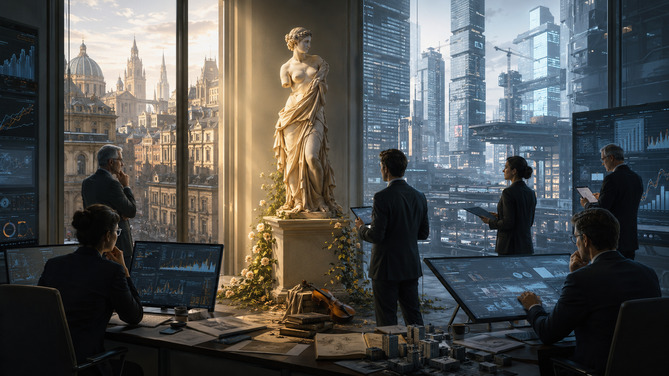
The business case for beauty — Illustration by ChatGPT
And it was in this context that ChatGPT came up with a question so profound, so relevant, it prompted me to write this post: “What is the business case for beauty?”
I dare say this article is poetic, impressive :)
As to the question – have I got it right that ChatGPT asked this question?
Why, beauty is exploited heavily in business as to my meek observations!
What does LLM say if in turn asked that same question?
Well, it was part of a longer conversation and it was clear that “beauty” in this context meant abstract beauty on its own right, as opposed to manufactured “beauty” as part of a marketing campaign.