My bet was on lightning, but perhaps I was wrong: it appears that there is good reason to believe that the in-flight breakup of Air France 447 was due to the pilots’ struggle to stay in control of an airplane with a faulty speed sensor.
23 years ago today, I left Hungary and registered as a political refugee in Austria. I started my new life with a suitcase full of clothes, and a little less than $1,000 in my pocket.
Yes, it was worth it.
According to Wikipedia, absolutely nothing else notable happened on this day in 1986.
Almost forgot. It was a Thursday.
I was channel-surfing for news this morning, and I caught a segment on CTV’s morning show about “dirty electricity”.
I shall refrain from calling the gentleman being interviewed using a variety of unflattering names, because it would not be polite, and in any case, it’s not the person but the message that I take issue with.
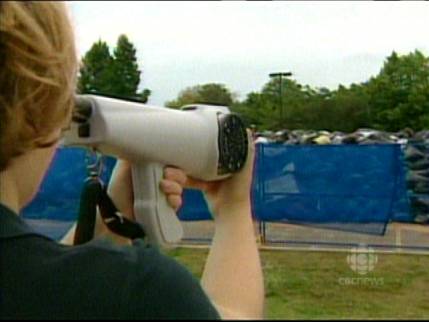
Basically, he put a bunch of electronic devices like cordless phones, baby monitors, Wi-Fi routers or even fluorescent light bulbs on a test bench, plugged them in, and then held a contraption with an antenna and a speaker close to them. The contraption was making loud noises, from which this gentleman concluded that these devices “emit radiation”, and “send dirty electricity back through the wires”.
So then… what? The whole Universe is emitting similar radiation at radio frequencies. Any warm object, including the walls of your house, emits radiation at such frequencies and higher. And why should I care?
Of course, it helps dropping a few scary phrases like, “skyrocketing rates of autism”. Oh, he wasn’t saying that they are related. Why should he? Merely mentioning autism while he’s talking about “dirty electricity” is enough to suggest a connection.
Just to be clear about it, almost all electronic devices emit radio frequency radiation that can then be picked up by a suitable receiver and converted into loud and scary noise. When I was 10 or so and got my first pocket calculator, I had endless fun holding it close to an AM receiver and listening to its “song”. Later, when I had my first programmable calculator, I could tell by listening to the sounds on a nearby radio if it was still executing a program, or even if it displayed the expected result or just showed an error condition. Modern calculators use so little power that their transmissions cannot be picked up so easily, but does this mean that the old calculators were a health threat? Of course not.
At such low frequencies, electromagnetic radiation does not interact with our bodies in harmful ways. To cause genetic damage, for instance, much shorter wavelengths would be needed, you need to go at least to the ultraviolet range to produce ionization and, possibly, damage to DNA. At lower frequencies, most emissions are not even absorbed by the body very effectively. The little energy that is being absorbed may turn into tiny currents, but those are far too tiny to have any appreciable biological impact. Note that we are not talking about holding a cell phone with a, say, 0.3W transmitter just an inch from your brain (though even that, I think, is probably quite harmless, never mind sensationalist claims to the contrary); we are talking about a few milliwatts of stray radio frequency emissions not mere inches, but feet or more from a person.
As to “dirty electricity”, any device that produces a capacitive or inductive load on the house wiring will invariably feed some high frequency noise back through the wiring. Motors are the worst offenders, like vacuum cleaners or washing machines. Is this a problem? I doubt it. House wiring already acts as a powerful transmission antenna, continuously emitting electromagnetic waves at 60 Hz (in North America); so what if this emission is modulated further by some higher frequency noise?
But even if I am wrong about all of this, and low-frequency, low-energy electromagnetic radiation has a biological effect after all… study it by all means, yes, but it is no excuse for CTV to bring a scaremongerer with his noisy gadget (designed clearly with the intent to impress, not measure) on live television.
Being self-employed means, among other things, that I am not just using my computer systems, I am also responsible for managing them.
On the second Tuesday of every month, Microsoft releases a batch of fixes. These fixes are important: they address known security issues among other things, and some of these issues may already be actively exploited by viruses or malicious Web sites. I prefer installing these updates by hand, because doing so allows me to test the updates on a test computer before putting them on “mission critical” machines. Also, my work is not interrupted by degraded system performance while an update is being processed, or by a sudden request by Windows to reboot.
A few months ago, I allowed Windows Update to install a bunch of Windows Live features on my main workstation, not because I needed them but, well, because they were available and they could do no harm, right? Well, they didn’t do any real harm, except for the annoying little issue of an Explorer window always opening up when I started the system, with the folder C:\Program Files\Microsoft, which contained just one subfolder called Search Enhancement Pack. So yesterday, since I was installing updates and rebooting the system anyway, I decided to do whatever it takes (short of reinstalling Windows, that is) to get rid of this thing.
Having done some research on Google, I decided to try a few promising-looking solutions. First, I used a command-line uninstallation command to get rid of a component called Choice Guard, which supposedly caused this folder to be opened on startup. Reboot… no cigar, the folder was still there.
One file in the folder in question was SeaPort.exe, a service component of the Search Enhancement Pack. On a hunch, I disabled this service and rebooted. Again no cigar… the folder was still there.
Then, I found the command-line command to actually uninstall the whole Search Enhancement Pack. I was sure that this would do the trick… but it didn’t. After reboot, the folder was still there.
OK, I don’t have time for this silliness, I thought, it’s time to get rid of all this Windows Live nonsense that I won’t be using much anyway. I uninstalled them all except for the Windows Live Onecare component. Reboot, and… the stupid folder was still opened by Explorer on startup.
Time to get rid of Onecare, too. I did, and rebooted… and once again, Explorer opened the folder. Mind you, by this time the folder contained only one file in a subfolder, a file called SearchHelper.dll, which many sites mistakenly identify as malicious (I believe that there is, in fact, a malicious file out there with this name, but this one is from Microsoft and not malicious. Well, not intentionally, anyhow.)
The final solution was also the lamest, something I could have done earlier had I not insisted on doing things the “right way”: I got rid of the folder in question altogether, just manually deleted it. This did the trick, but I do wonder: if for any reason, the folder is restored, would it open up again in the middle of my screen upon the next reboot? And why does Microsoft do this to us anyway?
Between this, obligatory backups, and updates to some half a dozen computers plus some virtual machines, my afternoon and most of my evening was gone.
Meanwhile, my wife received yet another spam e-mail with her own e-mail address used as the sender address. This became a new fad among spammers: why don’t we send spam pretending to be the recipient, perhaps this will trick spam filters? Well, it was time to do something about it, so I did. Unfortunately, these things can get tricky and sendmail’s configuration file, while extremely powerful, is more idiosyncratic than intuitive, with command lines like this:
R$* $| $=R $* $@ OK
So it’s not easy to get it right (that is, filter out unwanted mail but still letting us send out e-mails with our own sender addresses) and I had to be careful not to disable legitimate mail service by accident. Eventually, since it was well past midnight already, I decided that I was too tired to do such delicate surgery, and I only finished it this morning.
Finally, I can now get back to doing something useful on these stupid computers. About bleeping time!
I hold in my hands a copy of the June 5, 1939 issue of Life magazine. It is very interesting.
The cover theme is “America’s future”. On the first page, a full page ad features a Chrysler Plymouth coupe for the princely sum of 645 US dollars, taxes and charges included, delivered in Detroit.
The magazine features an illustrated report about the rescue of submariners from the USS Squalus, an incident famous to this day, as this was the first time sailors were rescued successfully from a disabled submarine nearly 80 meters below the surface.
There is a pictorial report about America’s yesterday, nearly a century of photographs (counting back from 1939 that is!) documenting America’s past.
An elegant Westfield watch cost $9.95, a “sensational new miniature” 35mm camera from Eastman Kodak was advertised at $33.50, while an 8mm Cine-Kodak movie camera (“also makes movies in gorgeous full color on Kodachrome Film!” No mention of sound, mind you) was only $29.50.
There is a full-color, two-page “official map of the United States of America – 1939”, and a wonderful full page color photograph of the Hoover Dam. Then there is a “portrait of America” in maps, pictures, and words. A picture report shows numerous scenes from documentaries about urban life in America. The promise, it seems, is that thanks to the automobile and “smooth new parkways”, Americans will soon live in “towns too small for traffic jams” where children get “a chance to play in safety”. The “girl of tomorrow” wears wire eyelashes and walks about in elevator shoes with 4-inch thick soles.
Then there is “America in 1960”, straight from General Motors’ famed Futurama at the New York World Fair. Express highways with 14-lanes indeed… as if only 14 lanes would suffice in places like Toronto!
In “Headlines to the editors”, we read that “Einstein Believes He’s Found Solution to Gravitation Riddle”. (Not sure what this refers to… perhaps Einstein’s 1939 paper (Ann. of Math 40, 922) challenging the existence of black holes?) We read that “New Key is Found to Atomic Energy […] With Power to Release Largest Store Known on Earth”, and that “Endless Duel of Atoms Declared Source of Fuel in Furnace of Sun”. What the magazine isn’t talking about is that two months later, on August 2, 1939, Einstein would sign a letter that was drafted by Leo Szilard and addressed to President Roosevelt, about the possibility that atomic energy could be used to build a weapon. The rest, the Manhattan Project, that is, is of course history.
Finally, a back page ad suggests, “for smoking pleasure at its best, let up–light up a Camel!” Back in my smoking days, Camels were my favorite.
So what else happened on the week of June 5, 1939? Oh, of course. My Mom was born.
The reason why I am concerning myself with more Maxima examples for relativity is that I am learning some subtle things about Brans-Dicke theory and the Parameterized Post-Newtonian (PPN) formalism.
Brans-Dicke theory is perhaps the simplest modification of general relativity. Instead of the gravitational constant, G, the theory has a scalar field φ, and the theory’s Lagrangian now reads
L = [φR − ω∂μφ∂μφ/φ] / 16π.
Here, R is the curvature scalar and ω is an unspecified constant of the theory.
The resulting field equations are just like Einstein’s, except for two things. First, the field equations for the metric now have additional terms containing derivatives of φ; second, there is a new field equation for the scalar field φ that basically says that the d’Alembertian of φ is proportional to the trace of the stress-energy tensor.
Clever people tell you that Brans-Dicke theory is practically excluded by solar system data, as it would only work for insanely high values of ω. They demonstrate this by building approximate solutions for the theory using the PPN formalism, and find that one of the PPN parameters, γ, will have the value of γ = (1 + ω) / (2 + ω); on the other hand, observations by the Cassini spacecraft restrict γ to |γ − 1| < 2.3 × 10⁻⁵, so |ω| must be at least 40,000.
Now here’s the puzzling bit: if you solve Brans-Dicke theory in a vacuum, you find that the celebrated Schwarzschild solution of general relativity still applies: keeping φ constant, you just get back this common solution which is known to fit solar system data well, and which has, most importantly, γ = 1 and the value of ω doesn’t matter.
So which is it? Is it γ = 1 or is it γ = (1 + ω) / (2 + ω)? Something is amiss here.
This dilemma can be resolved once you realize that whereas general relativity has a unique spherically symmetric, static vacuum solution, this is not the case for Brans-Dicke theory. This theory has an infinite family of spherically symmetric, static vacuum solutions. Indeed, I think you could actually use the value of γ to parameterize this solution space. However, once you allow some matter into that vacuum, no matter how little, you are locked in to a specific solution, for which γ = (1 + ω) / (2 + ω). In other words, the only vacuum solution that is consistent with the notion of taking the limit of a matter solution by gradually removing matter is NOT the Schwarzschild solution of general relativity, but another, incompatible solution.
This has extremely important implications for our work on MOG. So far, we have obtained a vacuum solution that appears consistent with observations on scales from the solar system to cosmology. However, a recent paper by Deng et al. challenges this work by suggesting that the MOG PPN parameter γ is not 1 and hence, the theory runs into the same trouble as Brans-Dicke theory in the solar system. Is this true? Did we pick a vacuum solution that happens to be inconsistent with matter solutions? This is what I am trying to investigate.
Some moderately interesting Maxima examples.
First, this is how we can prove that the covariant derivative of the metric vanishes (but only if the metric is symmetric!)
load(itensor); imetric(g); ishow(covdiff(g([],[i,j]),k))$ %,ichr2$ ishow(contract(canform(contract(canform(rename(expand(%)))))))$ ishow(covdiff(g([i,j],[]),k))$ %,ichr2$ ishow(canform(contract(rename(expand(%)))))$ decsym(g,2,0,[sym(all)],[]); decsym(g,0,2,[],[sym(all)]); ishow(covdiff(g([],[i,j]),k))$ %,ichr2$ ishow(contract(canform(contract(canform(rename(expand(%)))))))$ ishow(covdiff(g([i,j],[]),k))$ %,ichr2$ ishow(canform(contract(rename(expand(%)))))$
Next, the equation of motion for a perfect fluid:
load(itensor);
imetric(g);
decsym(g,2,0,[sym(all)],[]);
decsym(g,0,2,[],[sym(all)]);
defcon(v,v,u);
components(u([],[]),1);
components(T([],[i,j]),(rho([],[])+p([],[]))*v([],[i])*v([],[j])
-p([],[])*g([],[i,j]));
ishow(covdiff(T([],[i,j]),i))$
ishow(canform(%))$
ishow(canform(rename(contract(expand(%)))))$
%,ichr2$
canform(%)$
ishow(canform(rename(contract(expand(%)))))$
Finally, the equation of motion in the spherically symmetric, static case:
load(ctensor); load(itensor); K:J([i],[])=covdiff(T([i],[j]),j); E:ic_convert(K); ct_coords:[t,r,u,v]; lg:ident(4); lg[1,1]:B; lg[2,2]:-A; lg[3,3]:-r^2; lg[4,4]:-r^2*sin(u)^2; depends([A,B,T,rho,p],[r]); derivabbrev:true; cmetric(); christof(mcs); J:[0,0,0,0]; ev(E); T:ident(4); T[1,1]:rho; T[2,2]:T[3,3]:T[4,4]:p; J,ev;
These examples are probably not profound enough to include with Maxima, but are useful to remember.
65 years ago today, Allied troops landed in Normandy. CNN described this as “turning the tide”. It didn’t. The tide was turned in the winter of 1941-1942 at Moscow, or later, at Stalingrad. That does not make the sacrifices of those who landed in Normandy on this day any less heroic, mind you, or their accomplishments any less important… not only did they liberate large chunks of Europe from Hitler’s Third Reich, they also ensured that these chunks of Europe would not fall under the boot of Stalin. Sadly, Hungary was not one of these chunks.
In his celebrated speech at Cairo University, Barack Obama’s main message was that we should focus on those things that unite us, not those that divide us. To quote, “It’s easier to start wars than to end them. It’s easier to blame others than to look inward. It’s easier to see what is different about someone than to find the things we share. But we should choose the right path, not just the easy path. There’s one rule that lies at the heart of every religion — that we do unto others as we would have them do unto us.”
Unfortunately, many refuse to listen and instead, pursue their own extremist agendas. And this is not limited to followers of Al-Qaeda or the leaders of Iran. Self-appointed protectors of the West from Jihad also managed to pick apart Obama’s speech, ridiculing every sentence, responding to every request to find that which is common by rejection and calls for hatred.
Fortunately, members of this particular nuthouse no longer run the show in the White House.
Beijing celebrates the 20th anniversary of the Tiananmen Square massacre with umbrellas.
This weirdness came about as plainclothes policemen were trying to interfere with foreign television crews by blocking cameras with open umbrellas:

Umbrellas in Beijing
Whatever reason they have for doing this, it is strikingly pointless. Thanks in part to the tireless efforts of Chinese police, there are no mass demonstrations on Tiananmen Square, no protests, no silent vigils. Journalists who went there would be coming back with boring shots of a square that looks just like it looks on any other day… were it not for the umbrellas.
So why the umbrellas? Why not just round up and haul away foreign journalists? Is this a regime with a (guilty) conscience? When that happened in Hungary, when members of Hungary’s communist Politburo began relabeling the “counterrevolution” of 1956 as a (popular) uprising, the end was not far down the line: within a couple of years, the country opened its borders to East Germans fleeing to the West, transformed itself into a multi-party democracy, and arguably began the chain reaction that led to the collapse of the Soviet empire.
I think we should officially declare June 4 from now on Umbrella Day. (Hey, if we can have a Towel Day…)
AF447 flying from Rio de Janeiro to Paris has not arrived this morning; contact was lost some four hours into the flight, after the airplane flew through what was described by French officials as stormy weather. The last signal from the airplane, if news reports can be believed, was an indication of some electrical fault. A journalist mentioned lightning. At cruising altitude? Yet if it was lightning, I cannot help but be reminded of the fact that the Airbus 330 uses composite materials, carbon composites in particular, extensively; these have a higher electrical resistance than metal, and thus would be heated greatly by a lightning strike; and that experts I heard interviewed over the years said it’s just a matter of time before this will cause a major accident.
It has been 20 years ago this week that Chinese authorities cracked down on the Tiananmen Square protests, killing an unknown number of people.
Arguably, many (most?) Chinese are better off under a regime that produced unprecedented economic prosperity, while providing limited, but not insignificant, civil freedoms. Who knows what would have happened had the protesters succeeded. The record of Eastern Europe is spotty at best; some countries turned into fairly decent democracies, in others ethnic nationalism reared its ugly head, yet elsewhere one dictatorship was just replaced by another.
Yet it’s curious how shy the Chinese are about the events that took place 20 years ago. One can almost see parallels between this and how the events of 1956 were treated in communist Hungary in the 1970s and 1980s. First, it was the “counterrevolution”, that is, if they talked about it at all, which they preferred to avoid. Then, one party official had the courage to stand up and acknowledge that it was an “uprising”, even a “popular uprising”. These words, we now know, marked the beginning of the end for the monolithic one-party system: a dictatorship, no matter how benign or well-intentioned, cannot afford to have a conscience. Is the same thing happening in China?
I’ve been learning a lot about Web development these days: Dojo and Ajax, in particular. It’s incredible what you can do in Javascript nowadays, sophisticated desktop applications running inside a Web browser. I am spending a lot of time building a complex prototype application that has many features associated with desktop programs, including graphics, pop-up dialogs, menus, and more.
I’ve also been learning a lot about the intricacies Brans-Dicke gravity and about the parameterized post-Newtonian (PPN) formalism. Brans-Dicke theory is perhaps the simplest modified gravity theory that there is, and I have to explain to someone why the gravity theory that I spend time working on doesn’t quite behave like Brans-Dicke theory. In the process, I find out things about Brans-Dicke theory that I never knew.
And, I’ve also been doing a fair bit of SCPI programming this month. SCPI is a standardized way for computers to talk to measurement instrumentation, and an old program I wrote used to use a non-standard way… not anymore.
Meanwhile, in all the spare time that I’ve left, I’ve been learning Brook+, a supercomputer programming language based on C… that is because my new test machine is a supercomputer, sort of, with its graphics card that doubles as a numeric vector processor capable in theory of up to a trillion single precision floating point instructions per second… and nearly as many in practice, in the test programs that I threw at it.
I’m also learning a little more about the infamous cosmological constant problem (why is the cosmological constant at least over 50 orders magnitude too small but not exactly zero?) and about quantum gravity.
As I said in the subject… busy days. Much more fun though than following the news. Still, I did catch in the news that Susan Boyle lost in Britains Got Talent… only because an amazing dance group won:
Of all the living heads of state, our Queen (yes, she’s the queen of Canada, too) is perhaps the only one who actually served in World War 2. So why on Earth is she not invited to next month’s 65th anniversary D-day ceremonies? If it’s the French doing it, then perhaps it’s time to rename French fries to, say, Quebec fries?
North Korea today tested two additional missiles. Reason to worry, to be sure.
But there’s absolutely no reason for CTV Ottawa to announce this as “two more nuclear tests”. Not all rockets are nuclear. In fact, as far as I know we have no reason to believe that North Korea is anywhere near mastering the technology to place a nuclear weapon on top of a missile. So please… stop the hype and try to report the actual news, if you would?
Breaking news this morning: North Korea popped another one, another nuke test, that is. The world issues stern warning, and sanctions continue. Sanctions? When will the world learn that for a closed, totalitarian society for which the number one enemy is a strong middle class, sanctions are a lifeline? Sure, they might hurt the leadership and the military/industrial complex, but they hurt their nascent middle class far more, not to mention that sanctions provide the leadership with the perfect excuse for anything that might go wrong within the country.
And it’s not like in this day and age, it’s that hard for North Korea’s agents to obtain high technology for their military programs. I just bought a graphics card that can serve as a supercomputer vector processor with a raw performance exceeding a teraflop, for less than a thousand dollars. And never mind export restrictions… the card itself was manufactured in China, perhaps right next to the Korean border for all I know.
Ever since I installed a Microsoft update, not sure which one, whenever I reboot my computer, XP starts up opening a folder, notably C:\Program Files\Microsoft\.
Since I don’t reboot my computer that often, it’s only a minor annoyance, but I’ve learned long ago that minor annoyances can be symptoms of bigger problems, so I wanted to get to the bottom of it.
After some Googling, I took a closer look at my startup configuration using msconfig and the Registry editor, until I found that the default value under HKCU\Software\Microsoft\Windows\CurrentVersion\Run was not absent, as it should be, but rather, it was set to an empty string. Could that be the cause? I’ll know after the next reboot…
I heard on CBC Newsnet that according the US hurricane center, there is a 50% likelihood that this year will be an average year, hurricane-wise.
I am still pondering whether or not this statement had any information content.
And you wonder that people distrust lawyers.
I installed a fresh copy of the Adobe Reader on a test computer. It has a feature called “Create Adobe PDF using Acrobat.com…”, which I clicked on, out of curiosity. Up pops a dialog called “Adobe AIR License Agreement”:

Adobe AIR license agreement
The text seemed a bit long. I decided to copy it and paste it into another application, for better viewing. To their credit, they allowed me to copy. But, absent a Select All command, it was a tad hard to copy everything. Nonetheless, I managed. I was confronted by a huge bulk of text with no line breaks at all in Windows Notepad. I inserted some line breaks. The result is a 6-page legal agreement that, for all I know, obliges me to sell of all my future children and descendants to Adobe.
For what it’s worth, this is the small print they wanted me to agree to. For now, I clicked Quit as I had not the time to read it all:
ADOBE SYSTEMS INCORPORATED
Warranty Disclaimer and Software License Agreement.
THIS DOCUMENT INCLUDES WARRANTY INFORMATION (PART I) AND A LICENSE AGREEMENT GOVERNING THE USE OF ADOBE SOFTWARE (PART II).
PART I. WARRANTY DISCLAIMER.
THE SOFTWARE AND OTHER INFORMATION IS DELIVERED TO YOU “AS IS” AND WITH ALL FAULTS. ADOBE AND ITS SUPPLIERS AND CERTIFICATE AUTHORITIES DO NOT AND CANNOT WARRANT THE PERFORMANCE OR RESULTS YOU MAY OBTAIN BY USING THE SOFTWARE, CERTIFICATE AUTHORITY SERVICES OR OTHER THIRD PARTY OFFERINGS. EXCEPT TO THE EXTENT ANY WARRANTY, CONDITION, REPRESENTATION OR TERM CANNOT OR MAY NOT BE EXCLUDED OR LIMITED BY LAW APPLICABLE TO YOU IN YOUR JURISDICTION, ADOBE AND ITS SUPPLIERS AND CERTIFICATE AUTHORITIES MAKE NO WARRANTIES CONDITIONS, REPRESENTATIONS, OR TERMS (EXPRESS OR IMPLIED WHETHER BY STATUTE, COMMON LAW, CUSTOM, USAGE OR OTHERWISE) AS TO ANY MATTER INCLUDING WITHOUT LIMITATION NONINFRINGEMENT OF THIRD PARTY RIGHTS, MERCHANTABILITY, INTEGRATION, SATISFACTORY QUALITY, OR FITNESS FOR ANY PARTICULAR PURPOSE.
PART II. SOFTWARE LICENSE AGREEMENT.
BY USING, COPYING OR DISTRIBUTING ALL OR ANY PORTION OF THE ADOBE SOFTWARE, YOU ACCEPT ALL THE TERMS AND CONDITIONS OF THIS AGREEMENT, INCLUDING, IN PARTICULAR, THE PROVISIONS ON: USE CONTAINED IN SECTION 2; TRANSFERABILITY IN SECTION 4; CONNECTIVITY AND PRIVACY IN SECTION 6; WARRANTY IN SECTION 9 AND LIABILITY IN SECTIONS 10 AND 16. UPON ACCEPTANCE, THIS AGREEMENT IS ENFORCEABLE AGAINST YOU AND ANY ENTITY THAT OBTAINED THE SOFTWARE AND ON WHOSE BEHALF IT IS USED. IF YOU DO NOT AGREE, DO NOT USE THE SOFTWARE.
ADOBE PERMITS YOU TO USE THE SOFTWARE ONLY IN ACCORDANCE WITH THE TERMS OF THIS AGREEMENT. USE OF SOME THIRD PARTY MATERIALS INCLUDED IN THE SOFTWARE MAY BE SUBJECT TO OTHER TERMS AND CONDITIONS TYPICALLY FOUND IN A SEPARATE LICENSE AGREEMENT, A “READ ME” FILE LOCATED NEAR SUCH MATERIALS OR IN THE “THIRD PARTY SOFTWARE NOTICES AND/OR ADDITIONAL TERMS AND CONDITIONS” FOUND AT http://www.adobe.com/go/thirdparty .
1. Definitions.
“Adobe” means Adobe Systems Incorporated, a Delaware corporation, 345 Park Avenue, San Jose, California 95110, if subsection 12(a) of this agreement applies; otherwise it means Adobe Systems Software Ireland Limited, Unit 3100, Lake Drive, City West Campus, Saggart D24, Republic of Ireland, a company organized under the laws of Ireland and an affiliate and licensee of Adobe Systems Incorporated. “Computer” means a virtual or physical personal electronic device that accepts information in digital or similar form and manipulates it for a specific result based on a sequence of instructions. “Software” means (a) all of the contents of the files (delivered electronically or on physical media), or disk(s) or other media with which this agreement is provided, which may include (i) Adobe or third party computer information or software, including Adobe Reader® (“Adobe Reader”), Adobe® AIR™ (“Adobe AIR”), Adobe Flash® Player, Shockwave® Player and Authorware® Player (collectively, Adobe AIR and the Flash, Shockwave and Authorware players are the “Adobe Runtimes”); (ii) related explanatory written materials or files (“Documentation”); and (iii) fonts; and (b) upgrades, modified versions, updates, additions, and copies of the foregoing, provided to you by Adobe at any time (collectively, “Updates”). “Use” means to access, install, download, copy, or otherwise benefit from using the functionality of the Software.
2. Software License.
If you obtained the Software from Adobe or one of its authorized licensees, and subject to your compliance with the terms of this agreement, including the restrictions in Section 3, Adobe grants to you a non-exclusive license to use the Software in the manner and for the purposes described in the Documentation as follows:
2.1 General Use. You may install and use one copy of the Software on your compatible Computer. See Section 3 for important restrictions on the use of the Software.
2.2 Server Use. This agreement does not permit you to install or use the software on a computer file server. For information on use of software on a computer file server please refer to http://www.adobe.com/go/acrobat_distribute for information about Adobe Reader; or http://www.adobe.com/go/licensing for information about the Adobe Runtimes.
2.3 Distribution. This license does not grant you the right to sublicense or distribute the Software. For information about obtaining the right to distribute the Software on tangible media or through an internal network or with your product or service please refer to http://www.adobe.com/go/acrobat_distribute for information about Adobe Reader; or http://www.adobe.com/go/licensing for information about the Adobe Runtimes.
2.4 Backup Copy. You may make one backup copy of the Software, provided your backup copy is not installed or used. You may not transfer the rights to a backup copy unless you transfer all rights in the Software as provided under Section 4.
3. Obligations and Restrictions.
3.1 Adobe Runtime Restrictions. You will not use any Adobe Runtime on any non-PC device or with any embedded or device version of any operating system. For the avoidance of doubt, and by example only, you may not use an Adobe Runtime on any (a) mobile device, set top box (STB), handheld, phone, web pad, tablet and Tablet PC (other than with Windows XP Tablet PC Edition and its successors), game console, TV, DVD player, media center (other than with Windows XP Media Center Edition and its successors), electronic billboard or other digital signage, Internet appliance or other Internet-connected device, PDA, medical device, ATM, telematic device, gaming machine, home automation system, kiosk, remote control device, or any other consumer electronics device, (b) operator-based mobile, cable, satellite, or television system or (c) other closed system device. For information on licensing Adobe Runtimes for use on such systems please visit http://www.adobe.com/go/licensing .
3.2 Adobe Reader Restrictions. Adobe Reader is licensed and distributed by Adobe for viewing, distributing and sharing PDF files.
3.2.1 Conversion Restrictions. You will not integrate or use Adobe Reader with any other software, plug-in or enhancement that uses or relies upon Adobe Reader when converting or transforming PDF files into a different format (e.g., a PDF file into a TIFF, JPEG, or SVG file).
3.2.2 Plug-in Restrictions. You will not integrate or use Adobe Reader with any plug-in software not developed in accordance with the Adobe Integration Key License Agreement.
3.2.3 Disabled Features. Adobe Reader may contain features or functionalities that are hidden or appear disabled or “grayed out” (the “Disabled Features”). Disabled Features will activate only when opening a PDF document that was created using enabling technology available only from Adobe. You will not access, or attempt to access, any Disabled Features other than through the use of such enabling technologies, nor will you rely on Adobe Reader to create a feature substantially similar to any Disabled Feature or otherwise circumvent the technology that controls activation of any such feature. For more information on disabled features, please refer to http://www.adobe.com/go/readerextensions .
3.3 Notices. Any copy of the Software that you make must contain the same copyright and other proprietary notices that appear on or in the Software.
3.4 No Modification or Reverse Engineering. You may not modify, adapt, translate or create derivative works based upon the Software. You will not reverse engineer, decompile, disassemble or otherwise attempt to discover the source code of the Software except to the extent you may be expressly permitted to reverse engineer or decompile under applicable law.
4. Transfer.
You may not rent, lease, sublicense, assign or transfer your rights in the Software, or authorize all or any portion of the Software to be copied onto another user’s Computer except as may be expressly permitted by this agreement. You may, however, transfer all your rights to use the Software to another person or legal entity provided that:
(a) you also transfer
(i) this agreement, and
(ii) the Software and all other software or hardware bundled or pre-installed with the Software, including all copies, updates and prior versions, to such person or entity,
(b) you retain no copies, including backups and copies stored on a Computer, and
(c) the receiving party accepts the terms and conditions of this agreement and any other terms and conditions upon which you obtained a valid license to the Software. Notwithstanding the foregoing, you may not transfer education, pre-release, or not for resale copies of the Software.
5. Intellectual Property Ownership, Reservation of Rights.
The Software and any authorized copies that you make are the intellectual property of Adobe Systems Incorporated and its suppliers. The structure, organization and code of the Software are the valuable trade secrets and confidential information of Adobe Systems Incorporated and its suppliers. The Software is protected by law, including without limitation the copyright laws of the United States and other countries, and by international treaty provisions. Except as expressly stated herein, this agreement does not grant you any intellectual property rights in the Software and all rights not expressly granted are reserved by Adobe and its suppliers.
6. Connectivity and Privacy.
6.1 Use of PDF Files. When you use the Software to open a PDF file that has been enabled to display ads through registration with the Ads for Adobe PDF service, your computer may connect to a website operated by Adobe, an advertiser, or other third party. Your Internet Protocol (IP) address is sent when this happens. The party hosting the site may use technology to send (or “serve”) advertising or other electronic content that appears in or near the opened file. The website operator may also use JavaScript, web beacons (also known as action tags or single-pixel gifs), and other technologies to increase and measure the effectiveness of advertisements and to personalize advertising content. Your communication with Adobe websites is governed by the Adobe Online Privacy Policy found at http://www.adobe.com/go/privacy . Adobe may not have access to or control over features that a third party may use, and the information practices of third party websites are not covered by the Adobe Online Privacy Policy.
6.2 Updating. You acknowledge and agree that the Software may cause your Computer to automatically connect to the Internet to check for updates that are available for automatic download to your Computer and to let Adobe know the Software is successfully installed. Only non-personal identifying information is transmitted to Adobe when this happens. Your communication with Adobe websites is governed by the Adobe Online Privacy Policy found at http://www.adobe.com/go/privacy . Please consult the Documentation for information about changing default update settings.
6.3 Settings Manager. Flash Player may cause certain user settings to be stored on your Computer as a local shared object. These settings are not associated with you, but allow you to configure certain settings within the Flash Player. You can find more information on local shared objects at http://www.adobe.com/go/flashplayer_security and more information on the Settings Manager at http://www.adobe.com/go/settingsmanager .
7. Third Party Offerings.
The Software may allow you to access and interoperate with third party websites, software applications, and data services, including rich Internet applications (“Third Party Offerings”). Your access to and use of any Third Party Offering, including any goods, services or information, is governed by the terms and conditions respecting such offerings. Third Party Offerings are not owned or provided by Adobe.
8. Digital Certificates.
8.1 Use. Adobe AIR uses digital certificates to help you identify the publisher of Adobe AIR applications created by third parties. Adobe Reader uses digital certificates to sign and validate signatures within PDF documents and to validate certified PDF documents. Your Computer may connect to the Internet at the time of validation of a digital certificate. Digital certificates are issued by third party certificate authorities, including Adobe Certified Document Services (CDS) vendors listed at http://www.adobe.com/go/partners_cds (“Certificate Authorities”), or can be self-signed.
8.2 Terms and Conditions. Purchase, use and reliance upon digital certificates is the responsibility of you and a Certificate Authority. Before you rely upon any certified document, digital signature or Certificate Authority services, you should review the applicable terms and conditions under which the relevant Certificate Authority provides services, including, for example, any subscriber agreements, relying party agreements, certificate policies and practice statements. See the links on http://www.adobe.com/go/partners_cds for information about Adobe’s CDS vendors.
8.3 Acknowledgement. You agree that
(a) a digital certificate may have been revoked prior to the time of verification, making the digital signature or certificate appear valid when in fact it is not,
(b) the security or integrity of a digital certificate may be compromised due to an act or omission by the signer of the document, the applicable Certificate Authority, or any other third party and
(c) a certificate may be a self-signed certificate not provided by a Certificate Authority. YOU ARE SOLELY RESPONSIBLE FOR DECIDING WHETHER OR NOT TO RELY ON A CERTIFICATE. UNLESS A SEPARATE WRITTEN WARRANTY IS PROVIDED TO YOU BY A CERTIFICATE AUTHORITY, YOU USE DIGITAL CERTIFICATES AT YOUR SOLE RISK.
8.4 Third Party Beneficiaries. You agree that any Certificate Authority you rely upon is a third party beneficiary of this agreement and shall have the right to enforce this agreement in its own name as if it were Adobe.
8.5 Indemnity. You agree to hold Adobe and any applicable Certificate Authority (except as expressly provided in its terms and conditions) harmless from any and all liabilities, losses, actions, damages, or claims (including all reasonable expenses, costs, and attorneys fees) arising out of or relating to any use of, or reliance on, any service of such authority, including, without limitation
(a) reliance on an expired or revoked certificate,
(b) improper verification of a certificate,
(c) use of a certificate other than as permitted by any applicable terms and conditions, this agreement or applicable law;
(d) failure to exercise reasonable judgment under the circumstances in relying on issuer services or certificates or
(e) failure to perform any of the obligations as required in the terms and conditions related to the services.
9. No Warranty.
The Software is being delivered to you “AS IS” and with ALL FAULTS. ADOBE AND ITS SUPPLIERS AND CERTIFICATE AUTHORITIES DO NOT AND CANNOT WARRANT THE PERFORMANCE OR RESULTS YOU MAY OBTAIN BY USING THE SOFTWARE, CERTIFICATE AUTHORITY SERVICES OR OTHER THIRD PARTY OFFERINGS. EXCEPT TO THE EXTENT ANY WARRANTY, CONDITION, REPRESENTATION OR TERM CANNOT OR MAY NOT BE EXCLUDED OR LIMITED BY LAW APPLICABLE TO YOU IN YOUR JURISDICTION, ADOBE AND ITS SUPPLIERS AND CERTIFICATE AUTHORITIES MAKE NO WARRANTIES CONDITIONS, REPRESENTATIONS, OR TERMS (EXPRESS OR IMPLIED WHETHER BY STATUTE, COMMON LAW, CUSTOM, USAGE OR OTHERWISE) AS TO ANY MATTER INCLUDING WITHOUT LIMITATION NONINFRINGEMENT OF THIRD PARTY RIGHTS, MERCHANTABILITY, INTEGRATION, SATISFACTORY QUALITY, OR FITNESS FOR ANY PARTICULAR PURPOSE. The provisions of Section 9 and Section 10 shall survive the termination of this agreement, howsoever caused, but this shall not imply or create any continued right to use the Software after termination of this agreement.
10. Limitation of Liability.
IN NO EVENT WILL ADOBE, ITS SUPPLIERS, OR CERTIFICATE AUTHORITIES BE LIABLE TO YOU FOR ANY DAMAGES, CLAIMS OR COSTS WHATSOEVER INCLUDING ANY CONSEQUENTIAL, INDIRECT, INCIDENTAL DAMAGES, OR ANY LOST PROFITS OR LOST SAVINGS, EVEN IF AN ADOBE REPRESENTATIVE HAS BEEN ADVISED OF THE POSSIBILITY OF SUCH LOSS, DAMAGES, OR CLAIMS. THE FOREGOING LIMITATIONS AND EXCLUSIONS APPLY TO THE EXTENT PERMITTED BY APPLICABLE LAW IN YOUR JURISDICTION. ADOBE’S AGGREGATE LIABILITY AND THAT OF ITS SUPPLIERS AND CERTIFICATE AUTHORITIES UNDER OR IN CONNECTION WITH THIS AGREEMENT SHALL BE LIMITED TO THE AMOUNT PAID FOR THE SOFTWARE, IF ANY. Nothing contained in this agreement limits Adobe’s liability to you in the event of death or personal injury resulting from Adobe’s negligence or for the tort of deceit (fraud). Adobe is acting on behalf of its suppliers and Certificate Authorities for the purpose of disclaiming, excluding and/or limiting obligations, warranties and liability as provided in this agreement, but in no other respects and for no other purpose. For further information, please see the jurisdiction specific information at the end of this agreement, if any, or contact Adobe’s Customer Support Department.
11. Export Rules.
You agree that the Software will not be shipped, transferred or exported into any country or used in any manner prohibited by the United States Export Administration Act or any other export laws, restrictions or regulations (collectively the “Export Laws”). In addition, if the Software is identified as export controlled items under the Export Laws, you represent and warrant that you are not a citizen, or otherwise located within, an embargoed nation (including without limitation Iran, Syria, Sudan, Cuba, and North Korea) and that you are not otherwise prohibited under the Export Laws from receiving the Software. All rights to use the Software are granted on condition that such rights are forfeited if you fail to comply with the terms of this agreement.
12. Governing Law.
This agreement will be governed by and construed in accordance with the substantive laws in force:
(a) in the State of California, if a license to the Software is obtained when you are in the United States, Canada, or Mexico; or
(b) in Japan, if a license to the Software is obtained when you are in Japan, China, Korea, or other Southeast Asian country where all official languages are written in either an ideographic script (e.g., Hanzi, Kanji, or Hanja), and/or other script based upon or similar in structure to an ideographic script, such as Hangul or Kana; or
(c) England, if a license to the Software is obtained when you are in any other jurisdiction not described above. The respective courts of Santa Clara County, California when California law applies, Tokyo District Court in Japan, when Japanese law applies, and the competent courts of England, when the law of England applies, shall each have non-exclusive jurisdiction over all disputes relating to this agreement. This agreement will not be governed by the conflict of law rules of any jurisdiction or the United Nations Convention on Contracts for the International Sale of Goods, the application of which is expressly excluded.
13. General Provisions.
If any part of this agreement is found void and unenforceable, it will not affect the validity of the balance of this agreement, which shall remain valid and enforceable according to its terms. This agreement shall not prejudice the statutory rights of any party dealing as a consumer. This agreement may only be modified by a writing signed by an authorized officer of Adobe. updates may be licensed to you by Adobe with additional or different terms. This is the entire agreement between Adobe and you relating to the Software and it supersedes any prior representations, discussions, undertakings, communications or advertising relating to the Software.
14. Notice to U.S. Government End Users.
For U.S. Government End Users, Adobe agrees to comply with all applicable equal opportunity laws including, if appropriate, the provisions of Executive Order 11246, as amended, Section 402 of the Vietnam Era Veterans Readjustment Assistance Act of 1974 (38 USC 4212), and Section 503 of the Rehabilitation Act of 1973, as amended, and the regulations at 41 CFR Parts 60-1 through 60-60, 60-250, and 60-741. The affirmative action clause and regulations contained in the preceding sentence shall be incorporated by reference in this agreement.
15. Compliance with Licenses.
If you are a business or organization, you agree that upon request from Adobe or Adobe’s authorized representative, you will, within thirty (30) days, fully document and certify that use of any and all Software at the time of the request is in conformity with your valid licenses from Adobe.
16. Specific Provisions and Exceptions.
16.1 Limitation of Liability for Users Residing in Germany and Austria.
16.1.1 If you obtained the Software in Germany or Austria, and you usually reside in such country, then Section 10 does not apply, Instead, subject to the provisions in Section 16.1.2, Adobe’s statutory liability for damages shall be limited as follows:
(i) Adobe shall be liable only up to the amount of damages as typically foreseeable at the time of entering into the license agreement in respect of damages caused by a slightly negligent breach of a material contractual obligation and
(ii) Adobe shall not be liable for damages caused by a slightly negligent breach of a non-material contractual obligation.
16.1.2 The aforesaid limitation of liability shall not apply to any mandatory statutory liability, in particular, to liability under the German Product Liability Act, liability for assuming a specific guarantee or liability for culpably caused personal injuries.
16.1.3 You are required to take all reasonable measures to avoid and reduce damages, in particular to make back-up copies of the Software and your computer data subject to the provisions of this agreement.
If you have any questions regarding this agreement or if you wish to request any information from Adobe please use the address and contact information included with this product or via the web at www.adobe.com to contact the Adobe office serving your jurisdiction
Adobe, AIR, Authorware, Flash, Reader, and Shockwave are either registered trademarks or trademarks of Adobe Systems Incorporated in the United States and/or other countries.
Copyright 2006-2008 Adobe Systems Incorporated. All Rights Reserved.
Patents pending in the U.S. and/or other countries.
Reader_Player_AIR_WWEULA-en_US-20080204_1313
Our likely next Prime Minister, Michael Ignatieff, is an interesting character. Presently, the Conservatives run a TV ad suggesting that Ignatieff is not a proper Canadian, having spent a lot of time abroad, but they completely miss the point: as an academic intellectual, yes, Ignatieff spent a lot of time at Harvard, Cambridge, and Oxford, but I’d think that only strengthens, not weakens, his resume.
His views are another issue. Some have grave reservations about Ignatieff because of his apparent support for the war in Iraq and for controversial detention policies. I admit I am one of these doubters. Which is why I decided to read several of Ignatieff’s articles on these topics.
The impression I came away with, however, is overall a positive one. I may strongly disagree with Ignatieff on some issues, but judging from his writing, he’s not only an intellectual but an honest one. If only he could maintain that quality when he becomes our Prime Minister… Well, we’ll know when we’ll know, won’t we?