And you wonder that people distrust lawyers.
I installed a fresh copy of the Adobe Reader on a test computer. It has a feature called “Create Adobe PDF using Acrobat.com…”, which I clicked on, out of curiosity. Up pops a dialog called “Adobe AIR License Agreement”:
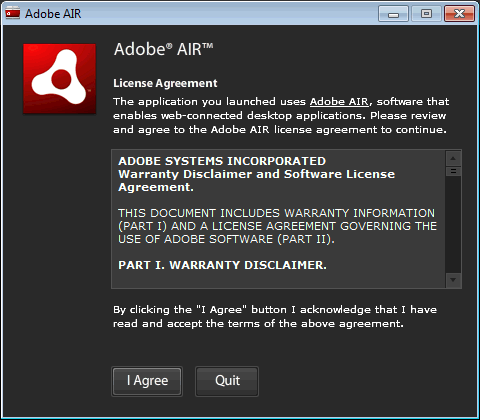
Adobe AIR license agreement
The text seemed a bit long. I decided to copy it and paste it into another application, for better viewing. To their credit, they allowed me to copy. But, absent a Select All command, it was a tad hard to copy everything. Nonetheless, I managed. I was confronted by a huge bulk of text with no line breaks at all in Windows Notepad. I inserted some line breaks. The result is a 6-page legal agreement that, for all I know, obliges me to sell of all my future children and descendants to Adobe.
For what it’s worth, this is the small print they wanted me to agree to. For now, I clicked Quit as I had not the time to read it all:
ADOBE SYSTEMS INCORPORATED
Warranty Disclaimer and Software License Agreement.
THIS DOCUMENT INCLUDES WARRANTY INFORMATION (PART I) AND A LICENSE AGREEMENT GOVERNING THE USE OF ADOBE SOFTWARE (PART II).
PART I. WARRANTY DISCLAIMER.
THE SOFTWARE AND OTHER INFORMATION IS DELIVERED TO YOU “AS IS” AND WITH ALL FAULTS. ADOBE AND ITS SUPPLIERS AND CERTIFICATE AUTHORITIES DO NOT AND CANNOT WARRANT THE PERFORMANCE OR RESULTS YOU MAY OBTAIN BY USING THE SOFTWARE, CERTIFICATE AUTHORITY SERVICES OR OTHER THIRD PARTY OFFERINGS. EXCEPT TO THE EXTENT ANY WARRANTY, CONDITION, REPRESENTATION OR TERM CANNOT OR MAY NOT BE EXCLUDED OR LIMITED BY LAW APPLICABLE TO YOU IN YOUR JURISDICTION, ADOBE AND ITS SUPPLIERS AND CERTIFICATE AUTHORITIES MAKE NO WARRANTIES CONDITIONS, REPRESENTATIONS, OR TERMS (EXPRESS OR IMPLIED WHETHER BY STATUTE, COMMON LAW, CUSTOM, USAGE OR OTHERWISE) AS TO ANY MATTER INCLUDING WITHOUT LIMITATION NONINFRINGEMENT OF THIRD PARTY RIGHTS, MERCHANTABILITY, INTEGRATION, SATISFACTORY QUALITY, OR FITNESS FOR ANY PARTICULAR PURPOSE.
PART II. SOFTWARE LICENSE AGREEMENT.
BY USING, COPYING OR DISTRIBUTING ALL OR ANY PORTION OF THE ADOBE SOFTWARE, YOU ACCEPT ALL THE TERMS AND CONDITIONS OF THIS AGREEMENT, INCLUDING, IN PARTICULAR, THE PROVISIONS ON: USE CONTAINED IN SECTION 2; TRANSFERABILITY IN SECTION 4; CONNECTIVITY AND PRIVACY IN SECTION 6; WARRANTY IN SECTION 9 AND LIABILITY IN SECTIONS 10 AND 16. UPON ACCEPTANCE, THIS AGREEMENT IS ENFORCEABLE AGAINST YOU AND ANY ENTITY THAT OBTAINED THE SOFTWARE AND ON WHOSE BEHALF IT IS USED. IF YOU DO NOT AGREE, DO NOT USE THE SOFTWARE.
ADOBE PERMITS YOU TO USE THE SOFTWARE ONLY IN ACCORDANCE WITH THE TERMS OF THIS AGREEMENT. USE OF SOME THIRD PARTY MATERIALS INCLUDED IN THE SOFTWARE MAY BE SUBJECT TO OTHER TERMS AND CONDITIONS TYPICALLY FOUND IN A SEPARATE LICENSE AGREEMENT, A “READ ME” FILE LOCATED NEAR SUCH MATERIALS OR IN THE “THIRD PARTY SOFTWARE NOTICES AND/OR ADDITIONAL TERMS AND CONDITIONS” FOUND AT http://www.adobe.com/go/thirdparty .
1. Definitions.
“Adobe” means Adobe Systems Incorporated, a Delaware corporation, 345 Park Avenue, San Jose, California 95110, if subsection 12(a) of this agreement applies; otherwise it means Adobe Systems Software Ireland Limited, Unit 3100, Lake Drive, City West Campus, Saggart D24, Republic of Ireland, a company organized under the laws of Ireland and an affiliate and licensee of Adobe Systems Incorporated. “Computer” means a virtual or physical personal electronic device that accepts information in digital or similar form and manipulates it for a specific result based on a sequence of instructions. “Software” means (a) all of the contents of the files (delivered electronically or on physical media), or disk(s) or other media with which this agreement is provided, which may include (i) Adobe or third party computer information or software, including Adobe Reader® (“Adobe Reader”), Adobe® AIR™ (“Adobe AIR”), Adobe Flash® Player, Shockwave® Player and Authorware® Player (collectively, Adobe AIR and the Flash, Shockwave and Authorware players are the “Adobe Runtimes”); (ii) related explanatory written materials or files (“Documentation”); and (iii) fonts; and (b) upgrades, modified versions, updates, additions, and copies of the foregoing, provided to you by Adobe at any time (collectively, “Updates”). “Use” means to access, install, download, copy, or otherwise benefit from using the functionality of the Software.
2. Software License.
If you obtained the Software from Adobe or one of its authorized licensees, and subject to your compliance with the terms of this agreement, including the restrictions in Section 3, Adobe grants to you a non-exclusive license to use the Software in the manner and for the purposes described in the Documentation as follows:
2.1 General Use. You may install and use one copy of the Software on your compatible Computer. See Section 3 for important restrictions on the use of the Software.
2.2 Server Use. This agreement does not permit you to install or use the software on a computer file server. For information on use of software on a computer file server please refer to http://www.adobe.com/go/acrobat_distribute for information about Adobe Reader; or http://www.adobe.com/go/licensing for information about the Adobe Runtimes.
2.3 Distribution. This license does not grant you the right to sublicense or distribute the Software. For information about obtaining the right to distribute the Software on tangible media or through an internal network or with your product or service please refer to http://www.adobe.com/go/acrobat_distribute for information about Adobe Reader; or http://www.adobe.com/go/licensing for information about the Adobe Runtimes.
2.4 Backup Copy. You may make one backup copy of the Software, provided your backup copy is not installed or used. You may not transfer the rights to a backup copy unless you transfer all rights in the Software as provided under Section 4.
3. Obligations and Restrictions.
3.1 Adobe Runtime Restrictions. You will not use any Adobe Runtime on any non-PC device or with any embedded or device version of any operating system. For the avoidance of doubt, and by example only, you may not use an Adobe Runtime on any (a) mobile device, set top box (STB), handheld, phone, web pad, tablet and Tablet PC (other than with Windows XP Tablet PC Edition and its successors), game console, TV, DVD player, media center (other than with Windows XP Media Center Edition and its successors), electronic billboard or other digital signage, Internet appliance or other Internet-connected device, PDA, medical device, ATM, telematic device, gaming machine, home automation system, kiosk, remote control device, or any other consumer electronics device, (b) operator-based mobile, cable, satellite, or television system or (c) other closed system device. For information on licensing Adobe Runtimes for use on such systems please visit http://www.adobe.com/go/licensing .
3.2 Adobe Reader Restrictions. Adobe Reader is licensed and distributed by Adobe for viewing, distributing and sharing PDF files.
3.2.1 Conversion Restrictions. You will not integrate or use Adobe Reader with any other software, plug-in or enhancement that uses or relies upon Adobe Reader when converting or transforming PDF files into a different format (e.g., a PDF file into a TIFF, JPEG, or SVG file).
3.2.2 Plug-in Restrictions. You will not integrate or use Adobe Reader with any plug-in software not developed in accordance with the Adobe Integration Key License Agreement.
3.2.3 Disabled Features. Adobe Reader may contain features or functionalities that are hidden or appear disabled or “grayed out” (the “Disabled Features”). Disabled Features will activate only when opening a PDF document that was created using enabling technology available only from Adobe. You will not access, or attempt to access, any Disabled Features other than through the use of such enabling technologies, nor will you rely on Adobe Reader to create a feature substantially similar to any Disabled Feature or otherwise circumvent the technology that controls activation of any such feature. For more information on disabled features, please refer to http://www.adobe.com/go/readerextensions .
3.3 Notices. Any copy of the Software that you make must contain the same copyright and other proprietary notices that appear on or in the Software.
3.4 No Modification or Reverse Engineering. You may not modify, adapt, translate or create derivative works based upon the Software. You will not reverse engineer, decompile, disassemble or otherwise attempt to discover the source code of the Software except to the extent you may be expressly permitted to reverse engineer or decompile under applicable law.
4. Transfer.
You may not rent, lease, sublicense, assign or transfer your rights in the Software, or authorize all or any portion of the Software to be copied onto another user’s Computer except as may be expressly permitted by this agreement. You may, however, transfer all your rights to use the Software to another person or legal entity provided that:
(a) you also transfer
(i) this agreement, and
(ii) the Software and all other software or hardware bundled or pre-installed with the Software, including all copies, updates and prior versions, to such person or entity,
(b) you retain no copies, including backups and copies stored on a Computer, and
(c) the receiving party accepts the terms and conditions of this agreement and any other terms and conditions upon which you obtained a valid license to the Software. Notwithstanding the foregoing, you may not transfer education, pre-release, or not for resale copies of the Software.
5. Intellectual Property Ownership, Reservation of Rights.
The Software and any authorized copies that you make are the intellectual property of Adobe Systems Incorporated and its suppliers. The structure, organization and code of the Software are the valuable trade secrets and confidential information of Adobe Systems Incorporated and its suppliers. The Software is protected by law, including without limitation the copyright laws of the United States and other countries, and by international treaty provisions. Except as expressly stated herein, this agreement does not grant you any intellectual property rights in the Software and all rights not expressly granted are reserved by Adobe and its suppliers.
6. Connectivity and Privacy.
6.1 Use of PDF Files. When you use the Software to open a PDF file that has been enabled to display ads through registration with the Ads for Adobe PDF service, your computer may connect to a website operated by Adobe, an advertiser, or other third party. Your Internet Protocol (IP) address is sent when this happens. The party hosting the site may use technology to send (or “serve”) advertising or other electronic content that appears in or near the opened file. The website operator may also use JavaScript, web beacons (also known as action tags or single-pixel gifs), and other technologies to increase and measure the effectiveness of advertisements and to personalize advertising content. Your communication with Adobe websites is governed by the Adobe Online Privacy Policy found at http://www.adobe.com/go/privacy . Adobe may not have access to or control over features that a third party may use, and the information practices of third party websites are not covered by the Adobe Online Privacy Policy.
6.2 Updating. You acknowledge and agree that the Software may cause your Computer to automatically connect to the Internet to check for updates that are available for automatic download to your Computer and to let Adobe know the Software is successfully installed. Only non-personal identifying information is transmitted to Adobe when this happens. Your communication with Adobe websites is governed by the Adobe Online Privacy Policy found at http://www.adobe.com/go/privacy . Please consult the Documentation for information about changing default update settings.
6.3 Settings Manager. Flash Player may cause certain user settings to be stored on your Computer as a local shared object. These settings are not associated with you, but allow you to configure certain settings within the Flash Player. You can find more information on local shared objects at http://www.adobe.com/go/flashplayer_security and more information on the Settings Manager at http://www.adobe.com/go/settingsmanager .
7. Third Party Offerings.
The Software may allow you to access and interoperate with third party websites, software applications, and data services, including rich Internet applications (“Third Party Offerings”). Your access to and use of any Third Party Offering, including any goods, services or information, is governed by the terms and conditions respecting such offerings. Third Party Offerings are not owned or provided by Adobe.
8. Digital Certificates.
8.1 Use. Adobe AIR uses digital certificates to help you identify the publisher of Adobe AIR applications created by third parties. Adobe Reader uses digital certificates to sign and validate signatures within PDF documents and to validate certified PDF documents. Your Computer may connect to the Internet at the time of validation of a digital certificate. Digital certificates are issued by third party certificate authorities, including Adobe Certified Document Services (CDS) vendors listed at http://www.adobe.com/go/partners_cds (“Certificate Authorities”), or can be self-signed.
8.2 Terms and Conditions. Purchase, use and reliance upon digital certificates is the responsibility of you and a Certificate Authority. Before you rely upon any certified document, digital signature or Certificate Authority services, you should review the applicable terms and conditions under which the relevant Certificate Authority provides services, including, for example, any subscriber agreements, relying party agreements, certificate policies and practice statements. See the links on http://www.adobe.com/go/partners_cds for information about Adobe’s CDS vendors.
8.3 Acknowledgement. You agree that
(a) a digital certificate may have been revoked prior to the time of verification, making the digital signature or certificate appear valid when in fact it is not,
(b) the security or integrity of a digital certificate may be compromised due to an act or omission by the signer of the document, the applicable Certificate Authority, or any other third party and
(c) a certificate may be a self-signed certificate not provided by a Certificate Authority. YOU ARE SOLELY RESPONSIBLE FOR DECIDING WHETHER OR NOT TO RELY ON A CERTIFICATE. UNLESS A SEPARATE WRITTEN WARRANTY IS PROVIDED TO YOU BY A CERTIFICATE AUTHORITY, YOU USE DIGITAL CERTIFICATES AT YOUR SOLE RISK.
8.4 Third Party Beneficiaries. You agree that any Certificate Authority you rely upon is a third party beneficiary of this agreement and shall have the right to enforce this agreement in its own name as if it were Adobe.
8.5 Indemnity. You agree to hold Adobe and any applicable Certificate Authority (except as expressly provided in its terms and conditions) harmless from any and all liabilities, losses, actions, damages, or claims (including all reasonable expenses, costs, and attorneys fees) arising out of or relating to any use of, or reliance on, any service of such authority, including, without limitation
(a) reliance on an expired or revoked certificate,
(b) improper verification of a certificate,
(c) use of a certificate other than as permitted by any applicable terms and conditions, this agreement or applicable law;
(d) failure to exercise reasonable judgment under the circumstances in relying on issuer services or certificates or
(e) failure to perform any of the obligations as required in the terms and conditions related to the services.
9. No Warranty.
The Software is being delivered to you “AS IS” and with ALL FAULTS. ADOBE AND ITS SUPPLIERS AND CERTIFICATE AUTHORITIES DO NOT AND CANNOT WARRANT THE PERFORMANCE OR RESULTS YOU MAY OBTAIN BY USING THE SOFTWARE, CERTIFICATE AUTHORITY SERVICES OR OTHER THIRD PARTY OFFERINGS. EXCEPT TO THE EXTENT ANY WARRANTY, CONDITION, REPRESENTATION OR TERM CANNOT OR MAY NOT BE EXCLUDED OR LIMITED BY LAW APPLICABLE TO YOU IN YOUR JURISDICTION, ADOBE AND ITS SUPPLIERS AND CERTIFICATE AUTHORITIES MAKE NO WARRANTIES CONDITIONS, REPRESENTATIONS, OR TERMS (EXPRESS OR IMPLIED WHETHER BY STATUTE, COMMON LAW, CUSTOM, USAGE OR OTHERWISE) AS TO ANY MATTER INCLUDING WITHOUT LIMITATION NONINFRINGEMENT OF THIRD PARTY RIGHTS, MERCHANTABILITY, INTEGRATION, SATISFACTORY QUALITY, OR FITNESS FOR ANY PARTICULAR PURPOSE. The provisions of Section 9 and Section 10 shall survive the termination of this agreement, howsoever caused, but this shall not imply or create any continued right to use the Software after termination of this agreement.
10. Limitation of Liability.
IN NO EVENT WILL ADOBE, ITS SUPPLIERS, OR CERTIFICATE AUTHORITIES BE LIABLE TO YOU FOR ANY DAMAGES, CLAIMS OR COSTS WHATSOEVER INCLUDING ANY CONSEQUENTIAL, INDIRECT, INCIDENTAL DAMAGES, OR ANY LOST PROFITS OR LOST SAVINGS, EVEN IF AN ADOBE REPRESENTATIVE HAS BEEN ADVISED OF THE POSSIBILITY OF SUCH LOSS, DAMAGES, OR CLAIMS. THE FOREGOING LIMITATIONS AND EXCLUSIONS APPLY TO THE EXTENT PERMITTED BY APPLICABLE LAW IN YOUR JURISDICTION. ADOBE’S AGGREGATE LIABILITY AND THAT OF ITS SUPPLIERS AND CERTIFICATE AUTHORITIES UNDER OR IN CONNECTION WITH THIS AGREEMENT SHALL BE LIMITED TO THE AMOUNT PAID FOR THE SOFTWARE, IF ANY. Nothing contained in this agreement limits Adobe’s liability to you in the event of death or personal injury resulting from Adobe’s negligence or for the tort of deceit (fraud). Adobe is acting on behalf of its suppliers and Certificate Authorities for the purpose of disclaiming, excluding and/or limiting obligations, warranties and liability as provided in this agreement, but in no other respects and for no other purpose. For further information, please see the jurisdiction specific information at the end of this agreement, if any, or contact Adobe’s Customer Support Department.
11. Export Rules.
You agree that the Software will not be shipped, transferred or exported into any country or used in any manner prohibited by the United States Export Administration Act or any other export laws, restrictions or regulations (collectively the “Export Laws”). In addition, if the Software is identified as export controlled items under the Export Laws, you represent and warrant that you are not a citizen, or otherwise located within, an embargoed nation (including without limitation Iran, Syria, Sudan, Cuba, and North Korea) and that you are not otherwise prohibited under the Export Laws from receiving the Software. All rights to use the Software are granted on condition that such rights are forfeited if you fail to comply with the terms of this agreement.
12. Governing Law.
This agreement will be governed by and construed in accordance with the substantive laws in force:
(a) in the State of California, if a license to the Software is obtained when you are in the United States, Canada, or Mexico; or
(b) in Japan, if a license to the Software is obtained when you are in Japan, China, Korea, or other Southeast Asian country where all official languages are written in either an ideographic script (e.g., Hanzi, Kanji, or Hanja), and/or other script based upon or similar in structure to an ideographic script, such as Hangul or Kana; or
(c) England, if a license to the Software is obtained when you are in any other jurisdiction not described above. The respective courts of Santa Clara County, California when California law applies, Tokyo District Court in Japan, when Japanese law applies, and the competent courts of England, when the law of England applies, shall each have non-exclusive jurisdiction over all disputes relating to this agreement. This agreement will not be governed by the conflict of law rules of any jurisdiction or the United Nations Convention on Contracts for the International Sale of Goods, the application of which is expressly excluded.
13. General Provisions.
If any part of this agreement is found void and unenforceable, it will not affect the validity of the balance of this agreement, which shall remain valid and enforceable according to its terms. This agreement shall not prejudice the statutory rights of any party dealing as a consumer. This agreement may only be modified by a writing signed by an authorized officer of Adobe. updates may be licensed to you by Adobe with additional or different terms. This is the entire agreement between Adobe and you relating to the Software and it supersedes any prior representations, discussions, undertakings, communications or advertising relating to the Software.
14. Notice to U.S. Government End Users.
For U.S. Government End Users, Adobe agrees to comply with all applicable equal opportunity laws including, if appropriate, the provisions of Executive Order 11246, as amended, Section 402 of the Vietnam Era Veterans Readjustment Assistance Act of 1974 (38 USC 4212), and Section 503 of the Rehabilitation Act of 1973, as amended, and the regulations at 41 CFR Parts 60-1 through 60-60, 60-250, and 60-741. The affirmative action clause and regulations contained in the preceding sentence shall be incorporated by reference in this agreement.
15. Compliance with Licenses.
If you are a business or organization, you agree that upon request from Adobe or Adobe’s authorized representative, you will, within thirty (30) days, fully document and certify that use of any and all Software at the time of the request is in conformity with your valid licenses from Adobe.
16. Specific Provisions and Exceptions.
16.1 Limitation of Liability for Users Residing in Germany and Austria.
16.1.1 If you obtained the Software in Germany or Austria, and you usually reside in such country, then Section 10 does not apply, Instead, subject to the provisions in Section 16.1.2, Adobe’s statutory liability for damages shall be limited as follows:
(i) Adobe shall be liable only up to the amount of damages as typically foreseeable at the time of entering into the license agreement in respect of damages caused by a slightly negligent breach of a material contractual obligation and
(ii) Adobe shall not be liable for damages caused by a slightly negligent breach of a non-material contractual obligation.
16.1.2 The aforesaid limitation of liability shall not apply to any mandatory statutory liability, in particular, to liability under the German Product Liability Act, liability for assuming a specific guarantee or liability for culpably caused personal injuries.
16.1.3 You are required to take all reasonable measures to avoid and reduce damages, in particular to make back-up copies of the Software and your computer data subject to the provisions of this agreement.
If you have any questions regarding this agreement or if you wish to request any information from Adobe please use the address and contact information included with this product or via the web at www.adobe.com to contact the Adobe office serving your jurisdiction
Adobe, AIR, Authorware, Flash, Reader, and Shockwave are either registered trademarks or trademarks of Adobe Systems Incorporated in the United States and/or other countries.
Copyright 2006-2008 Adobe Systems Incorporated. All Rights Reserved.
Patents pending in the U.S. and/or other countries.
Reader_Player_AIR_WWEULA-en_US-20080204_1313