I’m hearing on the BBC that Japan’s exports in February are down 50% since February last year and that their car exports are down an astonishing 70%.
These numbers are insane. What is this world coming to?
I’m hearing on the BBC that Japan’s exports in February are down 50% since February last year and that their car exports are down an astonishing 70%.
These numbers are insane. What is this world coming to?
If only I had known about it earlier… I am not a theater person, but The Gladstone’s The Radio Show definitely sounds like my cup of tea. Too bad it’s on for only three more days, and these will be three very busy days for me.
Republican lawmakers in America are concerned: they think that the request of the Obama administration and its treasury secretary for additional powers represents an unprecedented power grab. Being a libertarian at heart, I share their concerns even as I recognize the necessity for unprecedented government intervention at a time of unprecedented crisis.
But, it is difficult not to notice of the hipocrisy. The same lawmakers did not appear to be nearly as upset when the Bush administration grabbed unprecedented powers… not in the economic arena, mind you, but in the area of safety and security, directly impacting the personal freedoms and liberties of not just Americans, but also foreign nationals on American soil, such as Canadian Maher Arar who was deported to Syria for torture and unlawful imprisonment. If only Republican lawmakers were as eager to guard constitutional freedoms back then!
My god. Is this really what the “fair and balanced” network thinks of Canada’s involvement in Afghanistan, and the 117 Canadians (including a civilian diplomat) who died there?
I wonder why Canada even went there to fight. After all, it wasn’t Canada that was attacked on 9/11. Fortunately, I know that not all Americans are as dumb as these clowns… what is troubling is that way too many Americans DO watch FOX and believe that it presents an unbiased view of the world.
The video responses to this clip are interesting, too. One is an “adults only” propaganda piece warning us about Islam’s plans to take over the world. Oh my, I am so afraid, there are Muslims everywhere!
Yes, they do teach this in flight school. But even professionals make mistakes… and when those professionals happen to be pilots, they often pay with their lives:
Fortunately (?) in this case only the pilots had to pay, as the airplane in question was a FedEx cargo plane.
I am watching a documentary on BBC World.
BBC World is available here on basic analog cable, which is the only kind of cable I am interested in having in the house. (Mainly, I am put off digital cable because of the need for separate set-top boxes, but DRM also doesn’t help, not to mention the nasty habit of the box to wake up in the middle of the night to perform an OS upgrade, clearly demonstrating that I am not in control of equipment that is in my house.)
However, BBC World is, it appears, a high definition (HD) broadcast, so on analog cable it appears with a black stripe on the top and the bottom of the picture.
This particular documentary, however, was apparently shot in standard definition. So BBC World chose one of three options, each less than perfect: instead of cropping the picture at the top and the bottom, or introducing black stripes on the left and right, they decided to stretch the picture horizontally. Why so many people prefer a distorted picture over black stripes, I have no idea.
But this means that on my standard analog cable, I get a standard definition show that appears at less than standard resolution, vertically compressed, distorted, with unnecessary black stripes at the top and the bottom. Isn’t HD just glorious?

HD madness
Fortunately, as I tend to watch TV on my computer, I always have the option of stretching the video window vertically and get a picture with the correct aspect ratio. This option is not necessarily available on ordinary televisions.
Behind this ridiculousness is the insane decision to change not just the resolution but the aspect ratio of HD broadcasts. Why, you might ask? Very simple. If the aspect ratios were the same, most people could not tell the difference between standard definition and HD even when the broadcast was true HD, which often is not the case (older shows, and even some newer shows, are shot in standard definition.) So how do you convince people to buy HD anyway? By making it apparent that they have a “better” television set because it is wider.
And this has been done before. Back in the 1950s, when movie studios were seriously worried about the competition of television, they changed the aspect ratio of Hollywood movies, intentionally making them incompatible with the standard 4:3 aspect ratio of NTSC/PAL television. What is amazing is how well they managed to convince the public that a wider picture is better, providing yet another example of just how easy it is to manipulate people.
I’m done watching the very final episode of Battlestar Galactica.
Wow. Now this is what science fiction television is supposed to be like. When I saw the pilot movie back in 2003, I simply wondered, how on Earth they could possibly make something this gripping out of the “re-imagining” of a cheesy early-80s space opera? But they did… and the show never wavered in quality. I am sad that it’s over, but I respect their decision to finish the show the right way.
In the Futurama movie, The Beast with a Billion Backs, one scene features a blackboard with two different proofs of the Goldbach conjecture. The Goldback conjecture is one of the oldest unsolved problems in mathematics. One of those problems, like Fermat’s last theorem or the 4-color problem of maps that is deceivingly easy to state and fiendishly hard to prove: that every even number greater than 4 can be expressed as the sum of two primes.
Just how intriguing this problem is, it’s well illustrated by the following plot that shows the number of ways an even number between 4 and 1 million can be split into a sum of two primes:
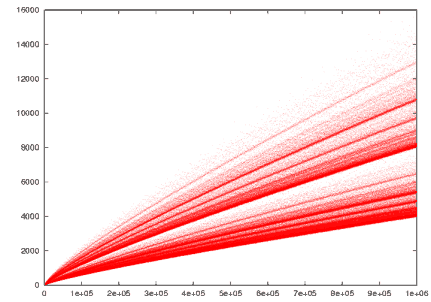
Golbach partitioning to 1000000
This plot, taken from Wikipedia, clearly shows that the results cluster along curves (asymptotes? attractors?) that follow some kind of a power law with an exponent between ~0.68 and ~0.77, and there may also be some fractal splitting involved, too. This plot is known as Goldbach’s comet. All I have to do is look at it to understand why many people find number theory endlessly fascinating.
In 2002, a tragic accident occurred over the skies of Europe, as a Russian passenger liner and a DHL cargo plane collided, causing the deaths of some 70 people, including the family of a certain Vitaly Kaloyev, a Russian architect working in Barcelona at the time.
Two years later Kaloyev killed Peter Nielsen, the air traffic controller that he believed was responsible for the death of his daughter. He was duly convicted and spent some time in prison. He was eventually released in late 2007 after winning an appeal on the grounds that his mental state at the time of the killing was not taken properly into account. He returned to Russia where many greeted him as a hero.
This is where things turn bizarre. Not long after Kaloyev’s return, Russia went to war with Georgia. One outcome of this war was the declaration of independence by the state of South Ossetia. Nationalists feelings were high on both sides of the intra-Ossetian border. And Vitaly Kaloyev was named deputy minister of housing in North Ossetia.
I can understand Kaloyev’s feelings. I can even understand why he killed Nielsen, even though Nielsen was himself a victim of incompetent management and bad organization. What I don’t understand is how a convicted killer can be named to such a high-profile public position. I think it speaks volumes about the politics of the region.
This phony, populist outrage over the AIG bonuses is really becoming ridiculous. They make it sound as if AIG’s top executives just took the bailout money as bonuses and ran with it. But that’s nonsense. First of all, the bonuses in question amount to barely 0.1% of the bailout that AIG received. Second, there are managers and there are managers… the ones getting these bonuses, are they the top level managers responsible for AIG’s demise, or are they the managers running, say, a successful branch office of AIG insurance?
Of course answering these questions might require some investigative journalism, some thinking, some hard explaining… not the kind of stuff the soundbyte journalism of the cable news universe likes. Glad I am not going to be home tonight, as I will not even accidentally watch the populist tripe of Lou Dobbs on CNN as he, no doubt, will take his turn at expressing outrage. Now if instead of spewing indignation, he actually took the trouble of locating a typical AIG executive who received a bonus and sat him or her down for a meaningful interview… of course I am quite willing to bet that this is not going to happen, not on CNN nor anywhere else… with the possible exception being BBC News.
I often get questions about the Pioneer anomaly and our on-going research. All too often, the questions boil down to this: what percentage of the anomaly can <insert theory here> account for?
This is a very bad way to think about the anomaly. It completely misses the fact that the Pioneer anomaly is not an observed sunward acceleration of the Pioneer spacecraft. The DATA is not a measured acceleration; what is measured is the frequency of the spacecraft’s radio signal.
I already capitalized the word DATA in the previous paragraph; let me also capitalize the words MODEL and RESIDUAL, as these are the right terms to use when thinking about the Pioneer anomaly.
As I said above, the DATA is the Doppler measurement of the spacecraft’s radio frequency.
The MODEL is a model of all forces acting on the spacecraft including gravity, on-board forces, solar pressure, etc; all effects acting on the spacecraft’s radio signal, including the Shapiro delay, solar plasma, the Earth’s atmosphere; and all effects governing the motion of the ground stations participating in the communication.
The RESIDUAL is the error, the difference between the MODEL’s prediction of the Doppler measurement vs. the actual measurement. This RESIDUAL basically appears as noise, but with characteristic signatures (a diurnal and an annual sinusoid along with discontinuous jumps at the time of maneuvers) that suggest mismodeling.
The goal is to make this RESIDUAL “vanish”; by that, we mean that only random noise remains, any diurnal, annual, or maneuver-related signatures are reduced to the level of background noise.
The RESIDUAL can be made to vanish (or at least, can be greatly reduced) by incorporating new contributions into the MODEL. These contributions may or may not be rooted in physics; indeed, orbit determination codes typically have the ability to add “unmodeled” effects (basically, mathematical formulae, such as a term that is a quadratic or exponential function of time) to the MODEL, without regard to the physical origin (if any) of these effects.
Anderson et al. found that if they add an unmodeled constant sunward acceleration to the MODEL, they can make the RESIDUAL vanish. This is the result that has been published as the Pioneer anomaly.
If one has a physical theory that predicts a constant sunward acceleration, it is meaningful to talk in terms of percentages. For instance, one may have a physical theory that predicts a constant sunward acceleration with magnitude cH where c is the speed of light and H is Hubble’s constant at the present epoch; it then makes sense to say that, “using the widely accepted value of H ~= 71 km/s/Mpc, the theory explains 79% of the Pioneer anomaly,” since we’re comparing two numbers that represent the same physical quantity, a constant sunward acceleration.
However, note (very important!) that the fact that a constant sunward acceleration fits the data does not exclude alternatives with forces that are not constant or sunward pointing; the DATA admits many different MODELs.
Now let’s talk about the thermal recoil force. It is NOT constant and it is NOT sunward pointing. As we recompute this force, incorporating the best thermal model that we can compute into the MODEL and re-evaluate it, we obtain a new RESIDUAL. There are, then, the following possibilities:
Instead of playing with percentages, it makes a lot more sense to do this: after applying our best present understanding insofar as thermal recoil forces are concerned, we re-evaluate the MODEL. We compute the RESIDUAL. We check if this residual contains any signatures of mismodeling. If it doesn’t, we have no anomaly. If it does, we characterize this mismodeling by applying various unmodeled effects (e.g., a constant sunward force, exponential decay, etc.) to check if any of these can characterize the RESIDUAL. We then report on the existence of a (revised) anomaly with the formula for the unmodeled effect as a means to consisely characterize the RESIDUAL. If this revised anomaly is still well described by a constant sunward term, we may use a percentage figure to describe it… otherwise, it’s probably not helpful to do so.
I’m watching a horrible movie (“Recon 2020“) and in an attempt to find out what it is about, I happened upon a Web page where I read this:
“Action packed lots and lots of monster killing. You know all the stuff sci-fi fans love.”
No. That’s not what sci-fi fans like. Or, at least, that’s not what this here sci-fi fan likes.
I grew up on the sci-fi of the likes of Asimov, Clarke, the Strugatsky brothers, Lem, or for that matter, Verne and Wells. Science fiction that contemplated the future of humanity, the role of science and technology, our destiny, the dangers we face, our chance of survival, our responsibilities. THAT’s what science fiction means to me. I don’t mind action and monsters, if well done it can even be fun, but no action or monster killing can make up for the absence of a credible plot and a meaningful story.
Einstein was right and Silberstein was wrong, but it’s beautifully subtle why.
Einstein’s point was that in a region free of singularities, the circumference of an infinitesimal circle should be 2π times its radius. He then showed that an infinitesimal circle perpendicular to, and centered around, the line connecting the two mass points in Silberstein’s solution has the wrong radius, hence the line connecting the two masses must be singular.
Silberstein countered by pointing out an error in Einstein’s derivation and then showing that a particular quantity rigorously vanishes along this line, implying that yes, the circumference of the infinitesimal circles in question do, in fact, have the right radii. This solution appeared in his paper in Physical Review in 1936.
Einstein then, in his published Letter that he wrote in reply to Silberstein’s paper, provided a technical argument discussing square roots and derivatives that, while correct, is not very enlightening. (It’s one of those comments that make perfect sense once you know what the devil he is talking about, but there’s no possible way you can actually understand what he’s talking about from the comment alone. Not that I haven’t been guilty of committing the same sin, even writing things that I myself wasn’t able to understand a few months later without going back to my notes or calculations. But I digress.)
By solving for the metric and obtaining an explicit formula, I was able to better understand this mystery.
First, it should be noted that the axis connecting the two mass points is also the origin of the radial coordinate, so the coordinate system itself is singular here even if there is no physical singularity. To verify that there is no physical singularity at this location, we can draw tiny, infinitesimal circles centered around this axis and check if they obey the rules of Euclidean geometry (one fundamental rule in curved spacetime is that in a small enough region, things always look Euclidean.) This was the basis of Einstein’s argument.
We can express the ratio of the angular and radial components of the metric in the form of an exponential expression, say exp(N) where N is some expression. Clearly, we must have N(r → 0) = 0 in order for the circumference of an infinitesimal circle centered around the axis to be 2π its radius.
As it turns out, N appears in the form [] + C where [] is just some complicated expression. It turns out that this part [] is constant along the axis, but its constant value is different between the two mass points vs. outside the mass points. I can draw the axis and the two mass points like this:
––––––––––––––––X––––––––––––––––X––––––––––––––––
The bracketed expression is constant along this line (not constant outside the line, such as above or below it but that’s not relevant now) but has one constant value between the two points (the two X’s) and another constant value on the two sides. The two constant values are not the same.
We can choose the constant C to make N vanish either between the two mass points or outside the two mass points but not both at the same time. When N vanishes outside, but not between, the two mass points, the singularity that remains serves as a “strut” holding the two mass points apart:
––––––––––––––––X================X––––––––––––––––
Or, when N vanishes outside, it’s as if the two mass points were attached by “ropes” to the “sphere at infinity”, hanging from there in static equilibrium as gravity pulls them together:
================X––––––––––––––––X================
So how come Silberstein was able to dismiss Einstein’s criticism? He was able to do so by making a particular choice of the sign of a square root that made N vanish both between and outside the two mass points. But this is where it helps to write N in the form that I obtained, symbolically as [] + C, with the bracketed part having one constant value along the axis between the two masses and another value outside. Sure we can make N vanish everywhere along the axis… by allowing C to have different values between vs. outside the masses.
This is fine along the axis… the masses themselves are singularities, so they represent a discontinuity anyway, so we are free to choose different integration constants on two sides of a discontinuity. This is indeed what Silberstein has done by choosing a particular sign of a square root in his formulation of the metric.
But, as Einstein pointed out, such a choice of sign leads to a discontinuity in derivatives. More explicitly, what happens is that the function N is defined not just along the axis but everywhere in spacetime… to get from a point on the axis between the two masses to a point outside, we need not go along the axis, we can leave the axis, go around the mass, and then return to the axis. As we do this, we encounter no singularity but the value of C must jump from one constant to another at some point. In other words, by removing the “strut” or “rope” singularity from the axis, we introduced a much worse singular “membrane” that separates regions of space.
One morale of this story is that when we use a coordinate system like polar coordinates that is not well defined at the origin, we must be ultra careful about that spot… since the coordinate system is singular here, this is where things can go wrong even if they appear perfect everywhere else.
I’m reading about the debate in the 1930s between Einstein and Silberstein about the (non-)existence of a static two-body vacuum solution of the Einstein field equations.
Silberstein claimed to have found just such a solution as a special case of Weyl’s metric. However, he then concluded that the existence of an unphysical solution implies that Einstein’s gravitational theory has to be modified.
Meanwhile, Einstein dismissed Silberstein’s solution on two grounds. First, he claimed that there are additional singularities; second, he claimed that a solution that yields singularities is in any case not a proper solution of a field theory, so it certainly cannot be used to discredit that theory.
I disagree with Silberstein… just because there exist solutions that are unphysical does not unmake a theory. The equations of ballistics also yield unphysical solutions, such as cannonballs going underground or flying backwards in time… but it simply means that we chose unphysical initial conditions, not that the theory is wrong.
I also disagree with Einstein’s second argument though… field theory or not, some singularities can be quite useful and physically meaningful, be it, say, the “point mass” in Newton’s theory, the “point source” in electromagnetism, or, well, singularities in general relativity representing compact (point) masses.
But both these issues are more philosophy than physics. I am more interested in Einstein’s first argument… is it really true that Silberstein’s solution yields more than two singularities?
That is because when I actually calculate with Silberstein’s metric, I find regular behavior everywhere except at the two singular points. I see no sign whatsoever of the supposed singular line between them. What am I missing?
During the Bush administration, we were used to dumb mistakes, but just because Bush is gone does not mean dumb mistakes have come to an end. Such as giving the Russian prime minister a gift, a button labeled “reset”… except that the mistranslated label actually carried a word that meant quite the opposite. Whatever one has to say about Condoleeza Rice, at least she spoke some Russian…
That’s an ad that is running during local commercial breaks on CNN here in Ottawa, on Rogers Cable.
Too bad that as of yesterday, there is no A-News at Six. We live in interesting times…
I just saw the news… Philip José Farmer, one of the giants of science fiction, died at the age of 91. May he rest in peace.
I’ve been reading Wikipedia about the so-called Sylvia Plath effect. It takes a bit of explaining.
I just finished reading Escape from Hell, the sequel to Larry Niven’s and Jerry Pournelle’s Inferno, itself a superb book, a modern rewrite of Dante’s hell. In this sequel, the principal companion of the protagonist is a woman named Sylvia Plath.
I must say I never heard of Sylvia Plath until this book. I knew nothing about her tragically short life nor about her death by suicide, a month before I was born in 1963. But that’s not why I was learning about her from Wikipedia this evening.
I finished Escape from Hell last night, less than 24 hours ago. Tonight, my wife and I watched the latest episode of The Simpsons. At the end of this (otherwise better than average) episode, there is a brief shot of Lisa holding a book in her hand. It’s the semi-autobiographical novel The Bell Jar, by Sylvia Plath.
One recurring theme in Inferno and Escape from Hell is that the protagonist meets just too many people he encountered in his earthly life for it to be a coincidence. I call such coincidences my Victrola moments… Many years ago, I played a Monty Python computer game which featured a Victrola, a word I never heard previously, but within 24 hours, I heard it in a completely different context. There were a few more instances like this in my life. Now, I can add Sylvia Plath to the list.
What’s this “European socialist model” that Gingrich is trying to frighten American conservatives with? They make it sound bad, like, “Soviet communist model” or “German fascist model”. But last time I was there, “European socialism” was none of that. Why has Europe suddenly become a scary word in the American right’s political vocabulary? While it is reeling from the recession just like elsewhere, Europe has a strong (private sector) economy, a functioning health care system, in many ways a better infrastructure (think TGV!) than the US, a strong united currency, and last but not least, Europe has found a way for the (so far) peaceful coexistence of many peoples who speak dozens of different languages and have waged the bloodiest wars in history against each other. Is this what scares the GOP?
Personally, I’d be much more worried that under the present GOP leadership, America might end up following the Chinese corporatist model…
I take it back. There are still some sane conservatives out there in America. Some even think that right-wing talk radio is destroying conservativism. I only wish they were listened to.

How Radio Wrecks The Right