Apr 212011
 

I used to think of myself as a moderate conservative. I didn’t much care for conservative ideology, but back in the 1980s, conservatives seemed to be much less burdened by ideology than their liberal counterparts, and more willing to make decisions based on facts.

How times have changed.

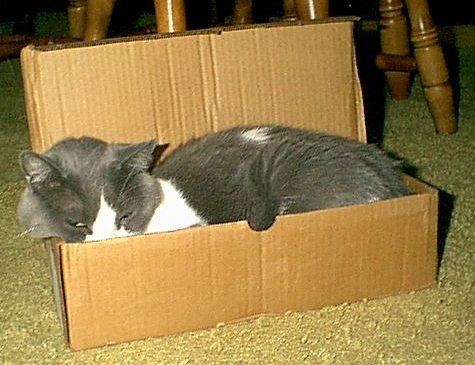
We have an election coming up here in Canada, and I cannot imagine voting for the Conservative party. It’s not that I dislike Harper. Hey, he’s a cat lover, and I am most certainly fond of cats. Nonetheless… he worries me.

The way the Harper government undermined the de facto independence of Statistics Canada and placed ideology ahead of facts when they made the decision to scrap the mandatory long-form census is but one example. Having grown up in a communist country, I used to think that ideological blindness was a prerogative of the political left; now I know better.

Proposals to rewrite Canada’s copyright law is another issue. Like the much criticized “Digital Millennium Copyright Act” of the United States, proposed law in Canada would also make it illegal to tamper with copy protection technology even when the planned use of the copyrighted work would itself be legal. Many don’t seem to understand that this formulation effectively turns a “limited monopoly” intellectual property right into an unlimited one: by using copy protection technology (even worthless, token technology will do), a copyright holder can prevent otherwise legal fair use. To be sure, I don’t necessarily expect a Liberal government to do better, but right now, it’s the Conservative proposals that I need to worry about, because they’re the ones edging ever closer to a parliamentary majority.

Then there was the proroguing of parliament, not once but twice. Harper’s conservatives seem utmostly concerned about the traditions of our parliamentary democracy when they try to frighten us with the spectre of a liberal-led coalition government (which, incidentally, would be entirely legal and constitutional, and also representing the majority of Canadian voters) yet they seem to think that shutting down parliament is not a violation of the same traditions. I am all for upholding both the written and unwritten traditions of this great country, but that then also includes not shutting down parliament, or, for that matter, not messing with or muzzling our statistics office.

One reason why I consider myself conservative is that I believe in fiscal conservativism: government being a “necessary evil”, it should be small, and the amounts it spends on programs, however worthy, should be constrained by the realities of available revenue and a desire to keep taxes low. Instead, Harper’s government delivered the biggest deficit in Canadian history. True, it was a result, in part, of an unprecedented recession, but only in part; they were well on their way towards sliding into the red long before the recession hit the Canadian economy.

Having said that… I don’t think that Harper is evil incarnate or that his re-election means the end of Canada as we know it. This is a fortunate country, blessed with a decent political elite that you can respect even when you disagree with them. But I still wouldn’t feel comfortable with Harper in charge of a majority government. I sincerely hope that he does not win that majority on May 2.

 Posted by at 2:00 pm
Apr 192011
 

The parliament of Hungary approved a new constitution.

Too bad that it’s a constitution designed the serve the interests of a single party and its predominantly Christian conservative ideology, as opposed to serving the interests of the nation by strengthening the system of democratic institutions, of checks and balances. And this time around, they can’t even blame foreign occupation as the cause… this wondrous piece of legalese wasn’t drafted in Vienna or Moscow or anywhere else.

 Posted by at 3:19 am
Apr 152011
 

Here’s the story of a person, former US Air Force major Harold Hering, who dared to ask a simple question: if your hand rests on the launch key of a nuclear missile, and you receive a launch order, how do you know that the order is truly lawful? He had no answer, and he was discharged from the military for asking a Forbidden Question that went beyond his “need to know” in the reading of a US Air Force panel. But the question is as valid today as it was in the times of Nixon.

Of course the fundamental conundrum is this: a sane society facing a nuclear opponent may rely on a nuclear deterrent to prevent attack, even though (being sane) it has no desire to respond to genocide with genocide if the unthinkable actually happens. So… how do you convince your enemies that you would launch a retaliatory strike even when in reality, you would prefer not to do so because killing millions of innocents on the opposing side will not bring your countrymen back to life?

 Posted by at 12:26 pm
Apr 122011
 

Fifty years ago today, Yuri Alekseyevich Gagarin flew into outer space, becoming the first human to orbit the Earth.

I often wonder why it is so that fifty years later, space travel still remains an incredibly expensive novelty. After all, 50 years after the Wright brothers’ first flight, transoceanic air travel was a daily reality, and the jet era and mass air travel were just around the corner.

But then, perhaps it is unfair to compare Gagarin’s flight to that of the Wright brothers. Perhaps it’s more like the Montgolfier brothers’ first manned flight in a balloon, in 1783. After all, a space capsule in an inertial orbit has a lot more in common with a balloon blown about by the wind than a modern, highly maneuverable airplane. So perhaps before space travel becomes routine for the masses, it is essential to make a technological leap similar to that between a primitive hot-air balloon and powered, heavier-than-air flight.

As a footnote of sorts, the maiden flight of the Space Shuttle also occurred on this date, 30 years ago. Unfortunately, the Shuttle was far from being that necessary breakthrough. Its winged elegance notwithstanding, it’s still a chemically powered rocket, and chemical propulsion is just not sufficient… space flight will never become routine if you need 3000 tons of propellant to put a 100-ton payload into orbit.

 Posted by at 12:16 pm
Apr 082011
 

I just finished reading Tommaso Dorigo’s excellent blog post about the new results from Fermilab. The bottom line:

  • There is a reason why a 3-σ result is not usually accepted a proof of discovery;
  • The detected signal is highly unlikely to be a Higgs particle;
  • It may be something exotic going beyond the Standard Model, such as a Z’ neutral vector boson;
  • Or, it may yet turn out to be nothing, a modeling artifact that will eventually go away after further analysis.

Interesting times.

 Posted by at 10:31 am
Apr 052011
 

So how can the daily high be 8 degrees centigrade; the low overnight, 14; and the daily high the next day, 2 degrees? Must be global warming. Or Fukushima. Or Muslims. Whatever.

 Posted by at 5:16 am
Apr 032011
 

I am listening to the Classical stream of CBC radio, and the music selection is very good. It is also utterly soulless.

You see, radio without presenters is no radio at all. I miss the likes of Jurgen Gothe who’d tell me something about the music. Why it was composed. When it was composed and where. Something about the composer, and why this particular piece was chosen to be played tonight.

For instance, right now I am listening to the 1st movement of Bax-Arnold’s Concertante. Back in the good ole’ days, Jurgen Gothe would have told me who this Bax-Arnold was. Yes, I can use Wikipedia and find out that “Bax-Arnold” is really English composer Sir Arnold Edward Trevor Bax, and that he wrote several pieces titled Concertante between 1918 and 1949, and thanks to Google and the disk number provided by the CBC, I can even figure out which of these is being played (it’s the Concertante for Piano Left Hand) but Internet searches are no substitute for the warm, friendly voice of a radio host who would tell me all this and more, anecdotes, back story, or completely irrelevant trivia about Ashley Wass on the piano, conductor James Judd, or perhaps the Bournemouth Symphony Orchestra and its relationship, if any, to the Bayview Retirement Home in Bournemouth in the British sitcom Waiting for God.

The music now changed. CBC now informs me that I am listening to the 3rd movement, Marche Funebre, by a composer named “Not Found”. Whatever happened to poor Chopin that a national radio station can no longer find his name?

Not to mention that unlike this sterile Classical stream (really just an endless playlist with an incomplete tombstone database), CBC Radio 2 wasn’t purely classical. Jurgen Gothe in particular had an eclectic selection of classical and modern, pop and jazz, Canadian folk music, and more. He was always full of surprises. The changes made to CBC Radio 2 just drastically narrowed the station’s scope for much of the broadcast day, because now, the richest musical genre of all (really, a collection of many genres) is simply excluded.

No wonder I nowadays listen to BBC 3 more than the CBC.

 Posted by at 4:37 am
Mar 312011
 

At the Kennedy Space Center, they began to take the space shuttle Discovery apart, and I don’t feel sad.

Why should I? Come on, these venerable machines are older than most airliners still in service. And taking them apart offers a unique opportunity to learn how reusable space vehicles actually fared after a large number of missions. Besides, some of the parts are truly reusable and may, in fact, end up being used in future hardware. Isn’t that a better legacy than simply stuffing a Shuttle in a museum somewhere in its last flight configuration?

Of course, it means that we lose the illusion that the Shuttle we’re looking at is ready to fly, if only one fueled it up. But then, without an external fuel tank, booster engines, and a launchpad, it’s not like they could get very far anyway.


 Posted by at 11:36 pm
Mar 282011
 

What happens when you’re a sailor, your boat has been detained by port authorities, and the owners aren’t paying, letting you stay stuck for the better part of a year, running out of food and supplies? Why, you wait for a revolution to break out, of course. That’s what happened to a Georgian boat that has been stuck in the Libyan port of Misurata for 11 months.

 Posted by at 8:37 pm
Mar 272011
 

Am I a fan of nuclear power? Probably not… but I like it more than most of the alternatives, including many supposedly “clean” ones.

I have seen statistics before that showed nuclear to be one of the safest, if not the safest, form of electricity generation. I was trying to find the data, and instead, I found this excellent article on the topic, followed by a passionate, but surprisingly civilized discussion with actual information content.

I wonder how many of the purported 200,000 who protested against nuclear power in Germany actually realize that if their wishes came true, many more people would be condemned to death than those killed by all nuclear disasters combined. Here are two numbers to illustrate that point. The worst nuclear disaster, Chernobyl, killed perhaps as many as 10,000 people. Compare that to the worst hydroelectric disaster, the collapse of the Banqiao dam in China… roughly 170,000 killed.

Fukushima was hit by a once-in-a-millennium natural disaster that far exceeded its design limits. Not surprisingly, it failed, along with many other man-made things, buildings, oil refineries, roads, bridges, railway lines, and more. We don’t single out any one of those industries as being inherently unsafe, despite the fact that hundreds (thousands?) died in Japan as a result of these failures in the wake of the earthquake and tsunami. In Fukushima, to date only one person died, in a crane accident. I’d say that this suggests that nuclear power is pretty safe even under a worse-than-worst-case scenario.

Banq
 Posted by at 2:27 am
Mar 242011
 

So you’re flying your airplane late at night and approach an obscure airport. You try to radio the tower, but there’s no response. The tower is unmanned. Not altogether unusual… pilots are able to land at uncontrolled airports, using the radio to inform one another of their progress if there’s more than one airplane about.

Oh, did I say obscure airport? Well, there’s the problem. The airport where this happened last night wasn’t some municipal airfield in Wyoming or the Yukon. It was Reagan National Airport, in Washington, D. C.

Reportedly, the lone controller in the airport’s control tower either managed to lock himself out or fell asleep.

 Posted by at 1:40 pm
Mar 202011
 

March 19 must be a bad date in the calendar of Middle Eastern dictators. Bush started his war against Hussein on March 19, 2003; and now, on March 19, 2011, Western powers began bombing Libya. For better of for worse… we shall see. I’d still like to know how it came to be that African countries in the Security Council didn’t vote against this fairly broad resolution, and China and Russia didn’t veto it.

 Posted by at 3:06 am
Mar 192011
 

Let me preface this with… I have huge respect for eminent physicist Michio Kaku, whose 1993 textbook, Quantum Field Theory: A Modern Introduction, continues to occupy a prominent place on my “primary” bookshelf, right above my workstation.

But… I guess that was before Kaku began writing popular science books and became a television personality.

Today he appeared on CNN and astonished me by suggesting that the best course of action is to bury and entomb Fukushima like they did with Chernobyl.

Never mind that in Chernobyl, the problem was a raging graphite fire that had to be put out. Never mind that Chernobyl had no containment building to begin with. Never mind that in Chernobyl, there was a “criticality incident”, a runaway chain reaction, whereas in Fukushima, the problem is decay heat. Never mind that in Chernobyl, the problem was localized to a single reactor, whereas in Fukushima, it is several reactors and also waste fuel pools that are threatened. Never mind that the critical problem at Fukushima is the complete loss of electrical power. Never mind that a single chunk of burning graphite flying out of the Chernobyl inferno probably carried more radioactivity than the total amount released by Fukushima after it’s all over. Who cares about the actual facts when you can make dramatic statements on television about calling in the air force of the Red Army, and peddle your latest book at the same time? I do not wish to use my blog to speak ill of a physicist that I respect but I think Dr. Kaku’s comments are unfounded, inappropriate, sensationalist, and harmful. I feel very disappointed, offended even; it’s one thing to hear this kind of stuff from the mouths of ignorant journalists or pundits, but someone like Dr. Kaku really, really should know better.

 Posted by at 12:56 am
Mar 172011
 

Today, a Home Hardware store just across the Rideau River here, one we visited frequently, went up in flames, along with several other businesses, as the whole building was demolished by firefighters combating a toxic column of smoke. I don’t yet know if my favorite barber shop, Lester’s, which is right next door, survived or not.

 Posted by at 1:25 am
Mar 142011
 

Back when the Iraq war was raging, I often put some statistics into my Day Book, comparing what has been said vs. what has been found (e.g., weapons of mass destruction.)

It’s time to do some statistics again.

Number of times the US economy (nominal GDP) is larger than China’s: 2.5
Number of times the US per capita GDP is larger than China’s: 10
Number of years it may take China to catch up to the US at present growth rates: 30
Number of people seriously injured by radiation at Fukushima: 0
Percentage of people in an informal CTV Ottawa poll who think nuclear power is unsafe: 53%
Number of people protesting nuclear power in Germany: 60,000
Number of nuclear weapons in existence: 22,000
Largest nuclear weapon ever detonated (the Tsar Bomba): 60 megatons
Number of Tsar Bomba’s with the energy equivalent of the Japanese earthquake: 100,000
Democracy index of China according to the Polity IV project: −7
Democracy index of Iran: −6
Democracy index of Iran just five years ago: 3
Democracy index of Japan: 10
Democracy index of Saudi Arabia: −10
Life expectancy in Japan (years): 82.6 (#1)
Life expectancy in Canada (years): 80.7 (#11)
Life expectancy in the United States (years): 78.1 (#36)
Life expectancy in Iraq (years): 59.5 (#153)
Life expectancy in Afghanistan (years): 43.8 (#188 out of 194)
Number of top ten most literate US cities found in the top ten most conservative US states: 0
Number of top ten most literate US cities found in the top ten most liberal US states: 5
Ranking of the state of Mississippi in the list of conservative states: #1
Ranking of the state of Mississippi by health according to the United Health Foundation: #50

The thing about presenting raw numbers is that you can draw your own conclusions. Except of course that choosing which numbers to present may already amount to a not-so-subtle lie. For what it’s worth, I chose my numbers on a whim.


 Posted by at 4:31 pm
Mar 122011
 

You gotta love these talking heads on TV.

A few minutes ago, I was listening to a CNN expert (I made a note of his name but it’s not relevant; this is not meant to be a personal attack on anyone but a criticism of television journalism in general, putting talking heads who know little more than the general public in front of live cameras). The expert was discussing the possible fate of the Fukushima nuclear power plant, making comparisons between the events unfolding in Japan and what happened 25 years ago in Chernobyl. This is when he uttered the sentence, “in Chernobyl, the core got uncovered“.

The problem with this utterance is that the core in Chernobyl was never covered (with water) in the first place.

The RBMK reactor used in Chernobyl has a graphite core that is not submerged. Water circulates in channels. What happened in Chernobyl was not that the core was uncovered, but that water boiled away. The resulting voids (containing only steam, far less dense than water) were no longer absorbing neutrons (which were still moderated by the graphite, but now in greater numbers), further accelerating the rise of heat in the reactor, producing more voids in a runaway reaction. Nothing like that can happen in a water-moderated reactor, where boiling the water away reduces the reaction rate, as fewer neutrons are moderated.

That is not to say that such a reactor cannot suffer a catastrophic meltdown. This is what happened at Three Mile Island, when a reactor’s core there was indeed uncovered due to errors in operating procedure and a stuck valve. In Three Mile Island, what saved the day was a reactor containment vessel that prevented a Chernobyl-type release of radioactive material to the environment. I fear that rather soon, we’ll find out just how good the containment vessel is at Fukushima I-1.

 Posted by at 2:28 pm