Here’s a sentence that I find bone-chilling, to be honest:
“This is reportedly the first known wartime strike on a major hyperscale cloud provider’s infrastructure.”
This sentence was written by ChatGPT, in response to my request to summarize recent events in the Gulf region, specifically the disruption to cloud services due to Iranian attacks on cloud infrastructure in the Gulf region.
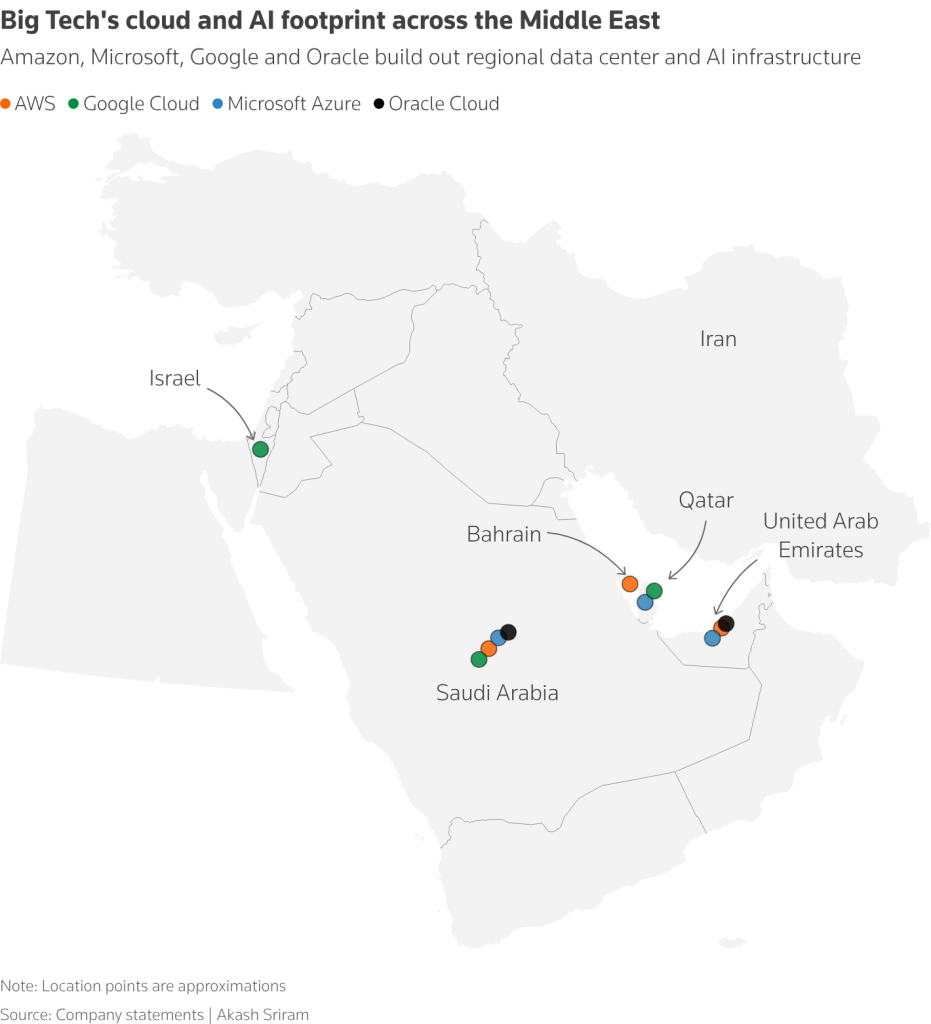
And there is a lot of such infrastructure in the region. Billions of dollars worth. And these data centers are uniquely vulnerable. Just take a look at this map by Reuters.
To quote, from Amazon’s continuously updated status page:
Mar 02 4:22 PM PST We are providing an update on the ongoing service disruptions affecting the AWS Middle East (UAE) Region (ME-CENTRAL-1) and the AWS Middle East (Bahrain) Region (ME-SOUTH-1). Due to the ongoing conflict in the Middle East, both affected regions have experienced physical impacts to infrastructure as a result of drone strikes. In the UAE, two of our facilities were directly struck, while in Bahrain, a drone strike in close proximity to one of our facilities caused physical impacts to our infrastructure. These strikes have caused structural damage, disrupted power delivery to our infrastructure, and in some cases required fire suppression activities that resulted in additional water damage. We are working closely with local authorities and prioritizing the safety of our personnel throughout our recovery efforts.
Welcome to the 21st century, I suppose. Our technology is amazing, but we are still the same violent, stupid monkeys as before. “War,” goes the motto of the Fallout family of computer games, “War never changes.”
In the bombing of Dresden decades ago the world had lost quite a number of cultural and historical treasures, which is especially sad as the attack seemingly was unnecessary. Ah, yes, also it is said that up to 25 thousand people had perished that night. I often think, what is worse – the loss of numerous artifacts of great historical value, which is irreparable, or loss of human lives (given that people tend to die anyway). Well, question is beyond logic and anyway it is not possible to stop feeling sorrow when people perish that way.
CNN yesterday had a large top about 4 US military personnel killed. Somewhere on the left, in the list of other news, there was a small line about funeral of 100+ souls killed in the attack on girls school.
Surely disrupture of IT infrastructure in the region is a serious matter, but it fails to make impression in comparison of report of 1000+ civilians killed in the past few days – and world leaders making statements that it’s all for the better and sheepishly offering their needless help to Trump.
Wars go as they should and we can’t stop them – but perhaps it still makes sort of sense what we feel about.
My point was not to emphasize infrastructure destruction over human suffering. Rather, to stress how it is yet another sign of a widening global impact, as the world spirals towards possible global conflict. When that happens, it’s not 100 souls but 100 million souls that we’ll be worried about… or not, beause as Stalin observed, one death may be a tragedy, but a million? Just statistics.