Today is March 18. It’s still winter, presumably, in what is supposed to be the second coldest capital city on Earth.
So how come it’s hotter outside than inside? (And no, my furnace did not break down.)
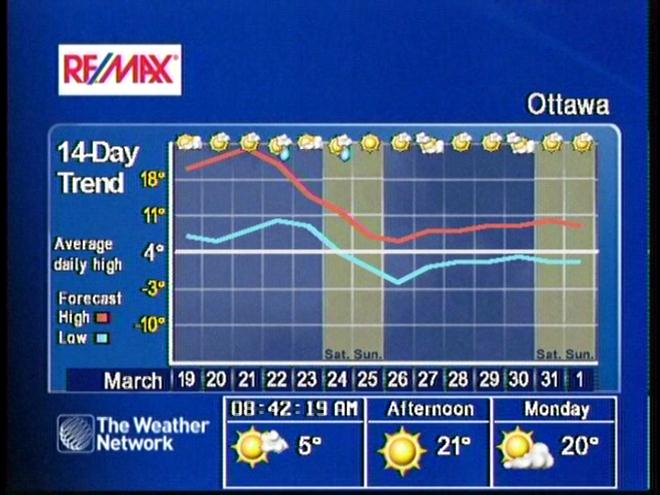
The Weather Network has this neat plot every ten minutes, showing the anticipated minimum and maximum temperatures for the next two weeks.
The forecast for Wednesday is off the chart. It is going to be so much hotter than the two-week average, it did not fit into the plot area.
Of course it could be just nonsense. They did predict 7 degrees Centigrade as the overnight low. It went down to 2 in foggy areas (most of Ottawa, I guess). Then again… even if it turns out to be 10 degrees colder than the predicted 24, it’s still a remarkably mild winter day. March 21, after all, is supposed to be the last day of winter. And I may have to fire up the A/C.
And it’s not just Ottawa. For Winnipeg (Winnipeg, for crying out loud!) today’s forecast is 28. A once in a thousand years event, says The Weather Network. Either that or the new norm, if global warming is to be believed. (Not necessarily bad news for many Canadians.)
I have been exchanging e-mails with a friend. We discussed, among other things, Rush Limbaugh’s now infamous comments on Sandra Fluke.
In response to comparisons of Limbaugh to some of the vile comments made by left-wing personalities like Bill Maher in the past (who called, for instance, Sarah Palin a ‘cunt’), I said this:
“I also note that Limbaugh’s rant went way beyond the use of an offensive word: he discussed Susan [sic!] Fluke’s sexual habits repeatedly and in detail, and once he was done demonstrating his complete ignorance on the topic of birth-control drugs (no, the amount of birth control pills consumed is not related to the amount of sex a person has, he must have confused it with the pills he takes for sex; and no, Fluke was not discussing recreational use of birth control pills but specifically their widespread use to treat serious gynecological conditions) he actually asked her publicly to make a porn video of her sexual activities. And, unlike the liberal comedians mentioned (who are, after all, comedians) Limbaugh did this in all seriousness. If I had been in Fluke’s place, I’d have called Limbaugh a lecherous, drug-addled dirty old pig. Fluke was more of a lady than I am a gentleman, I guess.”
And then I realized that I should not be ashamed of my words. Instead of saying what I should do in Fluke’s place, let me just do it, plain and simple:
In my opinion, Limbaugh is a lecherous, drug-addled dirty old pig.
I have been meaning to write about this since last month, when news photographer Damir Sagolj won a World Press award for his photograph of a North Korean building complex with the well lit picture of Kim Il-Sung highlighting a wall:
I think it’s an amazing shot. All those drab buildings with their dark windows, and the single source of light is the portrait of the Great Leader represent North Korean society in a way words cannot. I can almost visualize this image as part of some post-apocalyptic computer game.
Someone sent me this link (https://www.ted.com/talks/eli_pariser_beware_online_filter_bubbles.html).
It’s a talk about the growing prevalence of Internet content providers to present content that they presume you want to see. You go to Google News and the news you find is the kind of news Google thinks you like. You go to Facebook and the comments you see are the kind of comments Facebook believe you like. Comments from friends you were less likely to click on slowly vanish from sight… and you end up in a bubble of like-minded people, increasingly unaware of things that might challenge your thinking.
This is very bad. Indeed, I am beginning to wonder if perhaps the emergence of such information bubbles may be somewhat responsible for the increasing polarization in politics in many Western societies.
Maxima is an open-source computer algebra system (CAS) and a damn good one at that if I may say so myself, being one of Maxima’s developers.
Among other things, Maxima has top-notch tensor algebra capabilities, which can be used, among other things, to work with Lagrangian field theories.
This week, I am pleased to report, SourgeForge chose Maxima as one of the featured open-source projects on their front page. No, it won’t make us rich and famous (not even rich or famous) but it is nice to be recognized.
This is something I griped about before. Moments ago, I saw the following picture on the CBC Newsworld analog cable channel:
Yes, it does look like a ridiculous amount of blackness surrounding a small-ish picture. It turns out that I was looking at…
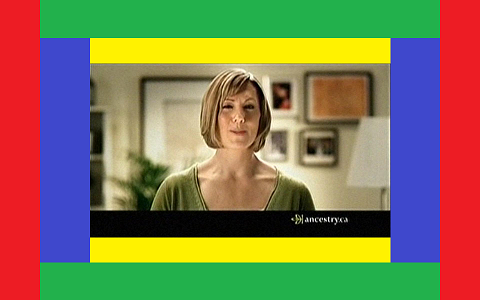
Confusing? Well, perhaps this picture clarifies it a little bit:
Still complicated? Let me make it simpler, then. After years of trying (and failing) to sell us high-definition televisions, manufacturers realized that casual viewers can’t readily tell the difference between resolutions; they can, however, tell the difference if the shape is different. So they opted to develop a widescreen high definition format. (Back in the 1950s, a similar reasoning led the movie industry to change to a widescreen format. It was not for technical or artistic purposes; it was pure marketing.)
The end result? In this example, approximately 65% of my beautiful high-resolution display is unused, with a postage-stamp like picture occupying the center 35%.
Welcome to the 21st century.
The cover story in a recent issue of New Scientist was titled Seven equations that rule your world, written by Ian Stewart.
I like Ian Stewart; I have several of his books on my bookshelf, including a 1978 Hungarian edition of his textbook, Catastrophe Theory and its Applications.
However, I disagree with his choice of equations. Stewart picked the four Maxwell equations, Schrödinger’s equation, the Fourier transform, and the wave equation:
\begin{align}
\nabla\cdot E&=0,\\
\nabla\times E&=-\frac{1}{c}\frac{\partial H}{\partial t},\\
\nabla\cdot H&=0,\\
\nabla\times H&=\frac{1}{c}\frac{\partial E}{\partial t},\\
i\hbar\frac{\partial}{\partial t}\psi&=\hat{H}\psi,\\
\hat{f}(\xi)&=\int\limits_{-\infty}^{\infty}f(x)e^{-2\pi ix\xi}dx,\\
\frac{\partial^2u}{\partial t^2}&=c^2\frac{\partial^2u}{\partial x^2}.
\end{align}
But these equations really aren’t that fundamental… and some rather fundamental equations are missing.
For starters, the four Maxwell equations really should just be two equations: given a smooth (or at least three times differentiable) vector field \(A\) in 4-dimensional spacetime, we define the electromagnetic field tensor \(F\) and current \(J\) as
\begin{align}
F&={\rm d}A,\\
J&=\star{\rm d}{\star{F}},
\end{align}
where the symbol \(\rm d\) denotes the exterior derivative and \(\star\) represents the Hodge dual. OK, these are not really trivial concepts from high school physics, but the main point is, we end up with a set of four Maxwell equations only because we (unnecessarily) split the equations into a three-dimensional and a one-dimensional part. Doing so also obscures some fundamental truths: notably that once the electromagnetic field is defined this way, its properties are inevitable mathematical identities, not equations imposed on the theoretician’s whim.
Moreover, the wave equation really is just a solution of the Maxwell equations, and conveys no new information. It is not something you invent, but something you derive.
I really have no nit to pick with Schrödinger’s equation, but before moving on to quantum physics, I would have written down the Euler-Lagrange equation first. For a generic theory with positions \(q\) and time \(t\), this could be written as
$$\frac{\partial{\cal L}}{\partial q}-\frac{d}{dt}\frac{\partial{\cal L}}{\partial\dot{q}}=0,$$
where \({\cal L}\) is the Lagrangian, or Lagrange function (of \(q\) and \(\dot{q}\), and possibly \(t\)) that describes this particular physical system. The significance of this equation is that it can be derived from the principle of least action, and tells us everything about the evolution of a system. Once you know the generic positions \(q\) and their time derivatives (i.e., velocities) \(\dot{q}\) at some time \(t=t_0\), you can calculate them at any other time \(t\). This is why physics can be used to make predictions: for instance, if you know the initial position and velocity of a cannonball, you can predict its trajectory. The beauty of the Euler-Lagrange equation is that it works equally well for particles and for fields and can be readily generalized to relativistic theories; moreover, the principle of least action is an absolutely universal one, unifying, in a sense, classical mechanics, electromagnetism, nuclear physics, and even gravity. All these theories can be described by simply stating the corresponding Lagrangian. Even more astonishingly, the basic mathematical properties of the Lagrangian can be used to deduce fundamental physical laws: for instance, a Lagrangian that remains invariant under time translation leads to the law of energy conservation.
The Euler-Lagrange equation remains valid in quantum physics, too. The big difference is that the quantities \(q\) are no longer simple numbers; they are non-commuting quantities, so-called “q-numbers”. These q-numbers sometimes coincide with ordinary numbers but more often, they do not. Most importantly, if \(q\) happens to be an ordinary number, \(\dot{q}\) cannot be, and vice versa. So the initial position and momentum of a quantum system cannot both be represented by numbers at the same time. Exact predictions are no longer possible.
We can still make approximate predictions though, by replacing the exact form of the Euler-Lagrange equation with a probabilistic prediction:
$$\xi(A\rightarrow B)=k\sum\limits_A^B\exp\left(\frac{i}{\hbar}\int_A^B{\cal L}\right),$$
where \(\xi(A\rightarrow B)\) is a complex number called the probability amplitude, the squared modulus of which tells us the likelihood of the system changing from state \(A\) to state \(B\) and the summation is meant to take place over “all possible paths” from \(A\) to \(B\). Schrödinger’s equation can be derived from this, as indeed most of quantum mechanics. So this, then, would be my fourth equation.
Would I include the Fourier transform? Probably not. It offers a different way of looking at the same problem, but no new information content. Whether I investigate a signal in the time domain or the frequency domain, it is still the same signal; arguably, it is simply a matter of convenience as to which representation I choose.
However, Stewart left out at least one extremely important equation:
$$dU=TdS-pdV.$$
This is the fundamental equation of thermodynamics, connecting quantities such as the internal energy \(U\), the temperature \(T\), the entropy \(S\), and the medium’s equation of state (here represented by the pressure \(p\) and volume \(V\).) Whether one derives it from the first principles of axiomatic thermodynamics or from the postulates of statistical physics, the end result is the same: this is the equation that defines the arrow of time, for instance, as all the other fundamental equations of physics work the same even if the arrow of time is reversed.
Well, that’s five equations. What else would I include in my list? The choices, I think, are obvious. First, the definition of the Lagrangian for gravity:
$${\cal L}_\mathrm{grav}=R+2\Lambda,$$
where \(R\) is the Ricci curvature scalar that characterizes the geometry of spacetime and \(\Lambda\) is the cosmological constant.
Finally, the last equation would be, for the time being, the “standard model” Lagrangian that describes all forms of matter and energy other than gravity:
$${\cal L}_\mathrm{SM}=…$$
Its actual form is too unwieldy to reproduce here (as it combines the electromagnetic, weak, and strong nuclear fields, all the known quarks and leptons, and their interactions) and in all likelihood, it’s not the final version anyway: the existence of the Higgs-boson is still an open question, and without the Higgs, the standard model would need to be modified.
The Holy Grail of fundamental physics, of course, is unification of these final two equations into a single, consistent framework, a true “theory of everything”.
Christopher Plummer is one of my favorite actors. I don’t usually care about the Oscars, but tonight, I was really rooting for him. And at last, it came true: at 82, he became the oldest recipient of a well-deserved Academy Award.
Looks like I am into signing petitions this week. I don’t like it, but I take it as a sign of the times that we live in.
Today, it’s the CBC’s turn; specifically, the unbelievable news that the CBC may begin dismantling its physical music archives next month.
I added the following comment when I signed the online petition: “Decades from now, the decision to discard these archives will be viewed as a grave, irreversible act of cultural vandalism. It is inconceivable that the leadership of the CBC is considering this. Then again, looking at what they’ve done to CBC Radio 2 and the Radio Orchestra, perhaps nothing should surprise me anymore…”
I just wrote a letter to Vic Toews, our honorable Minister of Public Safety. This was in response to an e-mail I received from him, sent no doubt to many Canadians. I hope he reads my letter, but just in case, I also cc’d our MP, Mr. Mauril Bélanger, and the Ottawa Citizen.
Here is what I wrote.
To: vic.toews.c1@parl.gc.ca; Toews.V@parl.gc.ca
Cc: contact@openmedia.ca; letters@ottawacitizen.com; belanm@parl.gc.ca
Subject: RE: Stop Online Spying
Honorable Minister:
I thank you for your informative e-mail (which I received, I guess, as a Twitter user participating in the #tellviceverything campaign). I am glad that this time around, you used a more civilized form of communication, instead of simply labeling your critics “supporters of child pornography” if they happened to disagree with your Bill C-30 and its pitifully Orwellian new title.
Unfortunately, I find that your e-mail is deceptive, as it directly contradicts the text of the proposed Bill C-30, as it appears on the Parliament of Canada Web site:
http://www.parl.gc.ca/HousePublications/Publication.aspx?Docid=5380965&file=4
Section 6 of this Bill mandates that telecommunications service providers must “have the capability to … provide intercepted communications”. Many described this requirement as a “hacker’s gold mine”: the apparatus and databases that providers will be required to maintain in order to comply with this Section will offer an unsurpassed opportunity for crimes such as identity theft. Indeed, Sections 6-12 can be basically summarized simply as, “If we cannot use your equipment to spy on your users, it is not legal”, while providing no guarantees that such equipment will be sufficiently secure and not subject to abuse (be it by government or by third parties). This does not suggest “a high priority on protecting the privacy of law-abiding Canadians”; if anything, it suggests the contrary.
Moreover, Section 14 effectively gives the right to government to prescribe exactly what equipment must be used by service providers. This requirement can have many unintended consequences going beyond the (absolutely incredible) invasion of privacy: for instance, it can stifle innovation, as telecommunications providers would not be able to install new technology if it fails to meet arbitrary requirements set forth by the government.
Honorable Minister, it is blatantly misleading to suggest that the law is only about “basic subscriber information.” Your law prescribes that telecommunications providers must “have the capability to … provide intercepted communications”. THIS IS NOT BASIC SUBSCRIBER INFORMATION. This is about the government-mandated capability to capture every single bit of data sent or received by Canadians.
While it is true that the legislation does not explicitly require telecommunications providers to “maintain databases”, the Bill remains open-ended in this regard: the equipment that telecommunications providers will be required to install may very well routinely incorporate the creation of such databases.
Regarding warrantless access to basic subscriber information, it is misleading to suggest that this Bill provides a counterbalance. On the contrary, it compels telecommunications providers to hand over this information upon a simple “oral request” by “any police officer”, and all the officer needs to provide is his or her name, rank, badge number and agency. This places in the hands of law enforcement personnel an authority that is perhaps unprecedented in Canada, and can be subject to grave abuse.
Honorable Minister, I understand that you have been personally affected by the debate surrounding this proposed Bill, and let me assure you that like most Canadians, I also strongly disapprove of any attempts to intimidate you unlawfully. However, the fact that you yourself have been wronged does not free you from the responsibility of representing a law that you propose in a truthful and thorough manner, and not attempt to mislead the public about its contents and foreseeable consequences.
In closing, I should mention that I have been trying to figure out if the manner in which your e-mail communication was sent was just a clumsy attempt to communicate with concerned Canadians via e-mail spam, or perhaps something more sinister. Sending an e-mail, presumably to Internet users who interacted with you via Twitter, can be seen as a not so subtle “I know who you are” message. Perhaps that is not the case… I am not a fan of conspiracy theories, so I feel compelled to give you the benefit of the doubt. In case I am wrong and it was indeed an attempt to intimidate your law-abiding critics, well, let me assure you that in my case it didn’t work: having grown up in a Communist one-party dictatorship, I am not that easily intimidated. On the other hand, that same upbringing compels me to feel very concerned whenever I see a government attempting to gain too much control over its citizens, no matter how noble the cause.
As a one-time Conservative voter, I believe in smaller, less intrusive government, the decisions of which are based on facts, not ideology. While I long for the day when I could proudly vote Conservative again, for the time being I must say that I remain thoroughly disappointed by the Conservative Party of Canada.
Sincerely,
Viktor T. Toth
<full address provided>
From: vic.toews.c1@parl.gc.ca [mailto:vic.toews.c1@parl.gc.ca]
Sent: Wednesday, February 22, 2012 12:43 PM
To: vic.toews.c1@parl.gc.ca
Subject: Re: Stop Online Spying
Thank you for contacting my office regarding Bill C-30, the Protecting Children from Internet Predators Act.
Canada’s laws currently do not adequately protect Canadians from online exploitation and we think there is widespread agreement that this is a problem.
We want to update our laws while striking the right balance between combating crime and protecting privacy.
Let me be very clear: the police will not be able to read emails or view web activity unless they obtain a warrant issued by a judge and we have constructed safeguards to protect the privacy of Canadians, including audits by privacy commissioners.
What’s needed most is an open discussion about how to better protect Canadians from online crime. We will therefore send this legislation directly to Parliamentary Committee for a full examination of the best ways to protect Canadians while respecting their privacy.
For your information, I have included some myths and facts below regarding Bill C-30 in its current state.
Sincerely,
Vic Toews
Member of Parliament for Provencher
Myth: Lawful Access legislation infringes on the privacy of Canadians.
Fact: Our Government puts a high priority on protecting the privacy of law-abiding Canadians. Current practices of accessing the actual content of communications with a legal authorization will not change.
Myth: Having access to basic subscriber information means that authorities can monitor personal communications and activities.
Fact: This has nothing to do with monitoring emails or web browsing. Basic subscriber information would be limited to a customer’s name, address, telephone number, email address, Internet Protocol (IP) address, and the name of the telecommunications service provider. It absolutely does not include the content of emails, phones calls or online activities.
Myth: This legislation does not benefit average Canadians and only gives authorities more power.
Fact: As a result of technological innovations, criminals and terrorists have found ways to hide their illegal activities. This legislation will keep Canadians safer by putting police on the same footing as those who seek to harm us.
Myth: Basic subscriber information is way beyond “phone book information”.
Fact: The basic subscriber information described in the proposed legislation is the modern day equivalent of information that is in the phone book. Individuals frequently freely share this information online and in many cases it is searchable and quite public.
Myth: Police and telecommunications service providers will now be required to maintain databases with information collected on Canadians.
Fact: This proposed legislation will not require either police or telecommunications service providers to create databases with information collected on Canadians.
Myth: “Warrantless access” to customer information will give police and government unregulated access to our personal information.
Fact: Federal legislation already allows telecommunications service providers to voluntarily release basic subscriber information to authorities without a warrant. This Bill acts as a counterbalance by adding a number of checks and balances which do not exist today, and clearly lists which basic subscriber identifiers authorities can access.
Why exactly do we believe that stars and more importantly, gas in the outer regions of spiral galaxies move in circular orbits? This assumption lies at the heart of the infamous galaxy rotation curve problem, as the circular orbital velocity for a spiral galaxy (whose visible mass is concentrated in the central bulge) should be proportional to the inverse square root of the distance from the center; instead, observed rotation curves are “flat”, meaning that the velocity remains approximately the same at various distances from the center.
So why do we assume that stars and gas move in circular orbits? Well, it turns out that one key bit of evidence is in a 32-year old paper that was published by two Indian physicists: Radhakrishnan and Sarma (A&A 85, 1980) made observations of hydrogen gas in the direction of the center of the Milky Way, and found that the bulk of gas between the solar system and the central bulge has no appreciable radial velocity.
However, more recent observations may be contradicting this result. Just two years ago, the Radial Velocity Experiment (RAVE) survey (Siebert et al, MNRAS 412, 2010) found, using a sample of several hundred thousand relatively nearby stars, that a significant radial velocity exists, putting into question the simple model that assumes that circular orbits dominate.
So maybe neutrinos don’t travel faster than light after all.
Instead, if rumors are to be believed, it was a simple instrumentation problem. There is no official confirmation yet, but according to a statement that also appears on Nature’s news blog, the OPERA team is indeed investigating two problems related to a timer oscillator and an optical fiber connection.
A while back, I wrote that I could identify four possible broad categories for conventional explanations of the OPERA result:
Of these, #4 was already out, as the OPERA team verified their result using short duration proton bunches that avoided the use of potentially controversial statistical methods. I never considered #2 a serious possibility, as highly accurate geographic localization is a well established art. Having read and re-read the OPERA team’s description of how they synchronized clocks, I was prepared to discount #1 as well, but then again, incorrect synchronization can arise as a result of equipment failure, so would that fall under #1 or #3?
In any case, it looks like #3, with a dash of #1 perhaps. Once again, conventional physics prevails.
That is, if we can believe these latest rumors.
Some thirty thousand years ago, homo sapiens was busy perfecting techniques to produce primitive stone tools. They may have already invented nets, the bow and arrow, and perhaps even ceramics, but they were still a long way away from inventing civilization.
Around the same time, an arctic squirrel in north-eastern Siberia took the fruit of a narrow-leafed campion, a small arctic flower, and hid it in its burrow, never to be touched again. The fruit froze and remained frozen for over three hundred centuries.
It is frozen no longer; rather, it is blooming, thanks to the efforts of a research team led by Svetlana Yashina and David Gilichinsky of the Russian Academy of Sciences. Against all odds, the genetic material in the seed appears to have survived. I say “appears” because such an extraordinary claim will be subject to extraordinary scrutiny, but what I have been reading suggests that this is indeed real: the age of the fruit is confirmed by radioactive dating.
I just finished doing our taxes. It’s not very complicated (I keep good books) but it still took a few hours. I feel drained… and not just in the wallet. Groan.
Speaking of Groans, I am re-reading the story about the 77th Earl of Groan, Mervyn Peake’s incredible trilogy about the mysterious castle of Gormenghast and its inhabitants. I became aware of this book some 10-odd years ago when the Canadian cable network Space showed the eponymous BBC miniseries; I had no idea what I was watching, but I got hooked by its atmosphere. Later, I bought the book and read it, and what a read it is! Now I decided to read it again, taking my time this time, enjoying every sentence, every turn of phrase. After spending hours with tax software, retiring to my bed with Gormenghast will be quite the relief.
The tax software I use is GenuTax. It is decent, perhaps not the best, but it has an advantage other tax packages lack: it does not require Activation nor does it incorporate other Draconian DRM technology. This is why I switched to this software many years ago. I am disgusted by software companies that treat us all like would-be criminals. Unfortunately, GenuTax is not doing well; their business model is a losing one (lifetime free upgrades) and I worry that they won’t be around much longer, which will be a pity.
Software updates are driving me nuts. One of these days, I’ll try to keep a log of just how much time I spend doing Windows updates, Linux updates, Flash updates, Acrobat updates, Java updates, other software updates… or in this case, updating the Facebook plugin of the blogging software I use, WordPress. The purpose of this post, then, is not just to complain but also verify that the updated plugin still works as advertised. Crossing fingers…
I was watching CNN’s Fareed Zakaria today, who expressed his opinion that the Eurozone crisis is over: that Greece may still default, but by and large, as a result of the activities of the European Central Bank, the Euro itself is now stable and its long-term survival is assured. I hope Zakaria is correct… indeed, this may be the best-case scenario, with a stronger Euro emerging from this crisis. One hopeful sign supporting this optimistic scenario has been the drop in the 10-year rates of Spanish and Italian government bonds; from a peak near 7% (exceeding 7% briefly in the case of Italy) the rates are back down to a more manageable 5.5%.
I wish I could say the same thing about Hungary. Unfortunately, the interest rate on 10 year bonds there is still well in excess of 8%. True, 8% is less than the 10% this rate was at just less than two months ago, or the astonishingly high rate over 12% back in 2009, but it is still very high, limiting the Hungarian government’s ability to deal with the crisis. The fact that many Hungarians (individuals, businesses, even municipalities) have accumulated large debts in foreign denominations (mainly in Swiss francs) also complicates things. Normally during this crisis, having a national currency should have worked to the government’s advantage; not with these excessive foreign currency debts.

My opinion about the abilities of Mr. Orban and his administration to deal with these challenges is less than flattering, but I have to admit that the challenges may test the abilities of even the best prepared government.
I always find these numbers astonishing.
The solar constant, the amount of energy received by a 1 square meter surface at 1 astronomical unit (AU) from the Sun is roughly s = 1.37 kW/m2. Given that 1 AU is approximately 150 million kilometers, or r = 1.5 × 10¹¹ m, the surface area of a 1 AU sphere surrounding the Sun would be A = 4πr2 = 2.8 × 10²³ m2. Multiplied by the solar constant, we get P = sA = 3.9 × 1026 W, or the energy E = sA = 3.9 × 1026 J every second. Using Einstein’s infamous mass-energy formula E = mc2, where c = 3 × 10⁸ m/s, we can easily calculate how much mass is converted into energy: m = E/c2 = 4.3 × 10⁹ kg. Close to four and a half million tons.
The dominant fusion process in the Sun is the proton-proton chain reaction, in which approximately 0.7% of the total mass of hydrogen is converted into energy. Thus 4.3 million tons of pure energy is equivalent to over 600 millon tons of hydrogen fuel burned every second. (For comparison, the largest ever nuclear device, the Soviet Tsar Bomba, burned no more than a few hundred kilograms of hydrogen to produce a 50 megaton explosion.)
Fortunately, there is plenty where that came from. The total mass of the Sun is 2 × 1030 kg, so if the Sun was made entirely of hydrogen, it could burn for 100 billion years before running out of fuel. Now the Sun is not made entirely of hydrogen, and the fusion reaction slows down and eventually stops long before all the hydrogen is consumed, but we still have a few billion years of useful life left in our middle-aged star. A much bigger (pun intended) problem is that as our Sun ages, it will grow in size; in a mere billion years, the Earth may well become uninhabitable as a result, with the oceans boiling away. I wonder if it’s too early to start worrying about it just yet.
Ontario is in trouble. According to economist Don Drummond’s devastating report, only drastic measures can reverse the trend of ballooning deficits. So something must be cut. But what? And who will do the cutting?
Normally, this would be the time when I’d be expressing a desperate wish for a Conservative government to replace the Liberals ASAP. Unfortunately, I don’t trust Ontario Conservatives. Chances are that rather than cutting, they’d continue with business as usual, perhaps even spending some more on populist programs that happen to suit their ideological agenda (like Harper’s federal government did, with its tough-on-crime legislation at a time of falling crime rates.) Paradoxically, by commissioning the Drummond report, the Liberals indicated that they may be the best candidates to fix the mess that we are in, even though they may very well have caused it in the first place.
Still, it will be an interesting spectacle with the governing Liberal minority introducing an austerity budget in the provincial legislature. Will the Conservatives vote against an austerity bill just to bring down the government?
Other countries have launched satellites to observe the Earth; observe the Sun; observe the stars; perform physical, chemical, or biological experiments in space; or even for military purposes. But here is a first: trust a Swiss team to propose a microsatellite specifically designed to capture orbital junk and drag it back to the atmosphere to burn it up.