After a brief commercial break, CTV News showed the following during today’s noontime news show:
No explanation was offered that I am aware of. But, it’s nice.
Here’s a headline from Google News that illustrates just how difficult it is for a non-native speaker of English (or, for that matter, for many a native speaker!) to understand journalists:
ABC Online: Houston expects changes for diggers under Petraeus
OK, so if you watch the news at all, you’d know that Petraeus is the US general who’ll be taking over in Afghanistan. But unless you also know that “ABC” can refer to the Australian Broadcasting Corporation, that Angus Houston is Australia’s Chief of the Defense Force, and that “digger” is a slang term for Australian or New Zealand soldiers, you could be excused if you thought that this was not an article title but a cryptic crossword entry.
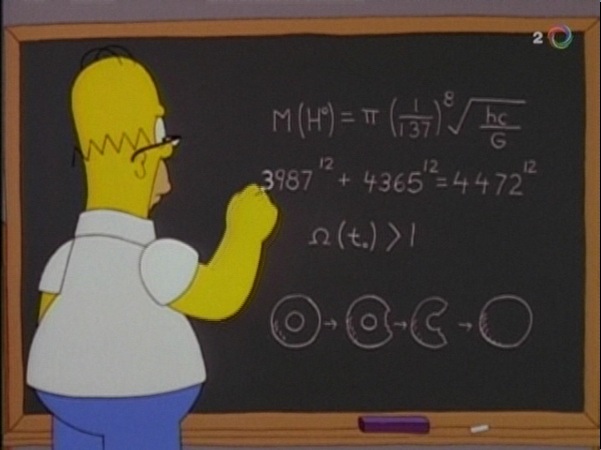
This Homer Simpson is one smart fellow. While he was trying to compete with Edison as an inventor, he accidentally managed to discover the mass of the Higgs boson, disprove Fermat’s theorem, discover that we live in a closed universe, and he was doing a bit of topology, too.
His Higgs mass estimate is a tad off, though. Whether or not the Higgs exists, the jury is still out, but its mass is definitely not around 775 GeV.
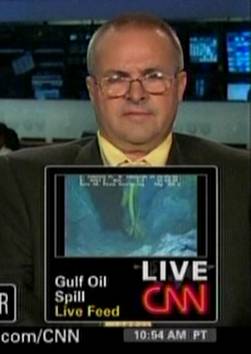
Sometimes, CNN uses a “picture-in-picture” format to show an important live feed while they are reporting on something else. It is important to make sure that the resulting composite picture does not convey the wrong impression. Otherwise, you might end up like this poor gentleman, who was talking on CNN about a new portable power source, but ended up appearing as if he was getting a chest X-ray on live television.
I was watching the noontime local CTV news today. At around 12:39 (!), in three consecutive reports, the number 39 popped up. First, a report about a youth who is charged with vandalizing 39 tombstones. This report mentioned the number 39 several times, which is probably why I noticed that in the next report, one about the recent terrorism-related arrests in the US, footage shown in the background included the front door of a house bearing the number 39. At this time, I began paying attention. The next report was about Ottawa tourism advertisements in American newspapers; it didn’t seem likely that the number 39 would pop up there until the official being interviewed answered a question about funding and mentioned their 39 member hotels. That’s when I told my wife that this is getting a tad creepy.
The other day, I was watching a Stargate Universe episode in which one of the protagonists was reliving a part of his life while his brain was connected to an alien computer, and a particular number kept popping up as a clue. That number was 46, the number of chromosomes in a human cell. So that’s what makes 46 special. But what about 39?
Or perhaps all this was just a clever form of subliminal advertising for a Web site called The 39 Clues, which happens to be the first hit on Google when one searches for “39”?
OK, I don’t usually play the geek game and look for nits to pick in television science programs. But…
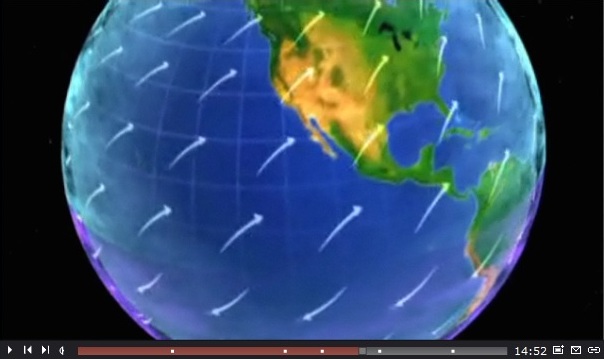
Today’s gem comes courtesy of the Canadian History Channel and their Aftermath series, the first episode of which I just watched over the Internet. The show had many eyebrow-raising moments (and I don’t mean the implausible concept itself, about the Earth’s rotation slowing down to zero in a mere five years; I could get over that if the science had been right otherwise). This particular gem of a sentence, complete with fancy animation, especially caught my attention:
“The rotation of the Earth creates constant patterns of east-moving winds in the Northern hemisphere, and west-moving winds in the Southern. This is called the Coriolis effect.”
Oh really. I wonder if pilots flying in the Southern hemisphere know this.
I’m watching a six-part CBC documentary miniseries titled Love, Hate and Propaganda, which looks, from a perspective of 70 years, at the role of propaganda during WW2. While the series is enjoyable (though shallow, like most historical documentaries are), I am coming to the conclusion that after 70 years, propaganda is still alive and well.
Take these sentences, for instance, explaining the beginning of The Blitz:
In the beginning, Germans attack military and industrial installations, but as time goes by, bombs get closer and closer to the big cities.
September 7th. They hit London. The Blitz begins.
So how does it compare to a more neutral, factual description of the same from Wikipedia? Let’s see:
In late August 1940 […] the Luftwaffe attacked industrial targets in Birmingham and Liverpool. This was part of an increase in night bombing brought about by the high casualty rates inflicted on German bombers in daylight.
During a raid on Thames Haven, on 24 August, some German aircraft […] strayed over London and dropped bombs in the east and northeast parts of the city, Bethnal Green, Hackney, Islington, Tottenham and Finchley. This prompted the British to mount a retaliatory raid on Berlin the next night with bombs falling in Kreuzberg and Wedding, causing 10 deaths. Hitler was said to be furious, and on 5 September, at the urging of the Luftwaffe high command, he issued a directive “for disruptive attacks on the population and air defences of major British cities, including London, by day and night”. The Luftwaffe began day and night attacks on British cities, concentrating on London. This relieved the pressure on the RAF’s airfields.
In the CBC’s version of events, there is no doubt that the indiscriminate bombing of civilian targets was the invention of the evil Nazi state. Wikipedia’s facts are more nuanced: it appears that the first intentional bombing of civilian targets may have actually been conducted by the RAF! This remains true regardless of the evil nature of the Nazi empire or the fact that it was them, not Britain, who started the most devastating war in history.
So, it seems, Love, Hate and Propaganda is guilty of the very thing that it purports to expose: by skewing the facts, it becomes a work of propaganda.
A new study, widely discussed in the news (I first heard about it on CNN this morning) suggests that portions may have increased gradually over the centuries, if depictions of one of history’s most famous suppers, the Last Supper, can be believed. To account for differences in dimensions, the researchers compared serving sizes to the heads of people depicted, and concluded that over the centuries, portions may have grown by as much as 69%.
There is, of course, another possibility. Perhaps it is people’s heads that shrank.
There are times when I like capitalism. Tropicana’s new commercial, bringing the “sun” to a Canadian community north of the Arctic Circle in the middle of January is one example:
Something I heard a few days ago on The Big Bang Theory:
“Where in this swamp of unbalanced formulas squatteth the toad of truth?”
What can I say… I know the feeling rather well.
The newsroom and possibly, significant portions of the archives of CTV Ottawa turned into smoke last night. Newsrooms can be rebuilt, equipment can be repurchased, no lives were lost, but the archives may be irreplaceable.
What’s up with all these big fires here in Ottawa this winter?
I’ve never even heard of this movie, Children of Men, until yesterday, when by chance I caught its trailer on the Space channel, announcing its broadcast tonight.
I’m watching it now, just about two thirds of the way through, and I think I already know why it earned the respectable spot of #184 among the top 250 movies of all time on the Internet Movie Database.
All I can say is… wow.
What a grand thing, this contraption called the Internet.
I was talking to my wife about the Olympics. (No, we aren’t fans.) I mentioned that in 2016, the games will be held in Rio. They’ll be dangling their breasts, she commented, sarcastically alluding to that Simpsons episode in which the family ends up in Rio. To the music of Villalobos, I added. (We both love the music of Villalobos.)
Then it occurred to me… last week, on my way to Waterloo, I heard a remarkable piece of music listening to the CBC in the car. All I remembered that it was from some Mexican composer. In the pre-Internet, pre-Google, pre-Wikipedia (not to mention pre-Youtube) days, that’d have been the end of the story: I’d not have been able to remember anything else.
But we live in the Internet/Google/Wikipedia/Youtube era. Within two minutes, we were listening to the Simon Bolivar Youth Orchestra playing Danzon n°2 by Arturo Márquez, as a matter of fact the very same performance I believe that I heard on the CBC:
You gotta love this Internet thing.
This is the year when the Soviet spaceship Alexei Leonov was supposed to fly to Jupiter, investigating the failure of the spaceship Discovery and the death of her crew nine years earlier. At least in one respect, Clarke’s vision will come true: after the Space Shuttle’s planned retirement later this year, the United States will be left without a manned launch capability, and American astronauts will be ferried to the International Space Station (alas, a mere few hundred kilometers above the Earth’s surface, not a billion kilometers from here like Jupiter) on board Russian spacecraft. Not exactly an inspiring thought, except perhaps to some Russians.
There is a fascinating book published by the RAND Corporation, available at Amazon for a mere 81 US dollars. I am tempted to buy it. It must be a fascinating read. Readers’ comments at Amazon are certainly encouraging; while the book has some minor flaws, despite the lack of serious proofreading it is guaranteed not to contain any errors, and it helped at least one reader get to meet the woman who eventually became his wife.
In case anyone was under the impression that cultural vandalism, such as the blowing up of historical monuments that happen to stand in the way of someone’s ideology, is the monopoly of Islamic fanatics, think again. The other day, Georgia’s (the country’s, not the US state’s) democratically elected president ordered the destruction of a Soviet-era monument, ostensibly to make room for a new parliament building. Unfortunately for him (not that I care) and for two innocent spectators (that I do care about) the demolition was botched, and flying concrete killed these two people, a mother and her 8-year old daughter. As to the memorial… I may not have too many fond thoughts about the Soviet Union and the Red Army, but few things are less controversial than a memorial dedicated to a victory over fascism and the glory of what Russians call the Great Patriotic War… in which, incidentally, some 300,000 Georgians also happened to have lost their lives.
I have done many things in my misguided past as a programmer, but strangely, I never did much work with XML. Which is why a recent annoyance turned into an interesting learning opportunity.
I usually watch TV on my computer. (This is why I see more TV than many people I know… not because I am a TV junkie who really “watches” it, I am actually working, but I have, e.g., CNN running in the background, in a small window, and I do occasionally pay attention when I see something unusual. Or change to a channel with The Simpsons.) For years, I’ve been using various ATI All-In-Wonder cards. (No, I don’t recommend them anymore; whereas in the past, they used to attach a tuner to some of their really high-end cards, this is no longer the case, the base graphics hardware of their current crop of AIW cards is quite lame. Their current software sucks, too.) The old ATI multimedia program I am using, while far from perfect, is fairly robust and reliable, and among other things, it comes with a built-in program guide feature. A feature that downloads programming information from an online server.
Except that, as of last week, it was no longer able to do so; the server refused the request. Several customers complained, but to no avail; they were not even able to get through to the right people.
So what is a poor programmer to do? I have known about Schedules Direct, the fee-based but non-profit, low-cost replacement of what used to be a free service from Zap2It, providing the ability to download TV guide data for personal use. The information from Schedules Direct comes in the form of XML. The ATI multimedia program stores its data in a Paradox database. In theory, the rest is just a straightforward exercise of downloading the data and loading it into the Paradox tables, and presto: one should have updated programming information.
Indeed things would be this simple if there were no several hurdles along the way.
First, the Paradox database is password-protected. Now Paradox passwords are a joke, especially since well-known backdoor passwords exist. Yet it turns out that those backdoor passwords work only with the original Borland/Corel/whatever drivers… third party drivers, e.g., the Paradox drivers in Microsoft Access 2007, do not recognize the backdoor passwords. Fortunately, cracking the password is not hard; I used Thegrideon Software’s Paradox Password program for this purpose, and (after payment of the registration fee, of course) it did the trick.
Second, the Microsoft drivers are finicky, and may not allow write access to the Paradox tables. This was most annoying, since I didn’t know the cause. Eventually, I loaded the tables on another machine that never saw the original Borland Database Engine, but did have Access 2007 installed (hence my need for a “real” password, not a backdoor one), and with this machine, I was able to write into the files… not sure if it was due to the absence of the BDE, the fact that I was using Office 2007 as opposed to Office 2003, or some other reason.
So far so good… Access can now write into the Paradox tables, and Access can read XML, after all, Microsoft is all about XML these days, right? No so fast… That’s when I ran into my third problem, namely the fact that Access cannot read XML attributes, whereas a lot of the programming information (including such minor details like the channel number or start time) are provided in attribute form by Schedules Direct (or to be more precise, by the XMLTV utility that I use to access Schedules Direct.) The solution: use XSLT to transform the source XML into a form that Access can digest properly.
With this and a few lines of SQL, I reached the finish line, more-or-less: I was able to update the Paradox tables, and the result appears digestible to the ATI media center application… though not to the accompanying Gemstar program grid application, which still crashes, but that’s okay, I never really used it anyway.
And I managed to accomplish all this just in time to find out that suddenly, the ATI/Gemstar update server is working again… once again, I can get programming information from them. More-or-less… a number of channels have been missing from the lineup for a long time now, so I may prefer to use my solution from now on anyway. Perhaps when I have a little time, I’ll find out what causes the crash (I have some ideas) and the program grid application will work, too.
Needless to say, I know a lot more about XML and XSLT than I did 24 hours ago.
Thank you, religious nuts, for many things, from the “clash of civilizations” to Creationism, or for something as mundane yet annoying and disgusting as your success at torpedoing the sequels to the film The Golden Compass. The book from which it was made is superb, the film was fine, and I’d have loved to see the sequels… alas, in the name of religious freedom and civil rights, the sequels won’t happen. So allow me to quote my favorite atheist author, Kurt Vonnegut, and tell you to go jump in a lake.
Vyacheslav Tikhonov is not exactly a household name in the English-speaking world, but to most Russians and many East Europeans, especially if they’re of my age or older, he is well-known as the Soviet-era actor who played Standartenführer Stirlitz, perhaps the greatest of all fictional spies, and protagonist of the 1973 black-and-white television series Seventeen Moments of Spring. A series that, incidentally, I recently purchased on DVD, and I was surprised to find that it remains highly enjoyable; not only is it light on communist ideology, it also manages to portray the German enemy as humans, which is somewhat unusual for films of this era.
Anyhow, the sad news is that Tikhonov has died.
I like good science-fiction.
Which is why a few years ago, I was about to give up on science-fiction in television. Star Trek: Enterprise was one of the last nails in the proverbial coffin, but my disenchantment probably began much earlier, with Star Trek: The Next Generation, describing a seriously damaged “Utopian” future in which the flagship of the United Federation of Planets is so screwed up, they need a psychiatrist on the bridge.
But then came shows the “re-imagined” Battlestar Galactica. Or Farscape. Or Lexx. Or Charlie Jade. Or even the awkwardly titled Total Recall 2070. Uniquely well done science fiction, which made television enjoyable again.
And then there was the Stargate franchise. I heard about the original movie, but never saw it. I only began watching Stargate SG-1 when it was into its sixth season. But, it didn’t take long to get hooked. Finally, science-fiction in which the protagonists are likable, intelligent professionals who act like rational human beings, not like messed up, spoiled brats. Stargate Atlantis, while less successful, continued in that tradition.
Now we have Stargate Universe. I’m still trying to like it, and it has its good moments. Few and far between, unfortunately. Meanwhile, we see messed up people engaged in gratuitous sex scenes, including sex while occupying someone else’s body. Yes. They’re billions of light years from the Earth, using unimaginably advanced alien technology to temporarily swap bodies with a terrestrial volunteer, to enjoy a few minutes with their friends and family back home… and then they promptly abuse the “loaner” body by getting drunk, engaging in sex (with partners who apparently don’t seem to mind that their loved ones look, smell, and sound like complete strangers) and even getting into fights, all with the tacit approval of the United States Air Force, which arranges these body-swapping visits.
Give me a break. I used to enjoy Stargate because, despite its flaws and sometimes (?) questionable science, it was fundamentally an intelligent show written for intelligent people. I’m still trying to find that spark of intelligence in Stargate Universe, but I may have to give up hope soon. At least I’ll be watching a little less television and have more time to do useful things.