Dec 172009
 

I’m reading an opinion piece in last week’s New Scientist, by Michael Le Page and Catherine Brahic. It’s titled, “Why there’s no sign of a climate conspiracy in hacked emails”. It is intended to reassure us that “Climategate” notwithstanding, we should trust the basic science. Yet I feel that it misses the point on all counts.

Take the title, for starters. While I am sure there are conspiracy nuts out there who view the hacked e-mails as a smoking gun, I think many more people see a more nuanced picture: the e-mails prove no conspiracy, but they do demonstrate contempt towards dissenters and the general public, not to mention the scientific process, and they do raise questions about the validity of the so-called “scientific consensus” on climate.

But it’s not just the title that’s deceptive. The authors raise five points, in the form of questions and answers. At least that’s how the article appeared in print; on-line, two of the questions were turned into unambiguous statements, according to which we are “100% sure” that the world is getting warmer and it’s because of greenhouse gases as the main cause. No, we are not 100% sure. If you want to assign a percentage, then take the data, fit the models, and show us a covariance matrix that tells us exactly how sure we are that a long-term trend is present. Leave this “100%” nonsense to political activists.

The print edition stuck to the question-and-answer form. “How can we be sure that the world really is warming?” they ask, but it’s a misleading question: of course the world is warming, the real question is, how much of that warming is due to short/medium/long term natural periodicities, and how much of it is due to a more sudden (e.g., linear, exponential, etc.) trend that may be due to human activity. Do we have enough data to distinguish unambiguously (never mind 100%, 1-sigma can do nicely) natural fluctuations from more direct trends?

Then they ask, “How do we know greenhouse gases are the main cause?”, and assure as that “The physics is clear: carbon dioxide is a greenhouse gas, greenhouse gases warm the atmosphere, and CO2 is accumulating in the atmosphere.” This is pure nonsense of course, since I could just as well say something like, “urine is a liquid, adding a liquid to the oceans increases ocean volume, I keep peeing into the ocean, hence cities will be swallowed by rising sea levels”. Their answer sounds more like an attempt to divert attention away from genuine questions, such as those concerning the effectiveness of CO2 as a greenhouse gas (CO2 is a very weak greenhouse gas; for instance, if rising CO2 levels somehow reduced the amount of water vapor in the atmosphere, the net effect would be global cooling), the accuracy of models describing the effects of CO2 in the atmosphere (I’ve read a paper, for instance, that questions the ability of widely used physics models to deal properly with the discontinuity of the atmosphere-surface boundary), or the “chicken-and-egg” question concerning the climate record, namely the extent to which CO2 caused warming trends or rising temperatures caused an increase in CO2 during past warm periods.

Their third question reads, “So why are scientists ‘fixing’ temperature data?”, which they answer by explaining that raw data almost always has to be manipulated to correct measurement problems or reconcile measurements made in different ways. True. But that is no excuse to discard the raw data. Not to mention that the data manipulation that caught so many people’s attention in the Climategate e-mails was not about fixing up raw data… it was about using two incompatible sets of data to change the appearance of a fitted curve, lest it gives the wrong impression to a scientifically illiterate audience. They do address this issue separately in the on-line version, but the explanation they offer raises its own questions: for instance, they say that “there has been no attempt to conceal this”, but how does that reconcile with the phrase, “hide the decline”, quoted from the hacked e-mails?

Lastly, their final two questions are about the attempts to suppress skeptical papers and attempts to prevent data from being released. We’re told that an independent inquiry is still ongoing, and in any case, the scientists may not have had the right to release the data. That’s a non-answer. You don’t need an independent inquiry to explain how it is acceptable to “redefine the peer review process” just to keep skeptical papers out, and as to the data, how about answering the question insofar as it concerns data that they did have the right to release?

All in all, I could have come up with much better arguments myself… instead of attempting to side-step the questions, I’d have tried to address them. Data were manipulated because a fit indeed gave a curve that would give the wrong impression to the uninitiated, and adding the instrumental data to the fossil temperature record seemed like an honest “trick” to avoid this. Skeptical papers were suppressed because those involved may genuinely believe in their science, may genuinely believe that many of the skeptics are motivated by something other than pure scientific curiosity (especially if they happen to be financed by, say, a friendly neighborhood oil company), and may genuinely believe that we just don’t have time for this nonsense while the planet is heading towards a global disaster. Data were withheld because otherwise, all the time in the world would not be enough to deal with clowns who take that data, ignorantly (or nefariously) manipulate it, and come up with nonsense conclusions. These explanations may not justify the actions taken, but they might be closer to the truth in the end… and supposedly, truth and integrity are the only real currencies that science has at its disposal. Currencies which will be needed badly in the coming decades, in order to convince the inhabitants of Earth not to trash their planet beyond repair… regardless whether or not CO2 leads to global warming.
 Posted by at 2:43 pm
Dec 072009
 

41,000 tons of CO2 is the amount of “CO2 equivalent” that the Copenhagen climate summit is expected to produce. No, it’s not the amount produced by Switzerland in a year, even though CNN’s Jack Cafferty said so, probably missing the phrase, “thousands of” in the column heading of Wikipedia’s statistics. But it IS the amount of CO2 some smaller or less developed countries, e.g., Slovenia, Lithuania, or Kenya produce in a day. Another way of looking at it is that during its 12 days, the climate summit will be responsible for about 0.004% of the entire world‘s CO2 output.

No need to worry, I am sure there is a neat “trick” that can be used to “hide” this embarrassing little data point, too, lest it dilutes the message about the coming climate disaster.

 Posted by at 9:32 pm
Nov 252009
 

I’m still trying to digest this… the meaning of recently released e-mails that suggest, to put it mildly, questionable behavior on behalf of some of the world’s leading climate researchers.

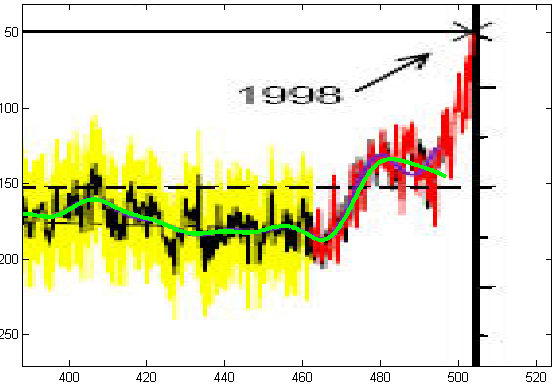
One e-mail that’s most hotly debated is about this:

mbh99smooth_no_inst

This plot contains two types of data: long-term reconstructed temperatures from the fossil record, and shorter term instrumental temperatures. Now the trouble is, the smoothed curve (green) based on the reconstructed temperatures alone points slightly downward… no dramatic warming trend. In contrast, the instrumental temperatures show an upward trend. This apparent disagreement is purely a mathematical artifact; anyone who ever attempted to fit, for instance, a polynomial curve to some data knows that the fit tends to diverge near the ends of the data interval. But it wouldn’t look good on a report that is designed to influence world opinion and global policy to show a downward trend, would it. So there’s a neat “trick”: the apparent downward trend can be eliminated by using the instrumental temperatures to pad the reconstructed temperature data set, and produce an upward trend.

Note that this doesn’t mean that there is a downward trend. The planet may very well be warming, due to what people are doing to it. Unfortunately, the information content of manipulated graphs is zero, or less than zero even… they can generate skepticism towards genuine future results and delay a necessary public response.

There are many other questionable e-mails in the lot, including e-mails that suggest the hiding of data from freedom-of-information requests, e-mails that suggest efforts to block the publication of research by climate change skeptics, and at least one eyebrow-raising comment cheering at the death of a climate change skeptic, leading to calls for a researcher to resign.

I’m still digesting this, but it reinforces my conviction that phrases like “standard model” or “scientific consensus”, far from reassuring, should be a clear indication that the science might be shaky, and that an attempt is being made to substitute authority in place of convincing data and firm logic.

 Posted by at 4:35 am
Jul 282009
 
An aerial view of the Finch Avenue W. sinkhole on Monday, July 27, 2009.

Finch Avenue W.

This July has been the rainy season here in Ottawa. Indeed, we may yet break the all-time record for July rainfall. In some parts of Ottawa, homes and streets have been flooded, and yet we can consider ourselves lucky: unlike the folks in Toronto, we have not yet had to cope with a giant sinkhole in the middle of a major city road.

 Posted by at 1:28 pm
Apr 272009
 

It’s April 27, in Ottawa, supposedly the second (third? sixth?) coldest capital city in the world. The temperature outside is presently 30.5°C outside (30°C according to the Weather Network) and still rising. Weren’t we wondering this time last year (okay, maybe a little earlier, but just a little) whether or not we were going to break the all-time snowfall record?

 Posted by at 8:15 pm
Apr 202009
 

I am watchin Deep Impact tonight, a ten-year old film about a comet impacting the Earth. Why the Canadian History Channel is showing this film is a good question. Future history? Imagined history?

But putting that question aside, the movie made me go to Wikipedia again, and I ended up (re-)reading several articles there relating to the issue of global warming and controversies surrounding it.

One thing that struck me (and not for the first time) is this: criticism of global warming theories are often dismissed by the assertion that these go “against the mainstream” or are “not supported by scientific consensus.”

And global warming is by no means the only area of science where such arguments are frequently invoked. Take two topics that I have become involved with. There is scientific consensus that the inadequacy of Einstein’s theory of gravitation to explain the rotation of galaxies and large scale features of the universe is due to “dark matter” and “dark energy”. Even though no one knows what dark matter (or dark energy) is made of, and no one actually detected any dark matter or dark energy ever, the idea is treated as fact. True, dark matter theory can explain a few things and even made a few minor (but nonetheless impressive) predictions, but that doesn’t necessarily make it true, and it certainly doesn’t make the theory the only kid on the block worth considering. Still, try proposing an alternative gravity theory: no matter how firmly rooted in real physics it is, you will be fighting an uphill battle.

Or take the Higgs boson. This hypothetical particle (often along with the graviton) is often portrayed as if it has already been detected. It hasn’t. Indeed, the only thing experiments have accomplished to date is that they excluded the possibility that the Higgs boson exist at nearly the two-σ level. There are also significant unresolved issues with the Higgs boson that put the theoretical validity of the idea into question. Yet the “scientific consensus” is that the Higgs boson exists, and if you try to propose a quantum field theory without the Higgs, well, good luck!

Just to be clear about it, I am not saying that the climate skeptics got it right, and for all I know, maybe there is dark matter out there in abundant quantities, along with Higgs bosons behind every corner. But not because this is what the “scientific consensus” says but because the theory is supported by facts and by successful predictions. Otherwise, the theory remains “just a theory”, as the creationist crowd likes to say… neglecting the inconvenient fact that, of course, the theory of evolution is supported by an abundance of facts and successful predictions.

 Posted by at 2:55 am
Feb 022009
 

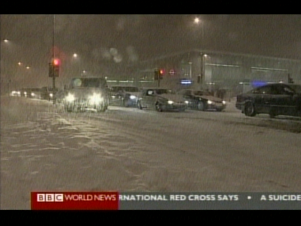
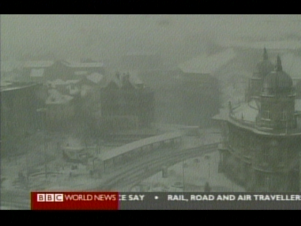
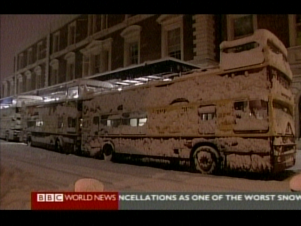
These are not unusual pictures for us up here in the Great White North:

Trouble is, these pictures are not from Ottawa, Toronto, or London, Ontario. They are from London, England, where it hasn’t stopped snowing yet.

 Posted by at 1:40 pm
Jan 152009
 

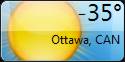
This is what Windows Vista’s weather gadget told me this morning:

Slightly exaggerated

Slightly exaggerated

Fortunately, it is lying. It’s only -29 outside, not -35. Still, it made me remember fondly the good ole’ days when there was still some global warming…

 Posted by at 2:21 pm
Jan 142009
 

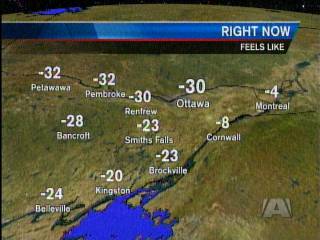
Wow. Look at this temperature gradient between Ottawa and Montreal:

Arctic cold front

Arctic cold front

And while these are wind chill temperatures, the real thing is soon to follow: some stations forecast a temperature of -33 Centigrade Friday morning. Needless to say, global warming is not exactly high on the list of priorities of most people I know.

 Posted by at 5:09 am